


 Listen to this article
•
15:34 min
The vast, luscious greens of the eastern Himalayas form a vast mosaic of forests and farmlands. From afar, they appear serene and untouched. However, a week-long engagement with families from different farming communities that live there revealed a complex narrative of change and resilience.
Traditionally, farming in the Darjeeling-Kalimpong region was largely based on diverse agroforestry and mixed-cropping systems. Mixed-plantation-based systems included large cardamom cultivated under shade trees like Himalayan alder (Alnus nepalensis), mandarin orange orchards intercropped with understory vegetables and legumes, integrated terrace rice cultivation (pani-khet) combined with maize-potato rotations, and ginger intercropping. In a 2009 paper published in Resources Science, Sharma et al. explain that farm-based systems primarily involved small-scale mixed farming centred on household food production and livestock rearing, supported by fodder trees maintained along field boundaries. Agricultural labour was collective, with family members involved in all stages of cultivation, while livestock supplied manure and relied on crop residues for fodder. Although farmers traded some cash crops, farming was primarily subsistence-oriented, with most produce consumed locally and surplus shared within villages.


Cover Photo: A typical integrated farming system includes cultivating staple cereals such as rice, millet, and maize, complemented by a wide variety of vegetables including ginger, beans, cauliflower, radish, carrot, leafy greens, and potatoes. Photo credit: Nabanita Ghosh
These practices provided a diverse range of ecosystem services, such as improved soil fertility and stability, controlled soil erosion, warranted nutrient cycling, nitrogen fixation, fodder and fuelwood.
However, Pingali (1997), in their study of agricultural transformation in Asia published in the American Journal of Agricultural Economics, noted that since the mid-1990s, these diverse agricultural practices have gradually shifted across large areas from rainfed crop-and-livestock mixed farming systems to primarily intensive, horticulture-based systems. Focused on a narrower range of high-value cash crops such as large cardamom (Amomum subulatum) or badi elaichi, betel nut (Areca catechu), and broom grass (Thysanolaena latifolia), this gradual shift toward commercial farming via intensive cash cropping is now widespread across this hill region. Consequently, Fu et al., in their 2010 study, noted that the previous balance between subsistence food production and supplementary cash income is increasingly shifting toward market-oriented production.
“People are becoming lazy; betel nut has made people lazier…. once you have transferred the saplings from the nursery to the main farm, they require little crop care and easily continue growing for the next 50 years”, says Pramod Chettri, who has a 2.5-acre betel nut plantation in Gorubathan, in eastern Kalimpong District. In three decades, the town has transformed into a betel nut cultivation hub. That doesn’t mean labour isn’t required; every year Pramod employs ~100 people to harvest betel nuts from his land.
Farmer Purna Rai has a similar story. During the harvest season, they employ daily-wage workers from the Dooars region at a rate of 1,700 rupees/day to climb and jump from one tree to another and harvest betel nuts. Before betel nut plantations, they practised crop and vegetable agriculture.


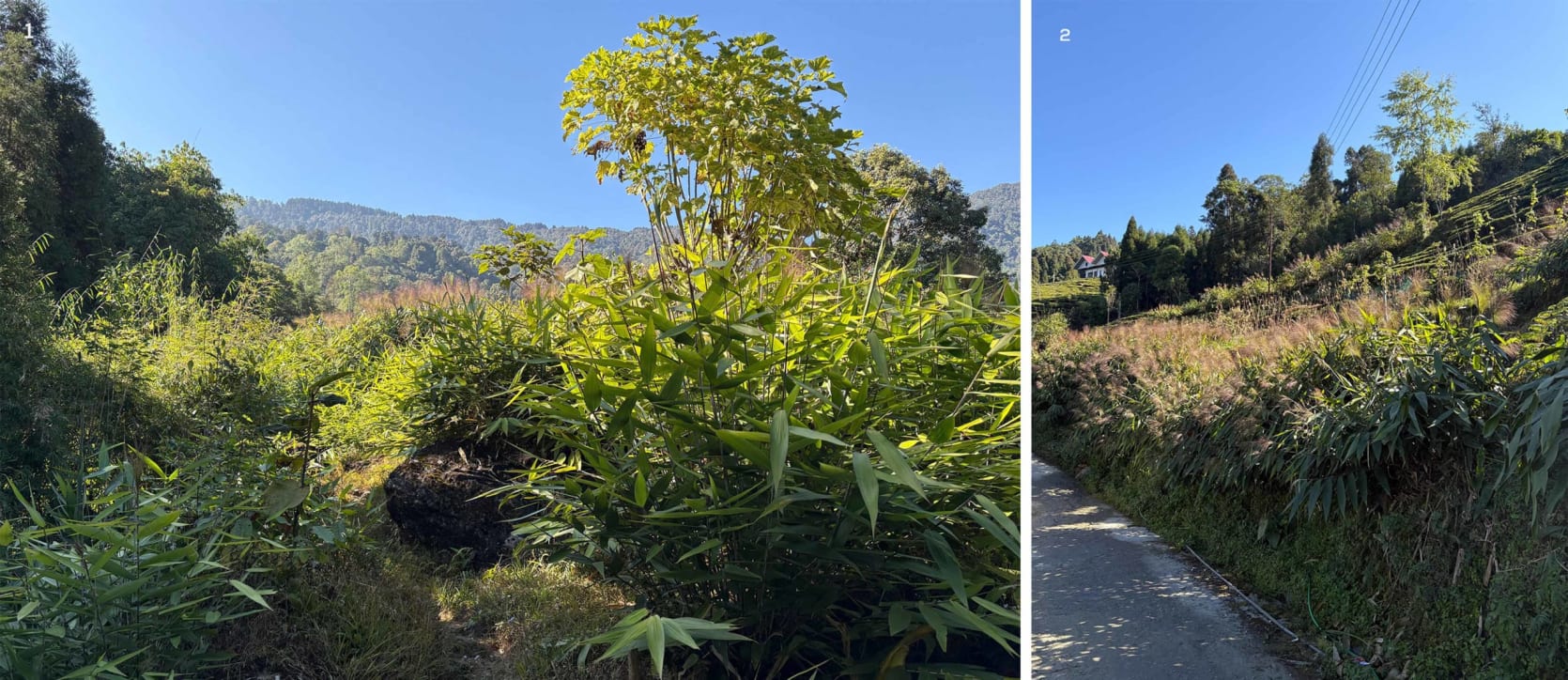
Initially, farmers planted broom grass along the edges of their farms as livestock fodder. Now they have sizeable farm plots dedicated to this easy-to-cultivate plant, which is now widely cultivated. Parsu Kumar Rai’s land yields two quintals of broom grass annually. Residing in the small village of Mamring, Darjeeling, he says that all his kids are uninterested in farming and have left the village to work outside. “I know they won’t continue farming after I divide the land amongst them, but they cannot sell the land either, absolutely cannot”, he says during an interview about his family’s willingness to continue farming. Rising opportunity cost of family labour, paired with youth preference for non-agricultural jobs due to low returns, has led to complete monocultural systems.
Another major driver of this transition is ongoing crop raiding by conflict animals, which results in financial losses for farmers. “Bhaalu awnxa ni yo baato, antah makkai khanxa ra janxa, (Bears come down this road, eat the maize and return)”, says Parsu Kumar Rai with a dignified smile while reminiscing about his encounters. “Majjur ra baadar chai yaha ko main ho,” (Peacocks and monkeys are the biggest nuisance), says K V Chettri, another crop-livestock farmer turned betel nut plantation owner. Diwas Rai from Mamring stressed that mammals, both small and medium-sized, are equally prominent pests: “Dhumsi pani pura awnxa” (porcupines are very frequent), “mirga awnxa, kharayo awnxa, sapai barbaad paar dinxa” (deer and hares come and destroy everything). Although some farmers still tolerate them, others have switched to betel nut or broom grass, where losses caused by animals are minimal to non-existent.

Additionally, climate change is increasingly altering the Himalayan region’s agroecological landscape. Changing precipitation patterns and monsoon timings lead to erratic water availability, soil erosion, and more extreme events such as landslides and flash floods, all of which directly affect agricultural productivity. “Our source of water is Maane darbhang, a stream on the far side of this hill, below the village. You have to pay 100 rupees and provide vegetables and meat to the person in charge of the water connection every month”, says Manmaya Chettri from Neem Basti, Gorubathan. Manmaya and her family primarily cultivated paddy, millet, and maize, but the current water crisis prevents them from even seasonal farming. Rajit Rai from Sittong, a small village in Darjeeling, says upcoming tea plantations and homestays in the area demand more water, leaving his farmland short. Scientists have shown that current climatic conditions will reduce precipitation in the coming years and lower water availability in the basins of the Eastern and Western Himalayan region due to rising global temperatures and population growth.
Studies such as those by Clough et al. in Nat Commun (2016) have also shown that monocultures create trade-offs affecting the region’s immediate environment and ecology while providing small landholding farmers with immediate socio-economic benefits.
Although the best approach is still unclear, a middle ground may exist. An integrated farming model can support farmers’ economic viability and the landscape’s ecological sustainability. This model allows diversification by integrating different enterprises, such as agriculture, horticulture, aquaculture, and animal husbandry, with one component as the central activity. It also meets basic household needs such as food, fodder, fibre, and feed. “Integrated farming methods, which also take into account traditional farming, help us to practice commercial farming while also ensuring food security, as we do not have to depend on the market for produce”, says Farden Lepcha, who also runs a farm stay and offers permaculture courses to young students from Neem Basti and around. He is one of the younger farmers who has continued to look after his land.
Sachin Rai, whose family has been practising agriculture for four generations in the same village, has an ideal crop-plantation-livestock farming system on his 3.5-acre farm. Support from government-led agricultural schemes and engagement from local NGOs can play a critical role in enabling such transitions through targeted incentives, technical guidance, farmer-to-farmer learning, knowledge exchange, and capacity-building initiatives.
Ultimately, the key question remains: how can growing market-driven agricultural practices be reshaped or combined with traditional farming to secure both farmers’ livelihoods and ecosystem health? Finding this balance will determine whether the region can sustain its people, biodiversity, and the ecological services that have long supported life in these landscapes.
About the Authors

Nabanita Ghosh

Satkar Deep Thapa



