Listen to this article
•
15:34 min
Listen to this article
•
15:34 min
Seated on a rock at the foothill of Mahendragiri Hill, the second-highest mountain peak in Odisha’s Gajapati district, 58-year-old Bisikishan Karji gazes toward the ridgeline. A Saura farmer with weathered hands and a steady voice, he points to a clearing atop the mountain where his ancestral village, Pandaboipadra, once stood. “Our forefathers were completely forest-dependent,” he recalls. Their food came largely from the hill: wild fruits, greens, tubers, mushrooms, honey, and yield from the fishtail and date palm trees. Millets and pulses were grown as rainfed crops on the slopes.
Even in the lean summer months, when crops are not ready to harvest, the Saura have long turned to the forest for sustenance. They extract the starchy pith from the Caryota urens or fishtail palm (locally called salap), sun-dry it carefully, and grind it with dried mango kernels. “Our grandparents would prepare a porridge from salap powder and mango kernels,” says Karji. After Independence, seeking better road access and communication, the residents moved downhill and established a new village at the foothill. They named it Badmasingh. Today, around 40 Saura households live there.
“Mahendragiri is the abode of easta devta, our supreme god,” says Karji. “From wild edibles and fodder for livestock to fertile soil for our native crops, medicinal herbs, and divine blessings, everything comes from Mahendragiri.” But over the past two decades, he says, the forests have steadily receded. There was a time when wildlife moved freely across Mahendragiri’s slopes. Deer, sambar, wild boar, sloth bear, kutra (Indian muntjac), parrot (plum-headed parakeet), and peacocks were common sightings. Leopards and elephants passed through the forest corridors.


Cover photo: The evergreen shola forests above 1,000 metres on Mahendragiri Hill have distinctive vegetation.
Widening Roads, Withering Wild
Mahendragiri Hill is part of the Eastern Ghats mountain range, spread over Gajapati and Ganjam districts. It was declared a Biodiversity Heritage Site in 2022 and covers 4,250 hectares. According to the Odisha Biodiversity Board, the Mahendragiri Hill hosts 1,370 plant species that represent 40 per cent of Odisha’s flora (two gymnosperms, 1,042 angiosperms, 60 bryophytes, 53 lichens, and 72 macro-fungi and 388 animal species, among them 27 mammal, 165 bird, 23 snake, 15 amphibian, 3 turtle, 19 lizard, 100 butterfly, and 36 moth species). Many of these are endemic and threatened due to habitat loss and large-scale infrastructure development.
There are several temples located across the broad summit plateau and adjoining rocky ridges near the hilltop. Kunti Temple stands on one side of the main plateau and is the most prominent structure, while the Yudhisthira Temple is situated on the opposite side of the summit. Bhima Temple lies on a slightly lower rocky stretch close to the main temple cluster. Near the central sacred zone of the summit is the Gokarnesvara shrine, while the Parashurama shrine sits close to the highest accessible crest of the hill. Slightly below the summit on a rocky slope is Arjuna Gumpha, a cave-like site.
Kailash Chandra Sabar, former sarpanch of Kainpur panchayat (which manages Badmasingh village), voices his apprehension about proposed development projects. “There is a proposal to build a two-km road to Darubrahma via Badmasingh village. This will connect Yudisthira Temple on the Mahendragiri hilltop to Bhima temple and Arjuna Cave. It will further damage the fragile landscape and biodiversity of the Mahendragiri Hill. Many trees will have to be felled for the construction.”


Jirang panchayat in Mohana block is home to the Padmasambhava Mahavihara Monastery, one of eastern India’s largest Buddhist monasteries and an important centre of Mahayana Buddhism. Established by Tibetan spiritual leaders, it draws monks, devotees, and visitors from across India and abroad.
“The Forest Department has a viewpoint at Raghunathpur Ghati in Jirang,” says Sabar. Improved roads now connect Gajapati district to Berhampur via Mahendragiri, making the hilltop temples and landscapes more accessible. At the summit, the government has built tourist cottages. More than one lakh devotees visit the hilltop temples of Kunti, Bhima, Arjuna, and Yudhisthira each year. But Sabar points out that expanding and renovating the ghat roads will threaten the area’s wildlife and ecology.
“With new roads and vehicles, the noise has grown,” Karji explains. “The forests are not as quiet as before. Gradually, the animals have retreated deeper into the remaining dense patches. Elephants vanished first. Then sambar and bears. Eventually, the leopards. Today, a kutra is rarely seen, a peacock rarely heard.”


Karji’s words find an echo in the memories of 79-year-old Jasoda Karji of Badmasingh. “Kutra and deer used to come to the nearby streams to quench their thirst,” she recalls. “Peacocks were everywhere around the hilltop temples. Their calls would fill the air.” Today, she says, those temples on Mahendragiri Hill stand strangely silent. Not a single peacock is seen there. “Earlier, we lived in harmony with wild animals,” she says, adding, “We grew up falling asleep to the bark of the kutra and sambar. Our children are not that fortunate. They have neither seen them nor heard them.”
For Jasoda Karji, the fading wildlife is only one part of a larger transformation. “Now there are better roads. People can easily visit the temples,” she says. On Mahendragiri Hill, the government has built gigantic gates and cottage houses. Tourist footfall has increased. Local families earn money from the steady stream of visitors. But at what cost, she rues.
As infrastructure expands, she fears that in the next 15-20 years, whatever remains of Mahendragiri’s wildlife may disappear entirely. The changes are visible not just in the forest but also in the sky and soil. “Earlier, when the forest was dense, rainfall was timely and plentiful. Winters were colder,” she recalls. Now the rain is erratic, sometimes too heavy, sometimes too little. Farming no longer feels as dependable as it once did.

Traditional Farming, Ecological Wisdom
“For generations, we have practised bagada chaso (jhum) on the slopes of Mahendragiri,” says 74-year-old Jara Sabar of the neighbouring village of Landusahi. “Our grandfathers taught us this way of farming. We sow ragi, sorghum, pearl and little millet together. Pulses, maize and tubers are also grown in the same field.”
The patches known as bagada are small, carved carefully out of steep slopes. In this method of farming, Sabar says, “We depend only on our native seeds and the timely arrival of rain. Since different crops ripen at different times, we reap crop by crop. Some farmers still practise bagada chaso. At night, we must stay awake to guard the crops from wild boars. Many have given up because it is labour-intensive farming. Yet Sabar remains attached to it.
Bisikesan Karji, 56, from Badmaisingh village, reflects on how much farming has changed. “Our grandparents ate the food grown through bagada chaso,” he says. “They lived strong lives, many of them up to 80 years. Now people mostly eat rice from ration cards. They hardly live beyond 50.” According to him, the difference lies in the way food was grown.


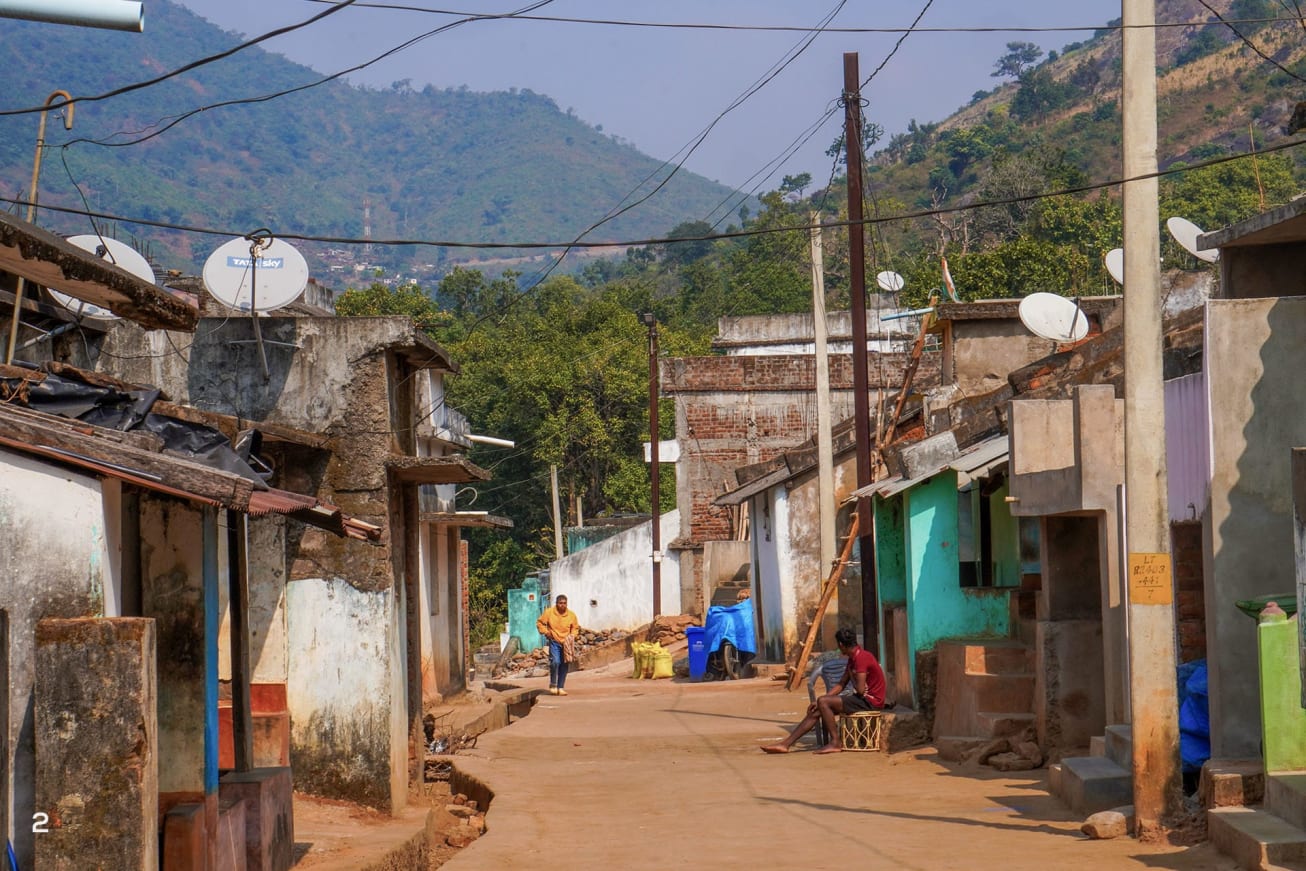
(1) A newly laid ghat road cuts across the slopes of the Mahendragiri Hill. (2) Construction work is underway along a ghat road. (3) Gangahati waterfall in Rayagada block in Gajapati.
Karji said the crops grown via bagada chaso were organic. “We used our own seeds. No chemicals. The soil stayed fertile, and the food was nourishing. It was good for our land, and good for our bodies.” Today, farming has become chemical-intensive. Hybrids have replaced our native seeds. They do not taste the same. They are not nutritious. It is bad for the soil and our health. We are slowly losing both.
There is yet another challenge for tribal communities living around the Mahendragiri Hill. “Earlier, our forest was untouched. Only we knew its paths,” says Sukmari Sabar, 54, of Uparlandusahi village. The slopes once abounded in medicinal plants like Terminalia chebula, Terminalia bellerica, and long pepper. “We took only what we needed. The forest was our go-to place for medicine. Now, traders from other states come, hire labourers, and strip the hill. Sometimes they even cut trees. What will be left for us?”
According to the International Union for Conservation of Nature, of the 41 threatened medicinal plant species recorded in Odisha, 29 are found in Mahendragiri, a stark reminder that what is being lost here is not just local heritage, but biodiversity of global significance.
As tourist footfall rises, environmentalists warn that the state’s push for large-scale infrastructure on Mahendragiri Hill threatens the very forests it aims to promote. A proposed Vanya Mandir complex and larger Parshuram temple could threaten an already fragile habitat.
About the Author