Listen to this article
•
15:34 min
Listen to this article
•
15:34 min
I was sitting on a boat enjoying the allure of Kerala’s monsoon, which I had previously only known through films and reels. As the romance of the land touched me, I reminded myself that my journey here was not just to experience beauty, but to understand it. I had joined the 18th edition of the Vembanad Fish Count to assess the health of Vembanad Lake and the livelihoods it supports. I thought about how the fish I had come to see and count did not care about my presence, nor did they know that their home is one of India’s largest and most biodiverse Ramsar sites.
Vembanad is a vast backwater lake in Kerala that supports a complex web of life — fish, migratory birds, and communities that depend on the lake. It also shares its waters with the surrounding terrestrial ecosystems and to its west, with the Arabian Sea. For someone like me, who grew up over 3,500 km away in Assam, surrounded by fish in food and folklore, this was my first encounter with fish beyond the plate. As part of ATREE-CERC’s programme, the romantic lens I had brought with me slowly faded, giving way to a more critical understanding of the lake’s realities.

Dr Priyadarsanan, Senior Fellow at ATREE and an ecologist who leads ATREE-CERC, explained that Vembanad has supported fishing and clam collection for over 1,500 years. This ecosystem, shaped over millions of years, is now increasingly measured only in economic and natural-resource-extraction terms. As human-driven demands exhaust Earth’s resources, we face crises on multiple fronts. One such example is Vembanad’s endemic black clam, which is threatened by siltation, pesticide runoff, industrial waste, and improper depth. This clam purifies water, supports aquatic food webs, and sustains around 15,000 families. Its decline signals not just ecological imbalance, but a threat to livelihoods.
Vembanad, also known as the rice bowl of Kerala, is one of the few places in the world where agriculture is practised below mean sea level. To support paddy cultivation, the 1.3-km-long Thannermukkom saltwater barrage was built to prevent seawater intrusion during the summer. But this intervention created a paradox: while it benefits agriculture, it disrupts natural migration between the sea and the lake. Professor Dr M K Saajevan of KUFOS noted that bird migration has declined by 33 per cent, and fish movement has followed a similar trend (M S Swaminathan, 2007). Meanwhile, the surrounding wetlands have shrunk, silt has accumulated, and the lake’s depth has decreased from 5 to just about 1.5 metres (according to Dr M K Saajevan and Dr Priyadarsanan. Today, nearly 60 per cent of the lake has been converted into fields for paddy and other crops. Fishing communities bear the immediate cost — a reality often overlooked in romanticised portrayals of Kerala’s monsoon.
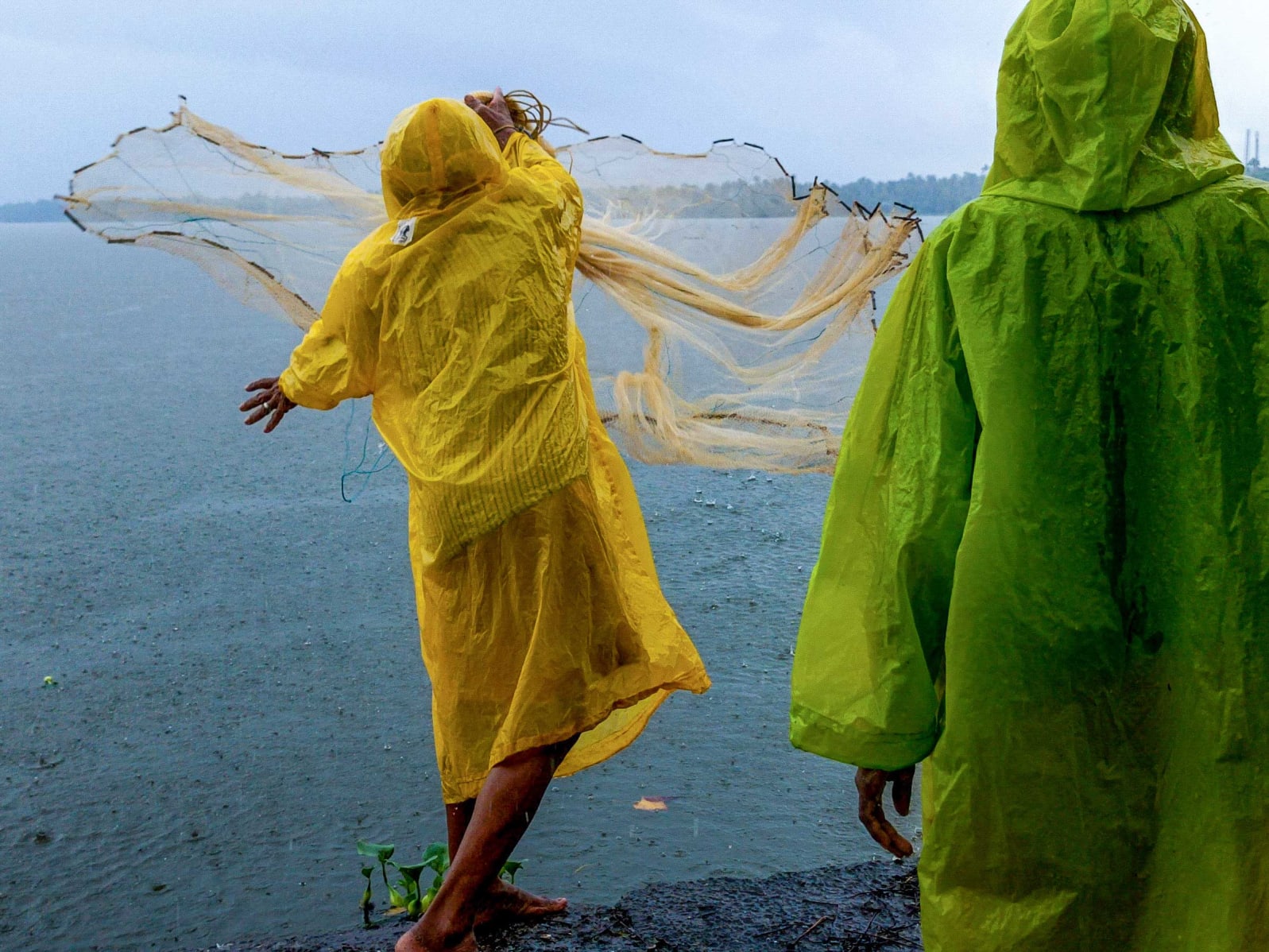
On fish count day, amidst thrashing rain, the sky was dark. Along with my fellow ATREEians, around 120 students had gathered. We were divided into groups and set out across different parts of the lake. As we ventured into the lake’s vast, reflective expanse, I could see only water. Tourist boats lining the sides made the vast lake feel unexpectedly crowded. We soon encountered fishermen in traditional dark wooden boats, clad in bright raincoats. After some time, the fisherfolk handed over their morning’s catch, and everyone crowded around the fish. The taxonomists lined up to identify the fishes. Others collected water samples to assess water quality. In that moment, the lake became both a field site and a lived space.
Among the catch was karimeen (pearl spot), a prized local fish. My mind instinctively drifted to food, but that thought was interrupted as I watched one fish struggle.
I felt a pang. I placed the karimeen on the edge of the ferry and bent closer — I could see the ferry and my own reflection in its eyes. It was an uneasy and intimate moment that felt like wearing wet shoes. I couldn’t help it; we were assessing the fish as part of a broader agenda to restore the lake.
Later, we stopped at a shell-crushing unit where black clam shells are processed for fertiliser. There was a rush as everyone searched for blue-green clam shells hidden inside dead black clams for their visual attractiveness.


We arrived at Pathiramanal, a 10-acre uninhabited island, in the middle of the lake, where dense vegetation, birds, frogs, and insects created a symphony.
After the fishing survey, I spoke to local fishers through a translator. Suresh (52) and Sashidharan (72), both with decades of experience, said the day’s catch was low due to rain. But their concern ran deeper.


Suresh added that Thannermukkom’s gates open post-monsoon, around December, allowing fish and mussels to migrate into this part of the lake, resulting in better harvest. However, for the rest of the year, the catch is poor, and labour costs remain high. As a result, the next generation is reluctant to continue with this profession.
On that day, although 44 species were recorded in markets, we observed only 18. The low diversity felt like a collective misfortune. Traditional fishers are fatigued by unpredictable weather and declining catches.
This raises a paradox of choices and values: what exactly are we saving by building the barrage — the paddy fields, fisheries, houses, or tourism? And what about the health of the lake itself? Beyond this ecological crisis, the lake still supports 1.6 million people through tourism, fishing, and related livelihoods. Its vast waters span seven of Kerala’s fourteen districts, complicating conservation efforts due to diverse perspectives and values. Yet, if Kerala can successfully revive the lake, I believe the rest of the country will be inspired.

About the Author