
 Listen to this article
•
15:34 min
Listen to this article
•
15:34 min
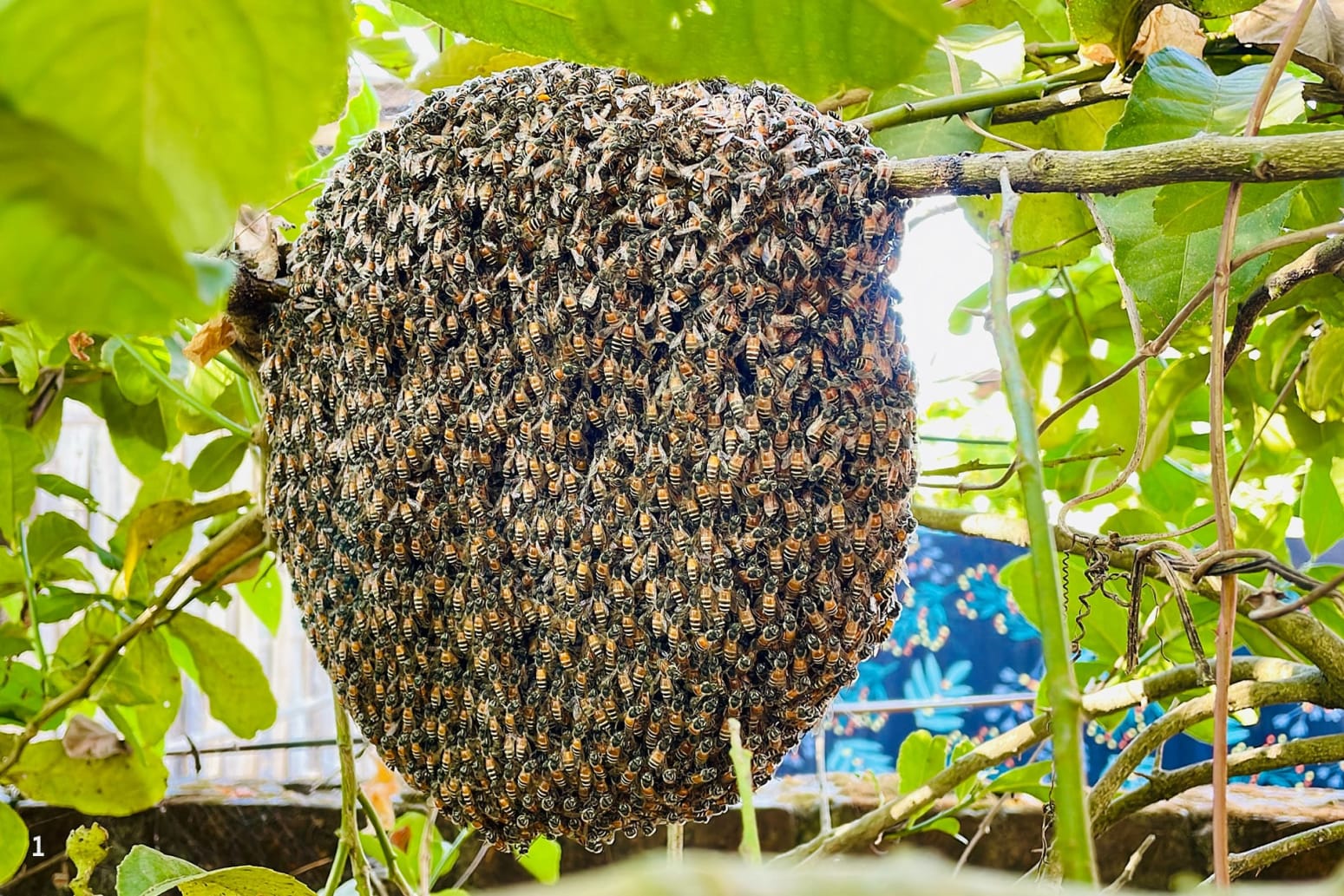
Before dawn breaks over the misty hills of Odisha’s Kandhamal district, the dense sal forests stir with an unusual chorus, “cheeerr-cheeerr, tchee-tchee”. Moving along narrow forest trails beneath towering sal canopies, where sunlight barely reaches the forest floor, Kutia Kondh honey gatherers repeatedly mimic these calls to locate jajesi pata, the black drongo. The glossy black bird, with its forked tail and red eyes, is known among the Kutia Kondh as a guide to wild honey. It swoops through the forest, catching bees and insects mid-air.
“Once we spot the bird, we follow its movement carefully,” says Makhan Majhi from Belghar panchayat in Tumudibandh block. “It often leads us to the honeycombs hidden inside hollow trees or rocky cliffs.”
For generations, the Kutia Kondh, one of India’s Particularly Vulnerable Tribal Groups (PVTGs), have developed a remarkable relationship with the forests and the creatures within them. In Kandhamal’s forested uplands, honey gathering is an ecological tradition shaped by observation and reciprocity.
Using dry leaves and wood, the honey gatherers create smoke, which interferes with the bees’ alarm signals and makes them less aggressive and helps the honey gatherers harvest honey. Only a portion of the comb is cut, leaving enough honey behind for the colony to survive.
“We never touch the queen cell or destroy the brood,” says 52-year-old Tumukarji Pradhan from Kahampadi village in Daringbadi block. “And we avoid collecting honey during the breeding season. If you destroy the hive, there will be no honey next year. Honeybees are the spirit of our forest.”


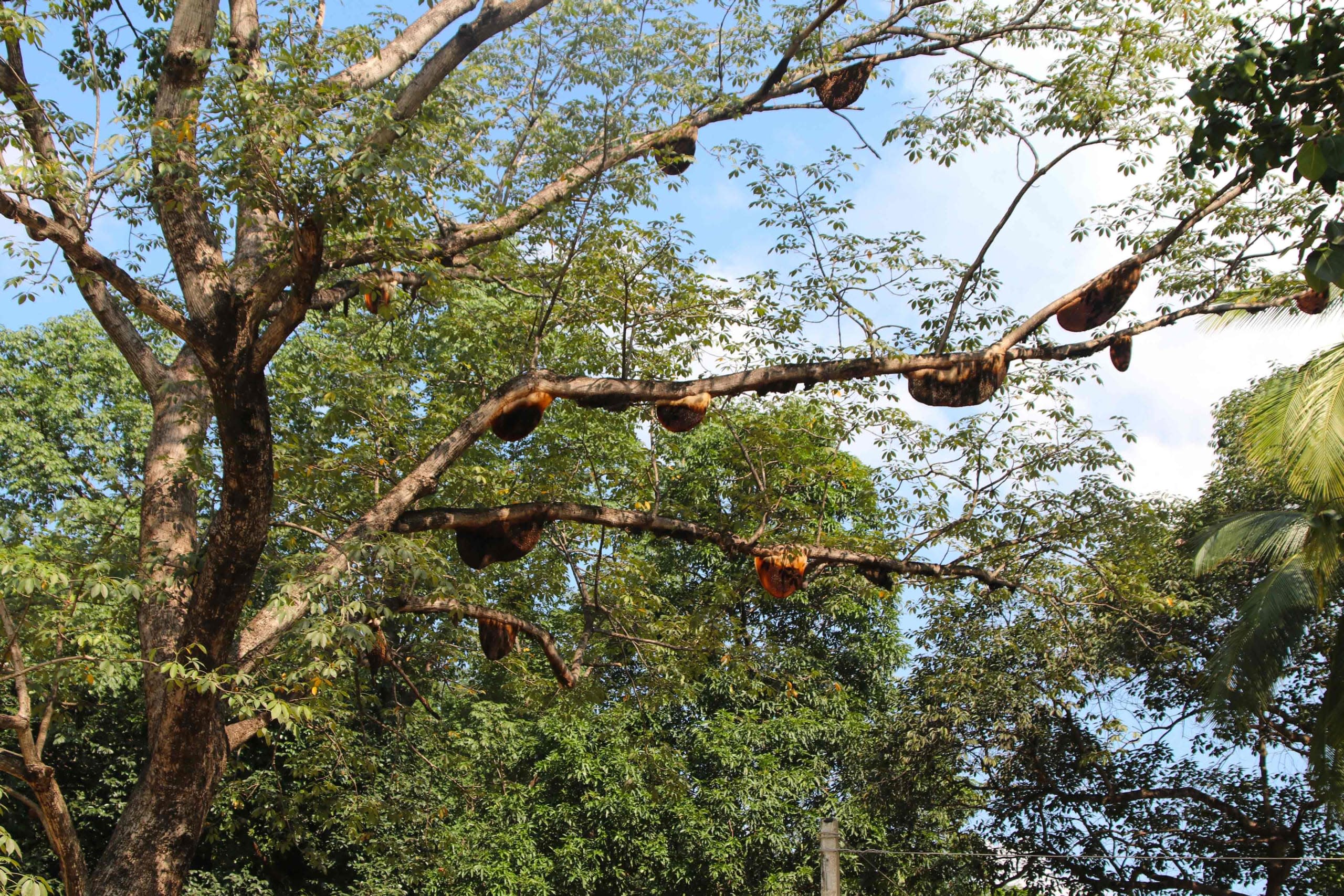
Cover Photo: A forest tree in the Gandhamardhan landscape supporting several giant honeybee (Apis dorsata) honeycombs across its branches. Photo: Abhijit Mohanty
Forests That Hum with Life
Across Odisha’s forested landscapes, tribal communities have long lived alongside wild bees. Honey is woven into food, medicine, ritual, and memory. It is mixed with herbs to treat coughs, wounds, and stomach ailments. In many villages, newborns are traditionally fed a drop of honey as their first taste of food, while it also features in weddings, harvest festivals, and community feasts.
Bees are sustained not only by forests but also protected by traditional farming systems. On the terraced slopes of the Niyamgiri Hills in Rayagada district, Dongria Kondh farmers cultivate diverse plots of millets, pulses, oilseeds, vegetables, and tubers. Mango, jackfruit, mahua, tamarind, and medicinal plants grow around the farms, creating a landscape that flowers across seasons. Unlike monoculture farms that bloom briefly and fall silent, these mixed fields offer nectar almost year-round. “When the forests flower, the bees return,” says Shyam Wadaka, a Dongria Kondh farmer from Khajuri village. “But if we spray chemicals on farms, the bees disappear.”
Dongria Kondh women closely observe bee behaviour while gathering edible greens or working in millet fields. They identify bee species by colour, nesting pattern, and season. Children learn early not to disturb nesting sites during the crop’s flowering months.

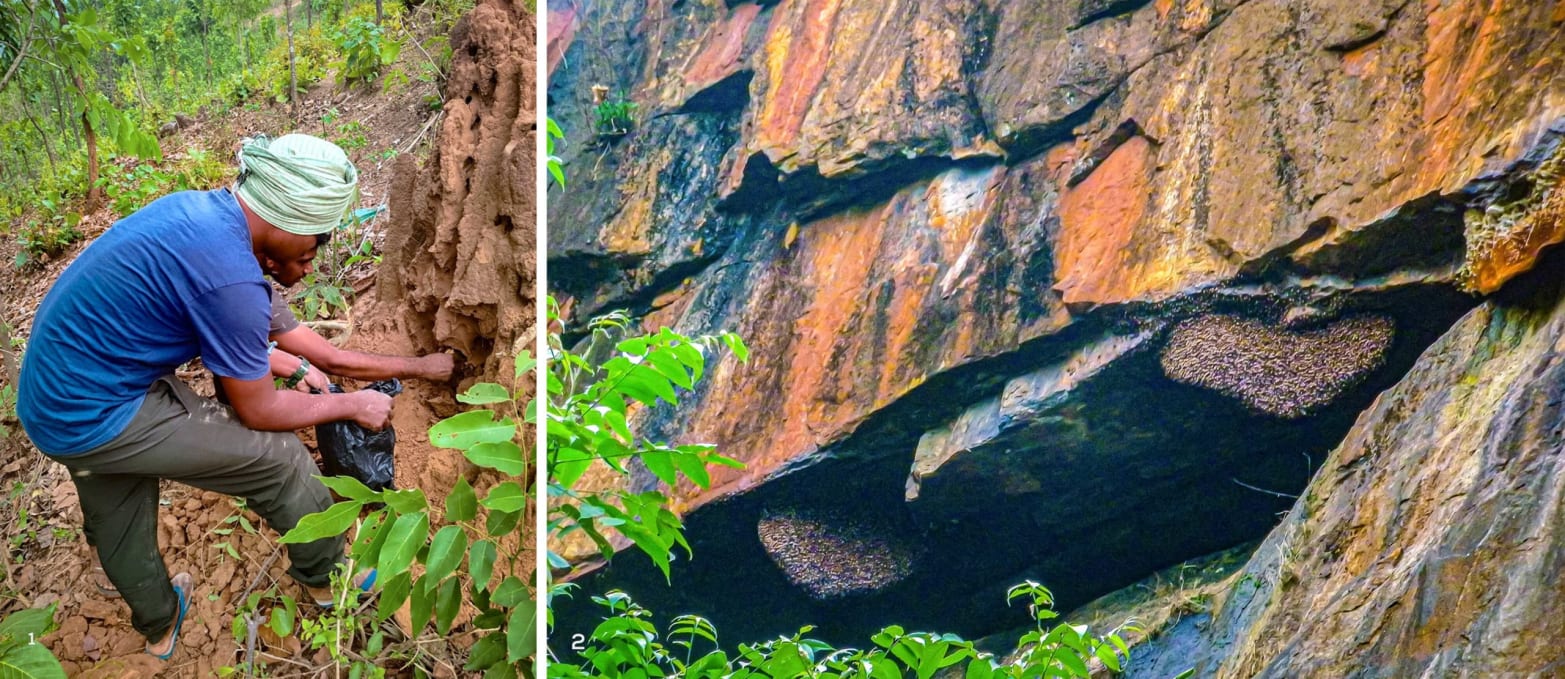
Similar ecological knowledge exists among PVTG communities in Mayurbhanj, such as the Lodha, Hill Kharia, and Mankidia. Honey gatherers track bees through dense forests by noting their flight direction, observing them at flowering plants and water sources, listening to their hum as they move through the forest, and even spotting droppings on leaves and rocks.
Honey collection also follows the lunar cycle. Harvesting increases during the full moon and gradually slows as the moon wanes. During the mahua flowering season, the forests around Similipal Biosphere Reserve transform into a dense web of sound and movement.
“The whole forest used to hum,” recalls Sriram Dehuri, an elderly Hill Kharia honey collector from Podagarh village near the Similipal. “There were hives on most tall trees and even on mountain cliffs.”
That abundance, however, is fading.
Pollinator Crisis
Across Odisha, climate change and ecological degradation are steadily shrinking habitats for wild bees. Unseasonal rainfall disrupts flowering cycles. Rising temperatures alter bee behaviour. Forest fires, logging, and habitat fragmentation reduce nesting spaces. Researchers warn that wild hives are disappearing from landscapes where they once thrived.
At the same time, chemical-intensive agriculture is rapidly transforming pollinator habitats. Vast stretches of monocropped paddy and commercial plantations are increasingly replacing traditional mixed farming systems that once supported insects, birds, and wild plants.
Odisha is home to several native bee species, including the giant rock bee (Apis dorsata), Indian honeybee (Apis cerana indica), dwarf honeybee (Apis florea), and stingless bees (Tetragonula iridipennis). Yet conservation efforts and commercial beekeeping policies remain largely focused on the European honeybee (Apis mellifera), an introduced species that dominates industrial honey production.


Scientists say native bees are often better adapted to local ecosystems and play a critical role in pollinating rain-fed crops and forest vegetation. “Forest bees like Apis cerana indica are essential for maintaining biodiversity,” says Manas Ranjan Jena, a beekeeper and trainer from Odisha’s Ganjam district. “They pollinate crops, medicinal plants, forest trees, and entire ecosystems. But they receive very little policy attention.”
In his village, Suruda, Jena maintains 50 bee boxes of Apis cerana indica and earns around Rs 4–5 lakh annually through honey production. Unlike imported species, the native bees adapt well to Odisha’s humid tropical climate, local flowering cycles, and low-investment farming systems.
Researchers are also exploring the potential of stingless bees, tiny native pollinators valued for their role in climate resilience and their medicinal honey.
Dr Bikash Kumar Patra, a Bhubaneswar-based apiculture scientist, says stingless bees thrive in small farms with minimal disturbance and can strengthen both rural livelihoods and ecological health. “Their honey has high medicinal value, and the bees are resilient to changing climatic conditions,” he says.
Lessons
Even as pollinator populations decline globally, many indigenous farming systems continue to protect bee habitats. In Rayagada, Dongria Kondh elders still teach children how to identify flowering trees that attract bees. In parts of Gajapati district, farmers deliberately leave uncultivated forest patches near farms to support pollinators and wild foods. Across Odisha’s tribal belts, traditional seed diversity itself helps sustain bee populations by extending flowering periods across seasons.
“For generations, these communities have protected pollinator habitats without calling it conservation,” says Susanta Kumar Dalai of Vasundhara, an organisation working with tribal communities in Odisha. “Their farming systems are biodiversity systems.”
That knowledge is becoming increasingly important in a warming world. Scientists estimate that nearly three-fourths of global food crops depend at least partly on animal pollination. In Odisha’s rainfed tribal regions, bees are crucial for crop yields and for maintaining resilient ecosystems capable of withstanding climate shocks.
As the morning sun slowly filters through Kandhamal’s sal forests, the Kutia Kondh honey gatherers descend carefully from the trees, carrying small pieces of honeycomb wrapped in sal leaves. Above them, bees continue circling the remaining hive.
“The forest feeds us because the bees are alive,” says Makhan Majhi, looking back at the canopy where the black drongo still calls. “If the bees vanish, the forest will fall silent too.”
About the Author