Why are net-casting spiders named so?
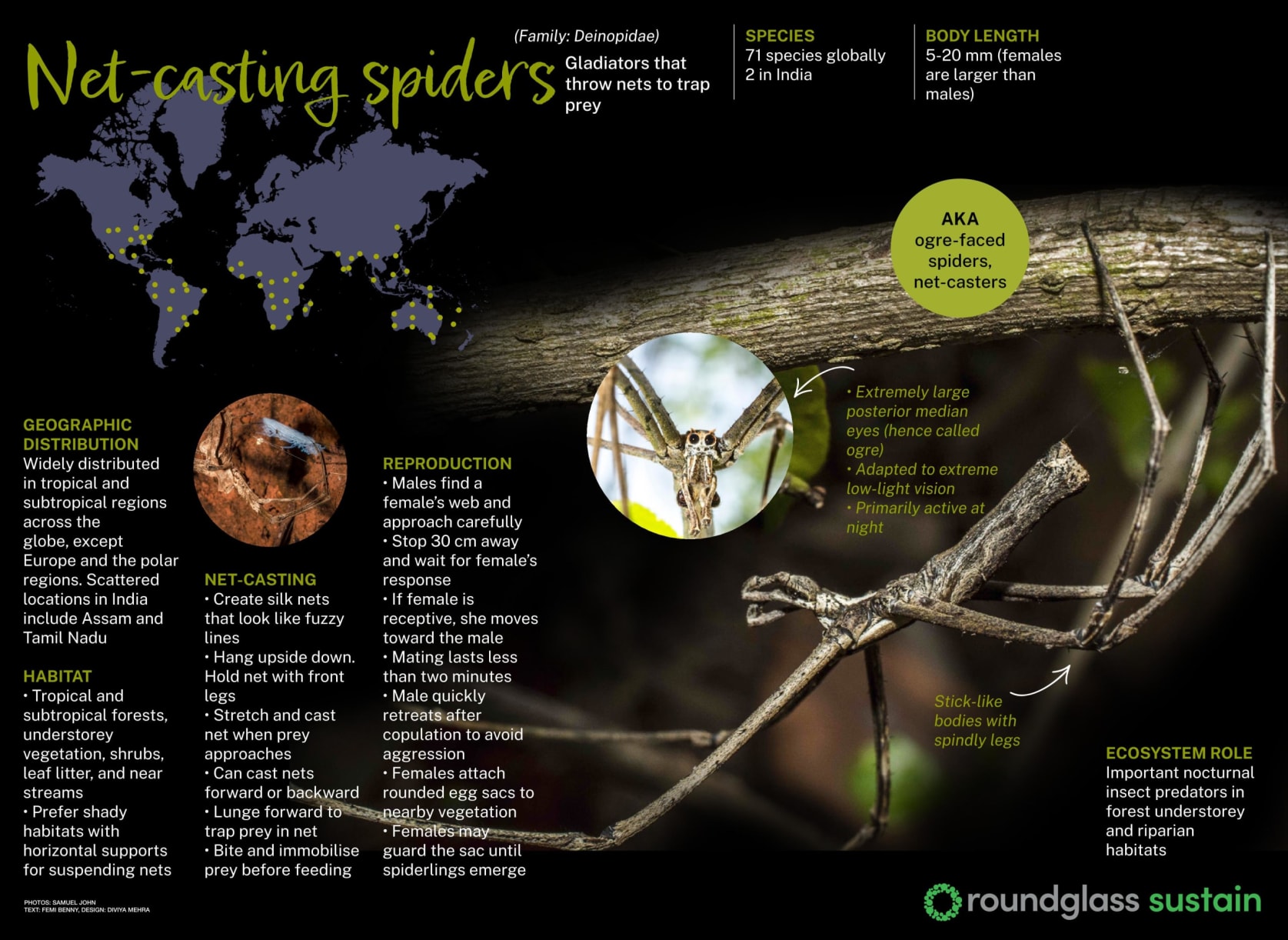
Net-casting spiders are named so because of their hunting strategy which involves casting a silk net to trap prey. They hold the net with their front legs and lunge forward to trap approaching prey. They are also known as ogre-faced spiders because they have extremely large posterior median eyes which help them adapt to low-light situations.
Where are net-casting spiders found?
Net-casting spiders are found in tropical and subtropical forests, near streams, amongst the understorey vegetation, shrubs and leaf litter. They prefer shady habitats with horizontal supports for suspendig or casting their nets.
What is the reproduction process of Net-casting spiders?
Male net-casting spiders find a female's web and approach it carefully, stopping about 30cm away waiting for a response. If the female is receptive, she moves towards the male. After copulation the male quickly retreats to avoid aggression. The female attaches the egg sac to nearby vegetation and guard it till the spiderlings emerge.
Are Net-casting spiders venomous?
Net-casting spiders do immobilise prey using venom as part of their net-casting hunting strategy, however they are not dangerous to humans.
About the Authors

Femi Ezhuthupallickal Benny
Femi is a PhD student at University College London (UCL), working on the ecology and behavior of Asian giant hornets. Passionate about insects, especially wasps, she loves fieldwork in underexplored places, studying how insects interact with their environment and discovering new species while at it!