


Why are solitary bees named so?
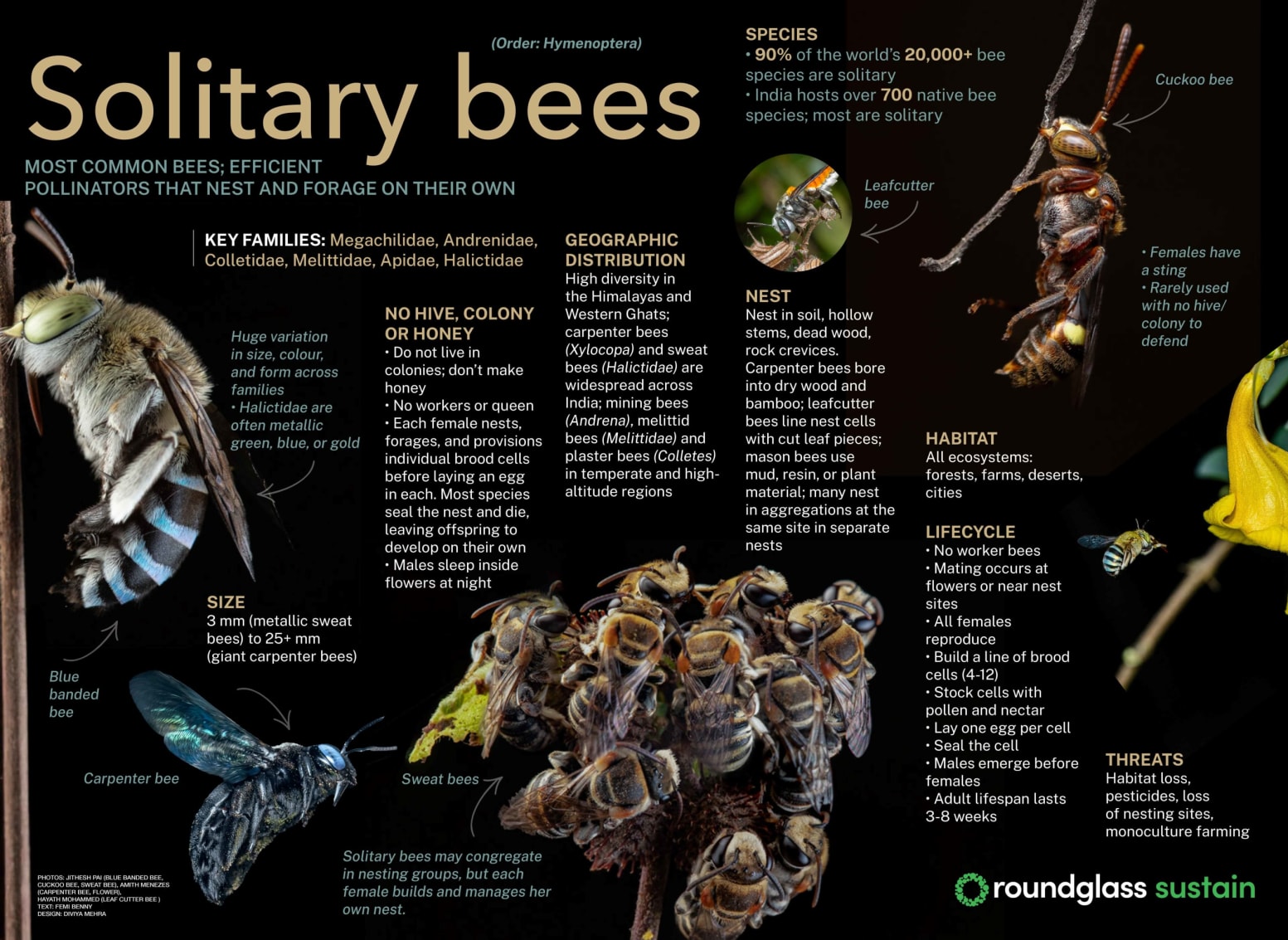
Solitary bees do not live in colonies and don't make honey. Every female nests, forages and raises young alone, meanwhile the males sleep inside flowers. Solitary bees are named so due to the solitary lives they lead.
What are some species of solitary bees?
Carpenter bees, blue-banded bees, sweat bees, cuckoo bees and leafcutter bees are some of the solitary bees found in India.
What are the nesting habits of solitary bees?
Solitary bees make independent nests in soil, hollow stems, dead wood and rock crevices. For instance, carpenter bees bore intro dry wood and bamboo; leafcutter bees line their nests with cut pieces of leaf; mason bees use plant, resin or plant materials.
About the Authors

Femi Ezhuthupallickal Benny
Femi is a PhD student at University College London (UCL), working on the ecology and behavior of Asian giant hornets. Passionate about insects, especially wasps, she loves fieldwork in underexplored places, studying how insects interact with their environment and discovering new species while at it!



