 Listen to this article
•
15:34 min
Listen to this article
•
15:34 min
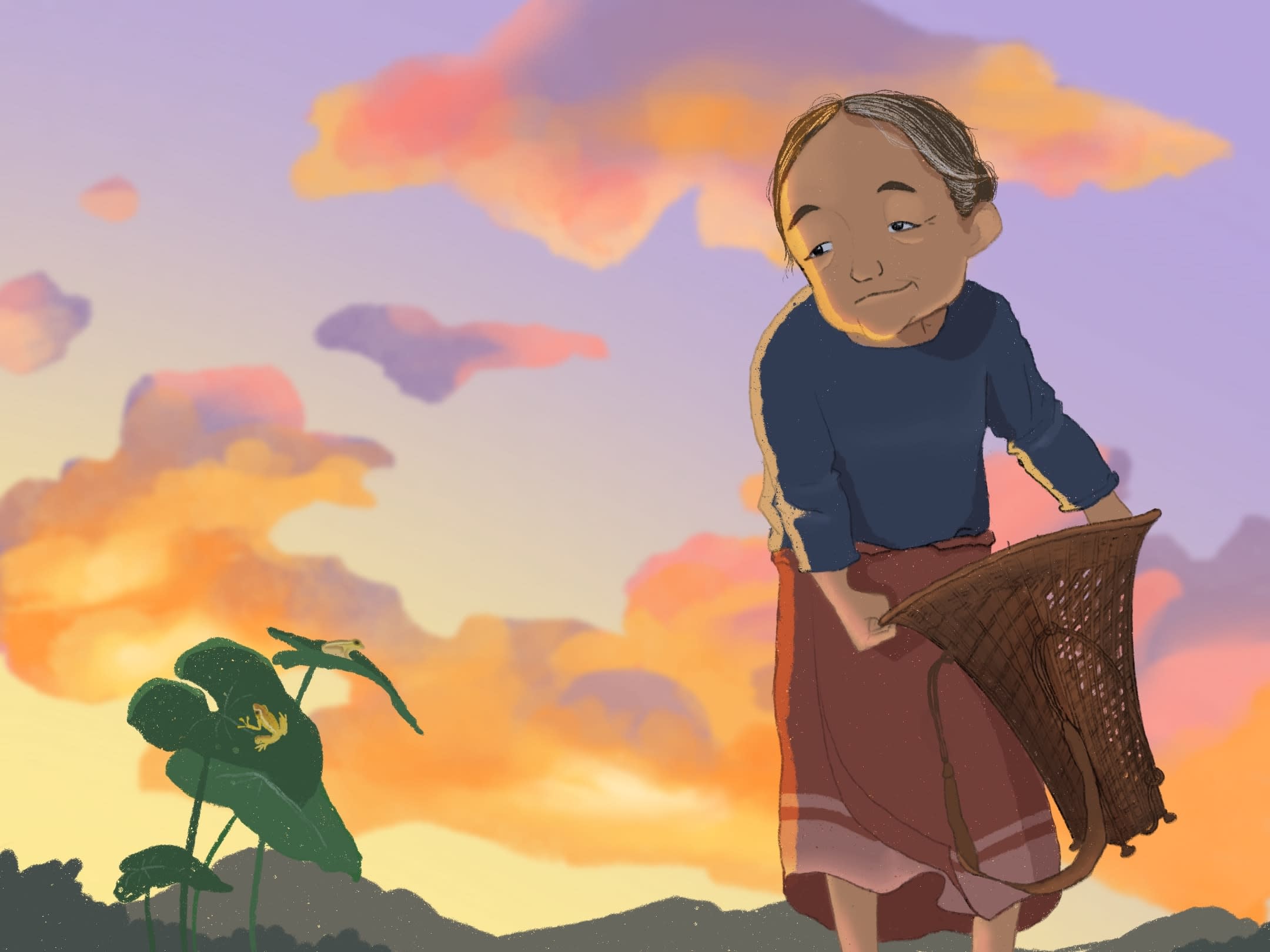
As a frog researcher, I have visited many landscapes as part of my fieldwork — but none have stayed with me quite like Atsa’s paddy field. This petite woman with a leathery, wrinkled face and a bright, playful sparkle in her eyes tended an incredibly biodiverse 20 by 30-metre paddy field. I asked Atsa if she thought the frogs were too loud, “Neiu (boy), I'd rather have this than people who talk too much.”
Atsa travels across town to work her land. She must be over 85 years old, but no one knows her real age — herself included. Unbeknownst to most people she passes by, takes the bus, walks barefoot to her field and does hard physical labour, all on her own. In a landscape that is rapidly losing its wetlands, this modest patch of paddy field is a refuge for frogs. Apart from being a safe haven for frogs, it also became a place I grew to love deeply.

People in Nagaland laugh when I tell them that I am researching frogs. To many people, frogs are an inexhaustible food source, after all they lay their eggs in thousands. Some people have the notion that it’d be a loss of good food if the frogs aren’t hunted, as they will come back in the same numbers or more, the following year. But the intensity of hunting I have witnessed makes me question that assumption, even though comprehensive population data is still unavailable.
In Kohima, paddy fields could be over 25 acres of land or be as small as 0.15 acres — like Atsa’s paddy field. With the town spreading outwards steadily, the paddy fields are being replaced by buildings. People come to Atsa's paddy field for different reasons: some are simply passing through, others are gathering firewood, and some come to hunt frogs. Frog hunters often hunt at night with torchlights held to their heads at eye level to spot the eye-shine of frogs. They scan the bunds and the water before quickly grabbing them by their expert hand.
On nights that Atsa stays in her hut by the paddy field instead of taking the bus home, she watches a familiar ritual unfold. As the sun sets and the frogs begin to call, her neighbours head out with flashlights to hunt them. She watches the beams sweep across the fields, washes her plate, and goes to bed, falling asleep to the chorus of frogs.
In a place where frogs are prized as one of the most nutritious foods, Atsa has never been tempted. A simple meal of boiled vegetables, with the occasional gift of meat from neighbours, is enough for her.

After the characteristically dry Kohima winter, the blue sky hides and gives way to clouds. The chorus of the cricket frogs (Minervarya nepalensis) signal the imminent rain. Soon the other frogs join in the chorus as the rain arrives, building the chorus. On one such rainy evening I was as usual looking for frogs in Atsa’s field. I crept toward the bright eye shine of what could be a Himalayan tree frog (Polypedates himalayensis), keeping my gaze fixed so I wouldn’t lose it. But I slipped on the wet bund and fell, and instead of calls, I heard the sudden plop of startled frogs diving into the water.
The embankments of Atsa’s field hold back shallow water but one can easily sink through the soft clay and get water inside your gumboots if you’re not careful. My pride was wounded but I wasn’t deterred. Drawn by the sound, I moved closer as the calls rose and I almost slipped again. Finally, when I regained my balance and reached the congregation, I swept my torch across the water and paused: a multitude of eyes stared back. Several Adolf’s skipper frogs (Euphlyctis adolfi) were floating with just half of their heads sticking out of the water. Later, as I packed up to leave, I encountered the shy Sendenyu striped caecilian (Ichthyophis sendenyu) at the edge of the paddy field. Its serpentine movement instinctively triggered my deep-rooted fear of snakes, even as I stood watching it glide smoothly across the ground.

The diversity of frogs seen in Atsa’s fields. (Left to right) Senapati's bubble-nest frog (Feihyla senapatiensis), Himalayan whipping frog (Polypedates himalayensis), Nepal cricket frog (Minervarya nepalensis), Adolf skipper frog (Ephlyctis adolfi), Mymensingh narrow-mouthed frog (Microhyla mymensinghensis)
The smell of wet earth rose around me. From farther away, another chorus began. Senapati’s tree frogs (Feihyla senapatiensis) calling from the banana trees above, while the smaller Mymensingh chorus frogs (Microhyla mymensinghensis) called from the bunds below. Of all the frogs I have encountered in the paddy fields, this one has always stood out to me. When I first heard the loud calls of Mymensingh chorus frogs, the smallest of them all, I had no idea that it would be such a tiny frog. While the other frogs in the field sing their parts in soprano, alto and tenor, this one calls out in a loud bass.
Frogs are voracious feeders, as I observed in the hills of Kohima. I have spent nights watching them and collecting diet samples with a syringe attached to a soft catheter tube to flush their stomachs. Frogs are estimated to consume about 10 per cent of their body weight in a day, feeding opportunistically on almost anything they can catch. One of their biggest predators, humans, can be similarly indiscriminate. In some villages in Nagaland, people eat nearly every frog they can catch, sparing only the tiniest bush frogs because they are too small to be worth the effort.
Atsa’s field has houses on two sides and roads on the other two. There are only a few streams and no other natural wetlands, but paddy fields serve as surrogate habitats for the frogs. Streams have now become unregulated drains, riddled with plastic. As more people move away from farming to other livelihoods, many paddy fields have been abandoned or built over. What was once a continuous stretch of wetlands is now increasingly fragmented by houses and roads.

Our knowledge of frogs is sadly limited to their behaviour in the monsoon, when they emerge to breed and call — leaving much of their lives outside this brief window poorly understood. My understanding of Atsa is also largely tied to days she visits her paddy field. I mostly see her from the veranda as she walks past our home to her paddy field. “Guorünuokoyo ruo di tik-tik-tik mu trrreeeek-trrreeeek bayacüko sü a kebvüya mote, mezhie thortacüu,” she tells me in Tenyidie, laughing, “I’m used to the tik-tik-tiks and the trrreeeek-trrreeeeksatsa,” “I don’t really like frogs or anything, they just live here with me and keep me company at night,” she says.
Atsa's paddy field lies still through the winter. The clayey soil dries, and the frogs disappear from sight. Then the rains arrive, and the silence is broken by an incessant chorus. What had seemed barren suddenly teems with movement and sound.
For now, the frogs still return to this small, fragmented refuge. I cannot help but wonder what this landscape once held, before the wetlands shrank and the paddy fields gave way to other land uses. I wish Atsa's little field could simply be one of many places where frogs gathered, rather than one of their last remaining shelters.
But Atsa won't be here forever, and I can't help wondering what will become of her paddy field when she is gone. If it, too, disappears, perhaps the chorus will fall silent — just as the fireflies have, and the many moths that once lit up these nights.
This piece was developed as part of the writing module of Canopy Collective's Future Full of Forests Fellowship (2026), supported by the Coexistence Champions Program. The writing module was designed and mentored by Roundglass Sustain.
About the Author