 Listen to this article
•
15:34 min
Listen to this article
•
15:34 min
As night settles over the Seshachalam Hills of the Eastern Ghats, a private farm near the forest’s fringes undergoes a silent transformation. Under the darkened sky, a gate that is unremarkable by day becomes a threshold for one gatecrasher at a time. These gate crashers include leopards (Panthera pardus), wild boars (Sus scrofa), Indian hares (Lepus nigricollis), rusty-spotted cats (Prionailurus rubiginosus), Indian crested porcupines (Hystrix indica), small Indian civets (Viverricula indica) and Indian grey mongoose (Urva edwardsii).
Wildlife photographer Sushmitha Reddy documented these animals during the summers of 2024 and 2025 by strategically placing a camera near one of the farm gates. “Out of the five or six gates around the 10-acre property, I chose one that was slightly tilted. Compared to the gates, it showed a higher probability of animal crossings, and I often noticed civet and porcupine footprints around it,” she said.
Paddy and sugarcane are the two primary crops cultivated on this farmland located along forest fringes. The area was fenced to reduce crop losses caused by wild boar depredation. But wild animals still make their way in through gaps in the fence to quench their thirst with irrigation water, especially during the summer months. “While animals are not entering the farmland solely in search of water, seasonal water availability does influence their movement, particularly during the summer months. Irrigation channels and a farm pond provide accessible water sources when natural availability in the surrounding landscape becomes less predictable,” Sushmitha explained.
Seshachalam Hills was declared India’s 17th Biosphere Reserve in 2010. Located in the southern Eastern Ghats of Chittoor and Kadapa districts, it is the first Biosphere Reserve in Andhra Pradesh. Despite this protected status, large tracts of forest land in the region have been cleared for mines, agriculture, and monoculture plantations.
“There is a lot of mining activity in this region. Mining for stone, sand, etc. is rampant and visible,” said Dr Nandini Rajamani, a wildlife biologist who works in the region. “Rapid urbanisation is the main threat to the Seshachalam forests. Native habitats, including open scrublands, are fast being replaced by urban and semi-urban landscapes,” she added.


The metal gate to the farm is opened first around 6 am, to allow a tractor to take the harvested produce. On-site workers open it a few more times in the morning to enter the farm, and shut it behind them. The gate remains shut throughout the night. “While farm workers access the fields during the day, wildlife moves through the same spaces at night, reducing direct encounters and enabling coexistence shaped by familiarity and an understanding of each other’s presence,” Sushmitha said.
Despite the presence of big cats, some workers patrol the area with torches at night to ensure wild boar don’t enter the farm. “Guards periodically patrol the sugarcane fields during the night to check for wild boar activity. Regular patrolling by forest department staff and long-term sensitisation have contributed to people’s acceptance of living alongside large predators, significantly reducing negative human-wildlife interactions,” she added.

“The boar was likely startled when my camera flash fired, and it shifted the rocks placed around the setup while trying to escape,” revealed Sushmitha.
Crop depredation by wild boar is a major issue for farmers in many parts of India. When wild boar populations outside protected areas multiply, they can become dependent on agricultural crops.

Her field observations revealed consistent signs of wildlife movement, with scat and footprints of multiple species confirming their presence in the landscape. Interactions with locals provided further context on how people and wild animals use the same terrain at different times, pointing to patterns of coexistence. Building trust with locals took time, but sustained conversations helped them recognise the purpose of documenting wildlife activity.


The small Indian civet is one of eight civet species found in India. Mostly active between sunset and sunrise, civets are elusive and seldom seen. With their long bodies and short legs, these omnivores are often mistakenly referred to as “civet cats,” though they are not true cats and are more closely related to mongooses. An opportunistic feeder, the small Indian civet consumes rodents, insects, and fruit, which makes forest–farm edges productive foraging zones, especially after dark.

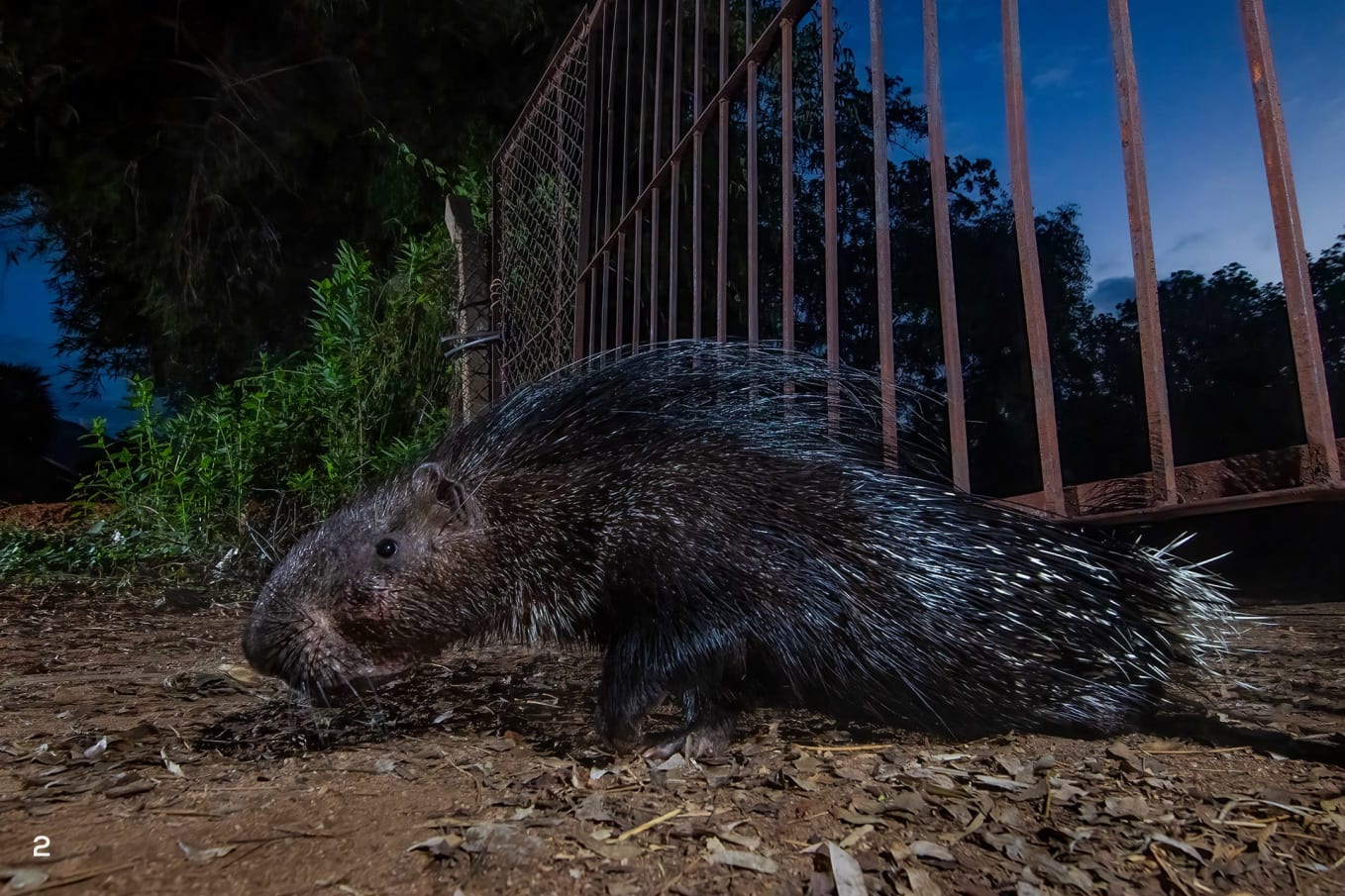


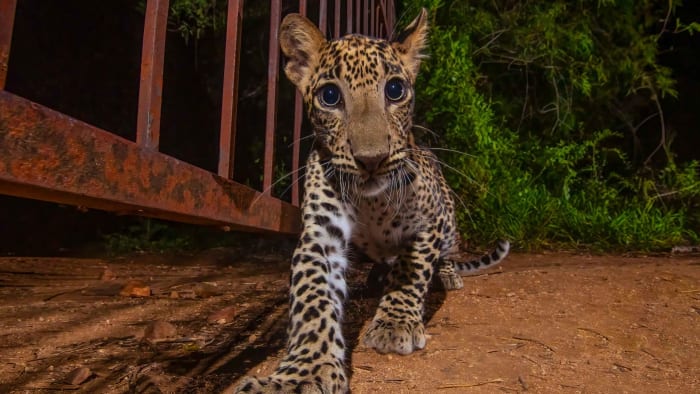
During her initial conversations with farm workers, Sushmitha learned that small cats would cross the gate into the farm. She was soon surprised by the diversity of wildlife recorded there between April and June 2024. The images revealed (1) Indian grey mongooses, (2) Indian porcupines, (3) Indian hares, and (4) rusty-spotted cats moving in and out through the gate. Camera placement and angle were gradually optimised, while giving animals time to habituate to the equipment.
The Seshachalam forests near the farm harbour diverse and highly endangered wildlife species, including the slender loris, mouse deer, Indian pangolin and golden gecko. The landscape is a mosaic of dense forests, fragmented patches, flat and rugged terrain, scrublands, farmlands, and villages. Tigers, elephants, sloth bears, Indian wolves, chinkaras, four-horned antelopes, chital, sambar, bonnet macaques, mongooses, dholes, gaur, jackals, foxes and jungle cats are also found in the area. Around 200 bird, 12 lizard, and 22 snake species have been recorded in these forests.

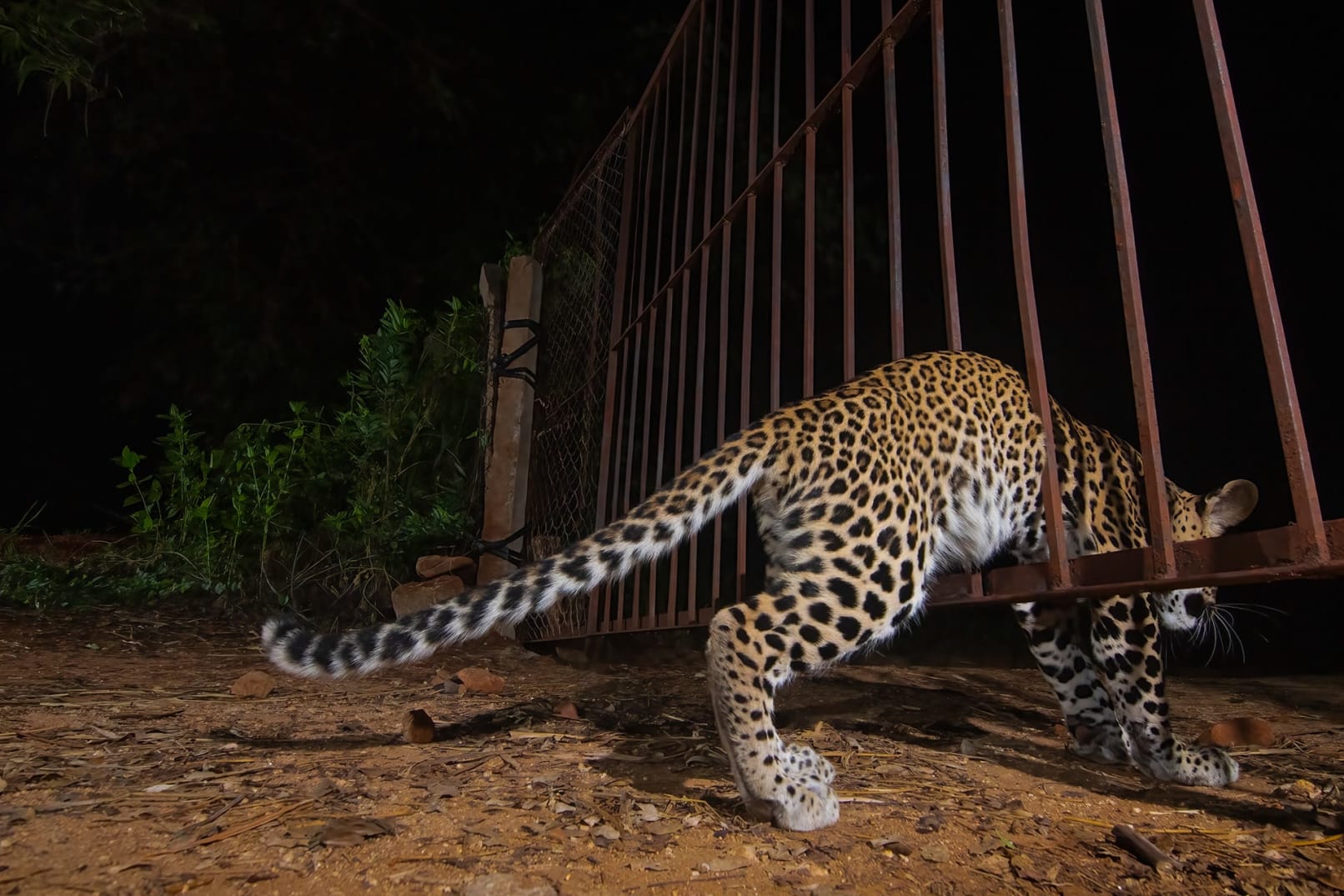
“As I was working with a single camera trap unit, I periodically repositioned it on either side of the gate to capture the face of the animals passing through the gate, since many early frames showed only their tails. On one such night, while reviewing the images, I was in complete awe — what first appeared to be just a tail in the frame revealed the unmistakable grace of an Indian leopard slipping through the narrow bars. Its appearance was entirely unexpected. In the stillness of the night, the animal moved through the farm gate with effortless confidence, unbothered by the tight space, as though it belonged there. This marked my first recorded leopard at the site, despite months of prior monitoring. Farm workers later confirmed that leopards regularly pass through the area and spoke of their presence without fear,” Sushmitha said.


Leopards, especially young ones, are naturally curious. Their curiosity drives their interactions with their environment, enabling them to find food and avoid danger. “There is still a lot of natural cover in the region, though it is growing rapidly. Land close to forests is being opened up, so naturally, you will have animals wandering in, whether leopards, wild boar, or something else,” said Dr Rajamani.
At the forest’s edge, such encounters reveal how wildlife is quietly adjusting to a shared landscape. Animals are subtly rearranging their lives in space and time, learning to navigate human presence while maintaining their own survival. Studying them together is essential because no species exists in isolation — each animal’s behaviour and survival are shaped both by other species and by human influence.

“Local inputs indicated that livestock losses in the area are relatively low. The presence of free-ranging dogs and the availability of wild prey may partly explain why leopard movement along the farm’s edge does not always result in livestock depredation. Easy access to water sources and open movement corridors could also be contributing factors — and at times, the visits appear exploratory or playful in nature,” added Sushmitha.
About the Authors