
 Listen to this article
•
15:34 min
Listen to this article
•
15:34 min
It was July 30, 2023, I had taken a late evening flight from Delhi, where I now reside, to Pune, which is where I grew up. By the time I got home it was well past midnight. I went up to my room on the first floor where a window overlooks the backyard garden. I was just about to sleep when I heard an unusual sound — an impressive high frequency ticking sound. I had never heard it before, at least never in my garden. To me, it sounded like a tree frog. But, that would be very special. Our gardens seemed far removed from the wetter forested habitats where tree frogs are typically found. I heard it again the next day and the day after. Finally, on the night of August 2, I recorded the sound and sent it to my friend and frog expert — Dr. Robin Suyesh.
Next morning there was a response, “Raorchestes ghatei”.
It felt as though the universe had quietly opened itself to me. I had never encountered this name before and I was beyond intrigued. I looked it up on the Internet and was astonished to find a 2013 paper by Prof. Anil Padhye, Amit Sayyed, and others, which formally described Raorchestes ghatei — Ghate’s Bush Frog — for the first time as a distinct species. Raorchestes is the genus for ‘bush frogs’ and ‘ghatei’ the species name came from Professor Ghate of Garware College, Pune in recognition of his contribution to the field of amphibian research.
I called up Amit Sayyed of the Wildlife Protection and Research Society, Satara who was one of the co-authors of the 2013 paper and the lead author of another paper dated 2020 that looked into the natural history of R. ghatei. Sayyed told me that he was studying bush frogs and felt that the specimen he had collected from Chalkewadi, Satara was different from that collected from Castle Rock, Karnataka. Till this time, they were all considered to be Maharashtra bush frogs (Raorchestes bombayensi).
“I was convinced that the Chalkewadi frog was a different species. So I teamed up with Dr Padhye and other researchers and studied numerous specimens collected from different parts of the Northern Sahayadris, examined a range of body parts and undertook DNA analysis to conclude that this was a separate species in itself,” he said.
The Ghate’s Bush Frog is widely distributed in the Western Ghats of Maharashtra and is currently known to occur from Thane in the north to Sindhudurg in the South. Its habitat usually includes semi-evergreen forests and scrub patches on plateaus, slopes as well as vegetation near human habitation. According to the 2013 paper, its closest relatives are the Maharashtra bush frog (Raorchestes bombayensi) which is found south of the range of the Ghate’s bush frog in Amboli upto Goa. The other close relative is the Kudremukh bush frog (Raorchestes tuberohumerus) found in Kudremukh in the Western Ghats. The other closest relatives, believe it or not, are in Vietnam and China. Keen to find out more, I spoke to Bangalore-based scientist Dr K S Seshadri, who has worked extensively on bush frogs and even described a new species of bush frogs. “It may seem like the bush frogs are being found in completely disconnected clusters now. But this takes us back to the ecological timescale or the varying time-frames over which natural processes occur. We don’t know when or exactly how this has happened and this makes it part of the many fascinating evolutionary histories waiting to be discovered,” he said.


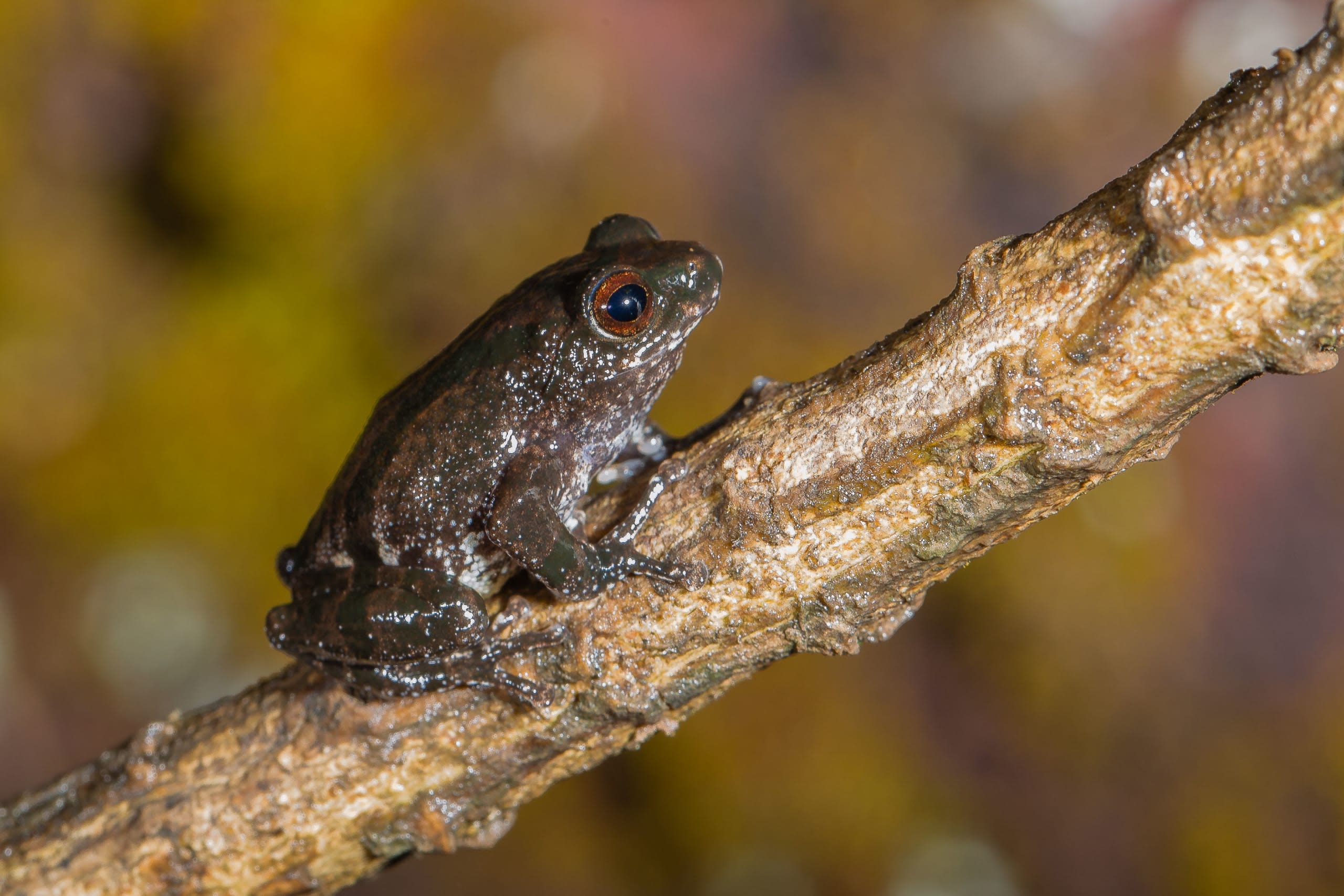
Cover photo: The Ghate’s bush frog is found in the northern Western Ghats, usually in semi-evergreen forests and scrub patches. Photo: Saurabh Sawant
I had first heard this frog from my backyard at the end of July, but I continued to take note of its calls whenever I was within earshot. I was also able to more or less locate its exact position. It seemed to be sitting just across the chainlink fence in my neighbours backyard on a small leafy bush along the back wall. There was some leaf litter left next to the bush. I tried approaching him a few times, for which I had to scale the small gate we have to separate our plots. But typically, he seemed to stop calling the minute he sensed somebody approaching. I wondered why he had chosen my neighbour’s backyard and not mine. I arrived at a few reasons — it is a larger backyard, the distance between their house and the back wall was more than ours, and the house remained closed most of the time. The frog clearly favoured less disturbance. Even to my untrained amateur ears, it clearly had different calls, which seemed to change based on the time.
Sayyed and Padhye’s 2020 paper on the natural history of the Ghate’s bush frog gave many interesting insights. Peak activity of adults begins with the first rains in early June and continues into October and at times extends up to December. With the first showers in June until August, males generally call from low perches close to the ground, where females are found. Later, males call from shrubs or trees at heights of 3–5 m — this frog is clearly quite a climber! Males call usually beginning around 6 pm, sometimes earlier, continuing past midnight, often all night. Males may call during the day, especially during light rain with calling often ceasing during heavy rainfall. Calling males used distinct territorial calls in addition to mating calls to define a territory. They will fight to defend territories, occasionally throwing the loser from the elevated perch. Males that lose sometimes cease calling and remain silent within the territory of a dominant male.
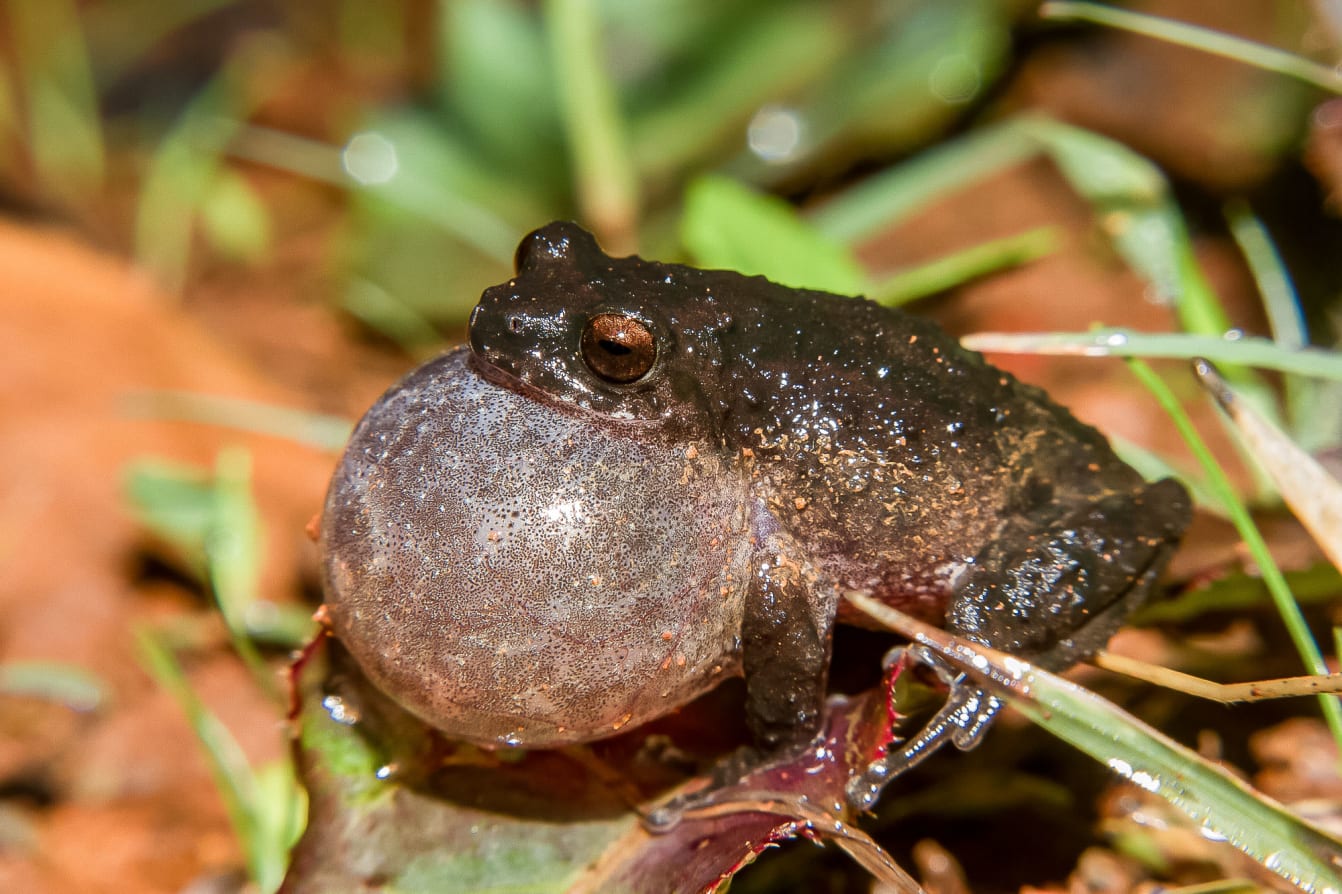
Their beautiful ticking sound is quite high-pitched and loud and travels quite far. So you can imagine my surprise when I discovered that the adult male is only 19–25.5 mm long—no bigger than a medium-sized almond. Like in frogs, the female is larger with maximum size close to 30 mm. Interestingly, unlike the larger frogs and toads we see, bush frog males have a single vocal sac. I checked with Sayyed on this and he said that male bush frog males have a single vocal sac primarily due to their evolutionary lineage not just because they are small. There many small frogs who have two vocal sacs, the number and structure of the vocal sac are species specific traits shaped by anatomy, calling behaviour, and evolutionary history.
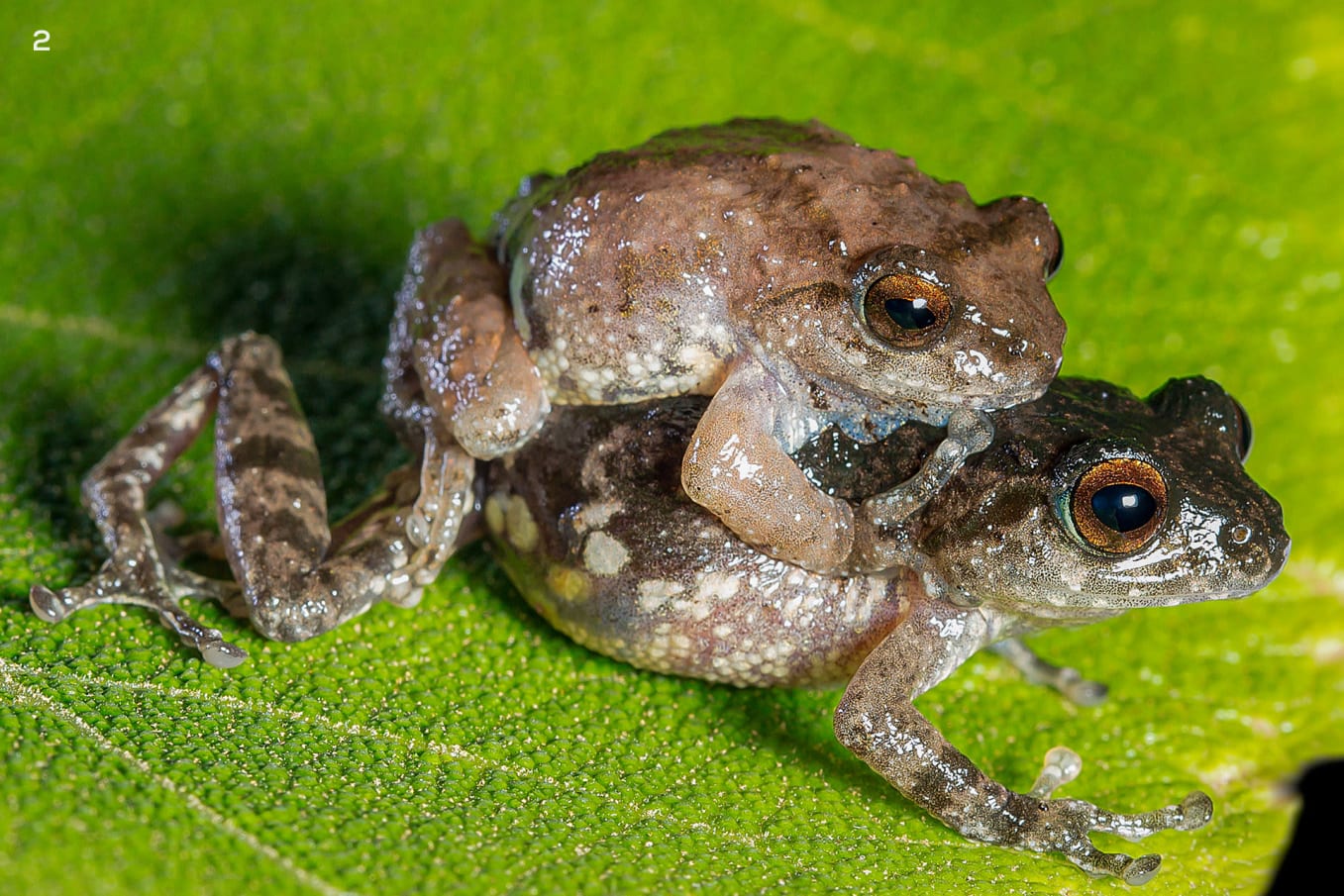
When a female climbs a bush approaching a male emitting the most frequent and loudest calls, he mounts her and they mate. The mating pair then descends to the ground and searches for stones, beneath which eggs usually are laid. However, if a pair does not find a suitable stone, egg laying takes place in wet leaf litter on the forest floor. The male climbs back to the original bush, assumes the calling position, and starts calling once again. The clutch size is between 40 and 60 eggs.
Most frogs lay eggs in water followed by the next stage — tadpoles. However, the Ghate’s bush frog, skips the tadpole phase entirely, and a fully metamorphosed froglet emerges from the egg. Imagine how small and cute the baby of a frog whose adult size ranges between 2-3 cm would be! In my conversation with Dr Seshadri he explained that amphibians employ a diversity of reproductive strategies. Most frog reproduction involves aquatic larval stages i.e. tadpoles, but direct development is not uncommon and indicates an important evolutionary phase, which allowed certain groups of frogs to reduce their dependence on water and occupy niches or bushes instead.
If this was not all Sayyed and Padhye also explored other behaviours. Parental care is uncommon in frogs, and very few species demonstrate the same, for example the male Günther’s Bush Frog (Raorchestes chalazodes) attends to the eggs to protect them. Sayyed and Padhye found that after the monsoon, the females were guarding eggs. They never encountered this during heavy rains because the rains provide the moisture needed for the safekeeping of the eggs. If disturbed, a female showed aggressive behaviour by elevating her body toward the threat, clearly demonstrating that females are protecting their eggs from potential predators and also maintaining sufficient moisture with water or urine to assure hatching in conditions that were less-than-ideal. In the absence of a female, they found the eggs parasitised by insects and subjected to fungal infections. They found that as the froglets developed, the outer egg membrane became increasingly thin and transparent. By September-October hatchlings were abundant and adult frog sightings had gone down significantly, and by December, the last calls were observed. The prey of adult frogs includes crickets (adults and nymphs), grasshoppers, other small insects and spiders. Hatchlings fed on mosquitoes and other small insects. These tiny frogs are the kind of pest control one wouldn’t find in any toxic chemical pesticides.

The Ghate’s bush frog seems pretty well distributed and common. Even though it seems to face no specific threats, continuous deforestation, increasing tourism, recreational activities, development projects like roads and wind farms leading to habitat fragmentation could be a threat.
Sayyed and Padhye also made very precise temperature measurements. Body temperatures of all frogs were 17.05 – 17.09 °C. Eggs developed at 20–22 °C. Soil temperatures where clutches were found were 18.07–19.05 °C and water temperatures near the egg-laying sites were 20.00–20.05 °C. Climate change will hit these species groups hard, with rising temperatures and more frequent, intense extreme weather.
As I wrote this piece, I often wondered where this little frog had come from. Was this really the first time it was in our neighbourhood? Had it always been there and I just hadn’t heard it? I wondered if I should try scaling that gate again to try and spot him. It wasn’t exactly a large, lush garden full of bushes and I was worried that if I disturbed him with my presence, he may not find another bush. I was worried that his incessant melodious call wouldn’t find a mate. But I reassured myself that his sudden appearance was a small but vital sign that we hadn’t got everything wrong. It left me hopeful that he would find mates this season and soon there would be millimetre-sized froglets in the garden, steadily thinning out the mosquitoes of our neighbourhood. In fact, I think there are fewer mosquitoes buzzing around my ears even this season!