 Listen to this article
•
15:34 min
Listen to this article
•
15:34 min
Wasps and bees were a common sight in my backyard for as long as I can remember. Until one day, I was greeted by a doppelganger. Amidst the lush backdrop of my college premises, my eyes instantly hooked onto something unusual. Wrapped in stillness — a bewildering visual blend of both bee and wasp — an imposter with an indispensable role in nature. A hoverfly!
Hovering mid-air, small, yet ambitious, hoverflies are commonly called flower flies or syrphid flies, which belong to the Syrphidae family of Diptera (true flies). With 6,000 species described across 200 genera worldwide, they are often neglected and underappreciated by scientists and policymakers. Measuring 1.3-2 cm with yellow, black, or white stripes, hairy or bare, hoverflies showcase remarkable mimicry. Yet it's not only their borrowed looks that demand attention but also their duties and actions.
Into their Lives?
Existing from meadows to gardens, grasslands to urban hedgerows, these impersonators possess unique lifestyles. The further I explored hoverflies, the more I was certain that size is just a shadow, but skill is substance.
Adult hoverflies often sway aloft flowers, savouring nectar and carrying pollen as they gracefully defy gravity. Their larvae, however, exist in both aquatic and terrestrial forms, exhibiting extensive responsibilities as both pest controllers and detritivores (organisms that feed on decaying matter). Water-dwelling larvae of hoverflies follow a scavenging saga. As decomposers, they consume and clear decaying remains, thereby purifying and recycling nutrients. For example, species such as rat-tailed maggots favour still and oxygen-poor waters, acting as nature’s janitor and maintaining ecosystem health.


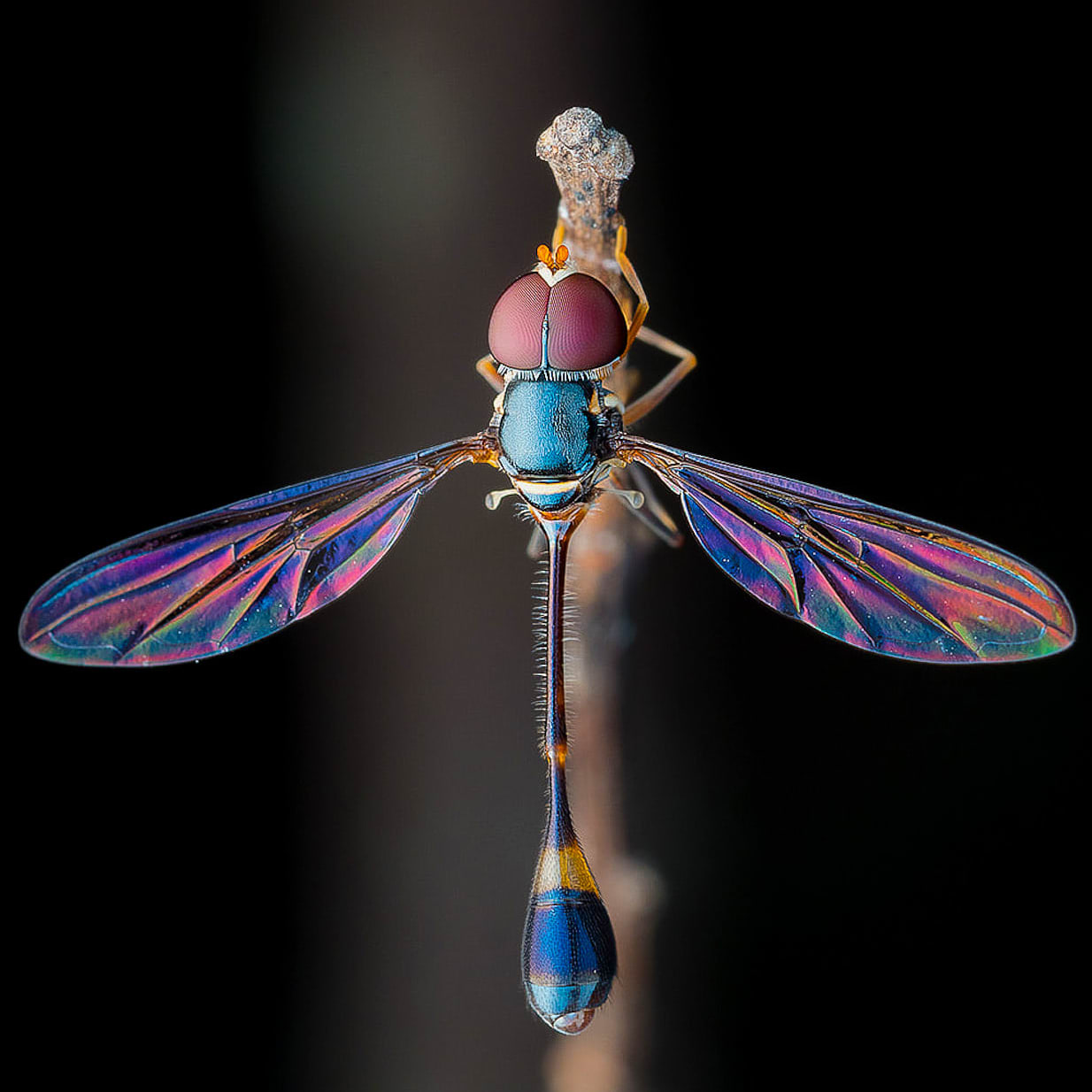
Cover Photo: Allobaccha sp. hoverflies often mimic the slender abdomen of wasps. Of the 79 species present globally, India hosts about 9 species. Their larvae are voracious feeders of soft-bodied bugs like aphids and psyllids, making them important as biocontrol agents. Photo: Hayath Mohammed
On land, females lay eggs on aphid colonies, guaranteeing enough food for their progeny. Draining the last breath of life, larvae mercilessly slurp aphids, leaving them mummified. This feeding frenzy annihilates approximately 70-100 per cent of aphid populations, thereby controlling further infestation. The story doesn't end here. Hoverfly larvae also target additional pests such as mealybugs, mites, and scale insects surrounding aphids, culminating in a pest slaying en masse. Species such as Episyrphus balteatus (marmalade hoverflies), documented exclusively from Europe and Asia, exemplify this role and are even employed in agriculture as biocontrol agents.
Whether on land or water, hoverflies efficiently impart their roles. From farmer’s friend to earth’s cleaning crew, these mimics combine charm with great work, clever enough to outsmart their enemies on the way.
Master mimics of nature
Although impersonation is common in the insect world, I was at sixes and sevens when I saw a flower fly. I wondered how a fly could be this pretty. Because for many of us, flies are disease vectors — repulsive and dirty. But not hoverflies. Featuring Batesian mimicry, a one-way protective adaptation where a palatable species (harmless) mimics an unpalatable one, hoverflies ensure they don't end up as their predator’s meal ticket. However, here’s a caveat: the actual harmful models/creatures must be in surplus relative to the mimics for this escape to succeed.
Hoverflies brilliantly execute deception with the conflicting aposematic stripes on their thorax and abdomen mirroring a wasp and a bee, causing predators and observers to dismiss them on sight. Some species, such as the drone fly (Eristalis tenax) found in the Himalayan region, have hairy, robust bodies with brownish-orange and black markings that mimic honeybees.


Let alone body form and colourations, even behavioural and limited auditory mimicking is well-orchestrated by hoverflies.
Like doing more with less, hoverflies perform a mock sting when provoked, by pushing their abdomen outward to avoid threats. Species like Spilomyia and Temnostoma wave their forelegs to resemble the long antennae of wasps. Some even produce a buzzing sound, like stinging insects, convincing anyone to flee. Although imperfect, this mimicry is not incidental but an evolutionary adaptation that enhances survival by deterring predators.
Not a bee, yet busy as one
Many of us grow up thinking of bees as the sole pollinators of the wild, but science tells a broader story. After bees, hoverflies are the second most important pollinators of wild and agricultural systems. One might ask why we should marvel at flies when bees pollinate with such efficiency. Bees do carry impressive amounts of pollen, but hoverflies bring their own strengths to pollination. Studies show that hoverflies visit more than 70 per cent of major food crops, including those grown in greenhouses, and contribute significantly to global pollination services valued in the hundreds of billions of dollars each year. Quietly abundant and highly adaptable, they are among the unsung heroes of pollination.


In May 2025, tiger butterfly migrations were a sensational headline for their long-distance travel, but can you imagine a tiny fly, voyaging across oceans persistently just to pollinate? Travelling tirelessly, even over 100 km, syrphids deliver pollen across the globe, connecting isolated islands and enriching gene pools. Scientists have also documented hoverfly migrations across North America, Asia, and Australia, gathering evidence through observations and experimental research for over a century and a half. In 2026, the role of seasonality in these journeys is a topic of active research. Not just distance, but altitudes matter too. Found at higher elevations in the Eastern Himalayas, species such as Eristalis himalayensis serve as alternative pollinators as bee activity declines with elevation. Even in areas of low pollinator density, hoverflies pollinate without fail, linking different plant populations.
With these daring, resilient fliers, pollination is definitely not only about bees anymore!
Distinguishing the doppelgängers
In natural science, the principles of truth ought to be confirmed by observation. — Linnaeus.
With 368 species described in 77 genera from India, hoverflies are far more diverse than we assumed. Perhaps a keen eye is all we need to distinguish it from its analogues.


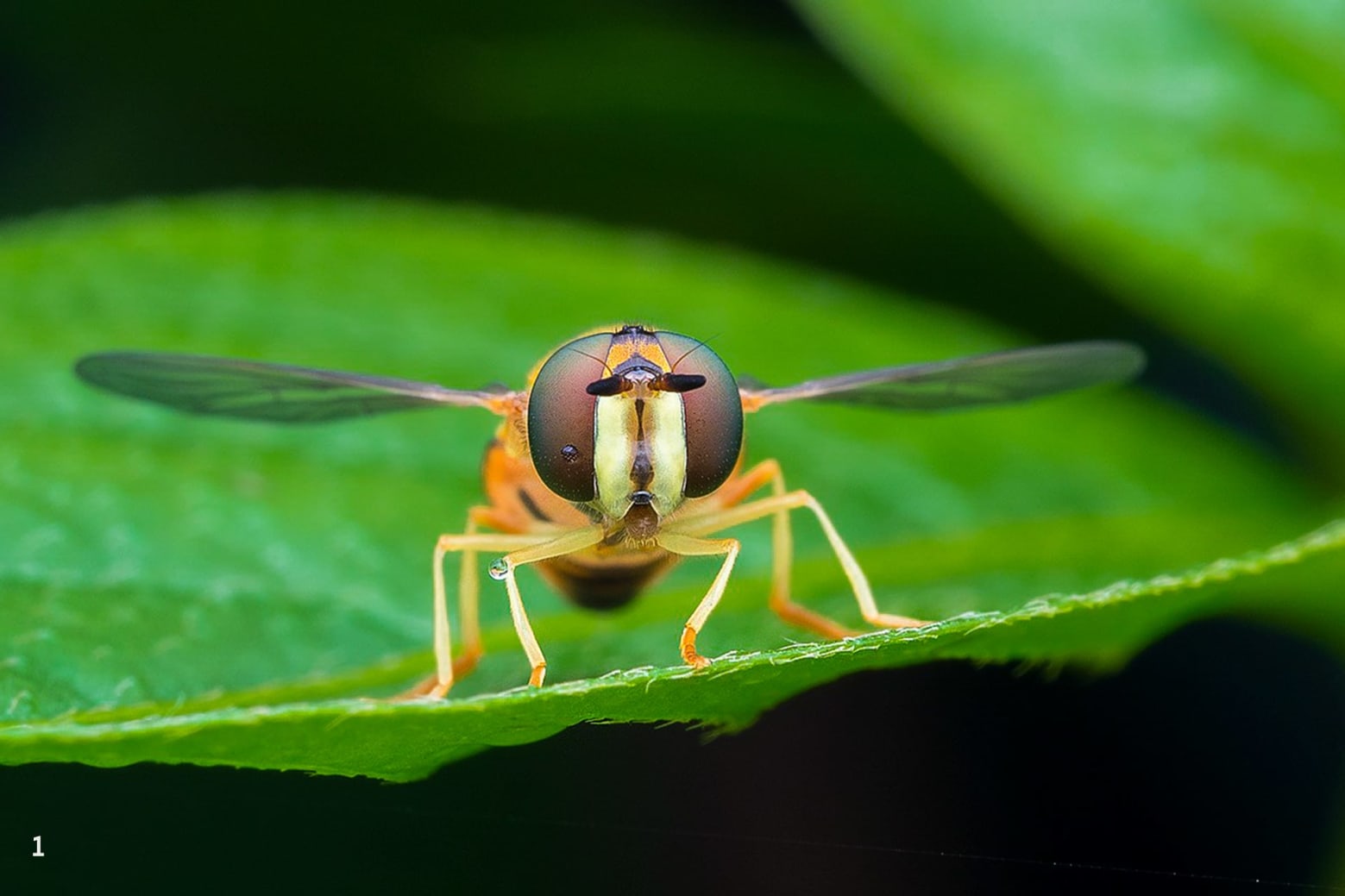
I vividly remember stumbling upon hoverfly eyes amidst foliage They were gleaming like tiny balls of fire, causing my heart to skip a beat. Hoverflies' globular yellow eyes, which meet at the forehead and cover almost half their head, are the easiest clue to identifying these mimics. Another easily observable and striking cue to spot hoverflies is that they levitate or float midair.
Unlike bees and wasps, hoverflies’ short, stubby antennae with a single pair of wings make identifying them even simpler. I reassure you, hoverflies do not possess a stinger to jab you, so it’s safe to watch them closely. Keeping all these tips in mind, when you undertake your next backyard adventure. Remember, never flee or fear, but witness these itty-bitty copycats at work.
Hoverflies project both brilliance and beauty. Promoting pollination to pest control, travelling across landscapes, yet misconceptions overshadow their value. It’s time we appreciate them. Pollinator-friendly landscaping, planting open, accessible flowers, cutting down use of pesticides, and allowing wild patches to flourish in backyards are a few ways we can support them. Next time you witness a hoverfly, remember, imitation is a survival strategy. To be small is not insignificant, but impactful. Let’s observe, recognise, celebrate, and conserve these tiny yet mighty pollinators before it's too late.
About the Author