Listen to this article
•
15:34 min
Listen to this article
•
15:34 min
“This is where I have seen her a hundred times,” Balla Patti says, pointing at the serene Beas River. I scan the water for a toothy snout. Heavy with silt, its chai-coloured waters plod ahead, but nothing dramatic happens.
It is April 2024. The country is walking into the most brutal heatwave in 74 years. It is our fourth afternoon of following Punjab’s Beas River in search of the Indus river dolphin (Platanista minor). So far, we’ve had terrible luck. Patti is a local farmer who grew up along the banks of the Beas River, watching dolphins in these waters. For the last few years, he has led scientists and experts along the same banks to find the last surviving ones. But today, as we wait, Patti’s relentless optimism falters. His cheeks are flushed red. His sweat-soaked T-shirt sticks to his back. Parched, I retreat under the sparse shade of a scrub, but Patti ties a cloth on his dripping forehead and darts into the ten-foot-tall grass that fortifies the banks like a golden wall.
A month earlier, a local newspaper reported that the carcass of an Indus river dolphin — about seven feet long and 100 kg in weight — was found at Harike Barrage in Punjab, a border state in northwestern India. Harike Barrage sits at the confluence of the Sutlej and Beas rivers. Since 1953, the barrage has blocked and redirected at least 90 per cent of the water that naturally flowed into Pakistan to irrigate farms in India. At one of the barrage’s gates, a local fisherman had seen the dolphin’s bloated body floating with garbage and alerted the forest department. The officials confirmed the cause of death as natural. The article concluded, “As per experts, now there are five dolphins left (in India)”.
Until the turn of the 21st century, six species of freshwater dolphins were found on our planet. They lived in the rivers of some of the most populous countries in Asia and South America, with at least a billion people living along their banks. Since the 1980s, the combined populations of river dolphin species have plummeted by 73 per cent. Today, five of the six are declared “Endangered” or “Critically Endangered” on the IUCN Red List. The sixth, the Yangtze river dolphin, found exclusively in China, marred by pollution and dams, was declared extinct in 2006.
The Indian subcontinent is home to two freshwater dolphin species. The Ganges river dolphin (Platanista gangetica) inhabits the interconnected Ganga and Brahmaputra systems in north and east India. The Indus river dolphin navigates the Indus River system in the west. Of the roughly 2,000 Indus river dolphins that survive, almost all are in Pakistan, split across six isolated stretches of the Indus River by barrages and dams. Nearly 600 kilometres east, a few dozen survive in a stretch of India's Beas River, trapped between two dams, living on borrowed time.

Cover video: Dhritiman Mukherjee
The origin story
The story of the Indus river dolphin begins with the creation of the world’s tallest mountains. About 200 million years ago, the Indian subcontinent broke away from the supercontinent Pangea and drifted northward to meet the Eurasian plate, in the process swallowing an entire ocean called the Tethys. When the continents collided, the edges of their crusts crumpled, lifting the ocean bed skywards to form the Himalayas. To date, marine fossils — shellfish, feather stars, corals — can be seen fused into rocks on the “top of the world”.
The new mountains gave birth to one of the richest river systems on Earth — the Indus River System — formed by an interconnected network of the Indus River and five major tributaries (the Jhelum, Chenab, Ravi, Beas, and Sutlej) that are lifelines of the region.
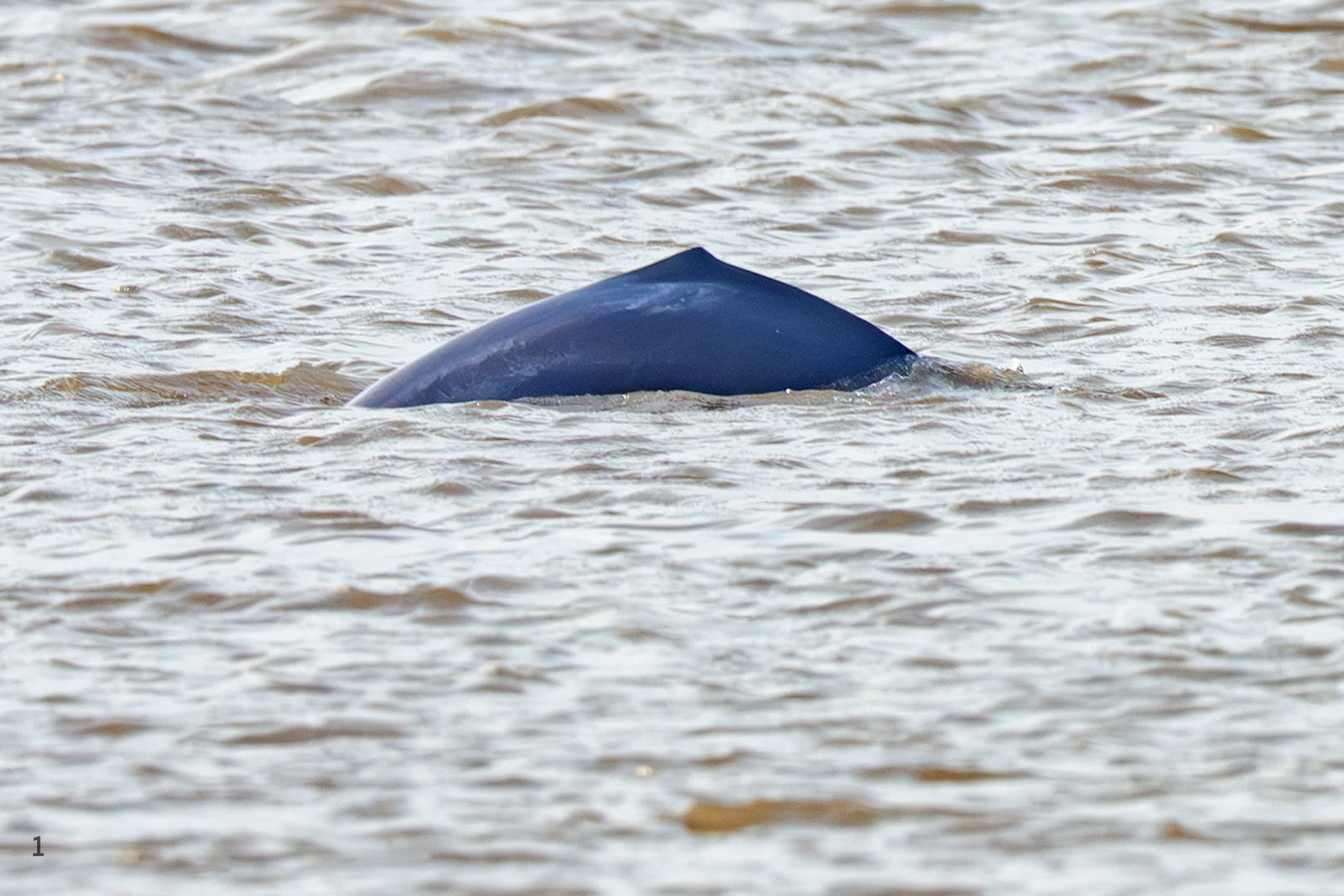
When the Tethys closed, some of the dolphins’ ancestors that lived in the oceans moved into the newly formed rivers, improvising and evolving to fit a new world. The rivers dragged silt as they tumbled down the mountains, so the dolphins traded sight for a sophisticated sonar system to communicate in muddy rivers. These dolphins are functionally blind. Instead of lenses, they have two dimples where their lips curve, through which they can detect only light and dark. With echoes, they map their surroundings, navigating the world with sound. When a river’s waters turn shallow, they swim sideways, one flipper grazing the riverbed, just like humans may grope along walls in the dark. Turns out, like humans, dolphins are right- or left-handed, too. However, anybody would be lucky to see one long enough to notice all these details. You only see parts of the dolphins when they breach — either a long “beak” with a neat set of teeth crisscrossing over their lips or the perfect arch of their backs and a small fin.
Sifting through the archives
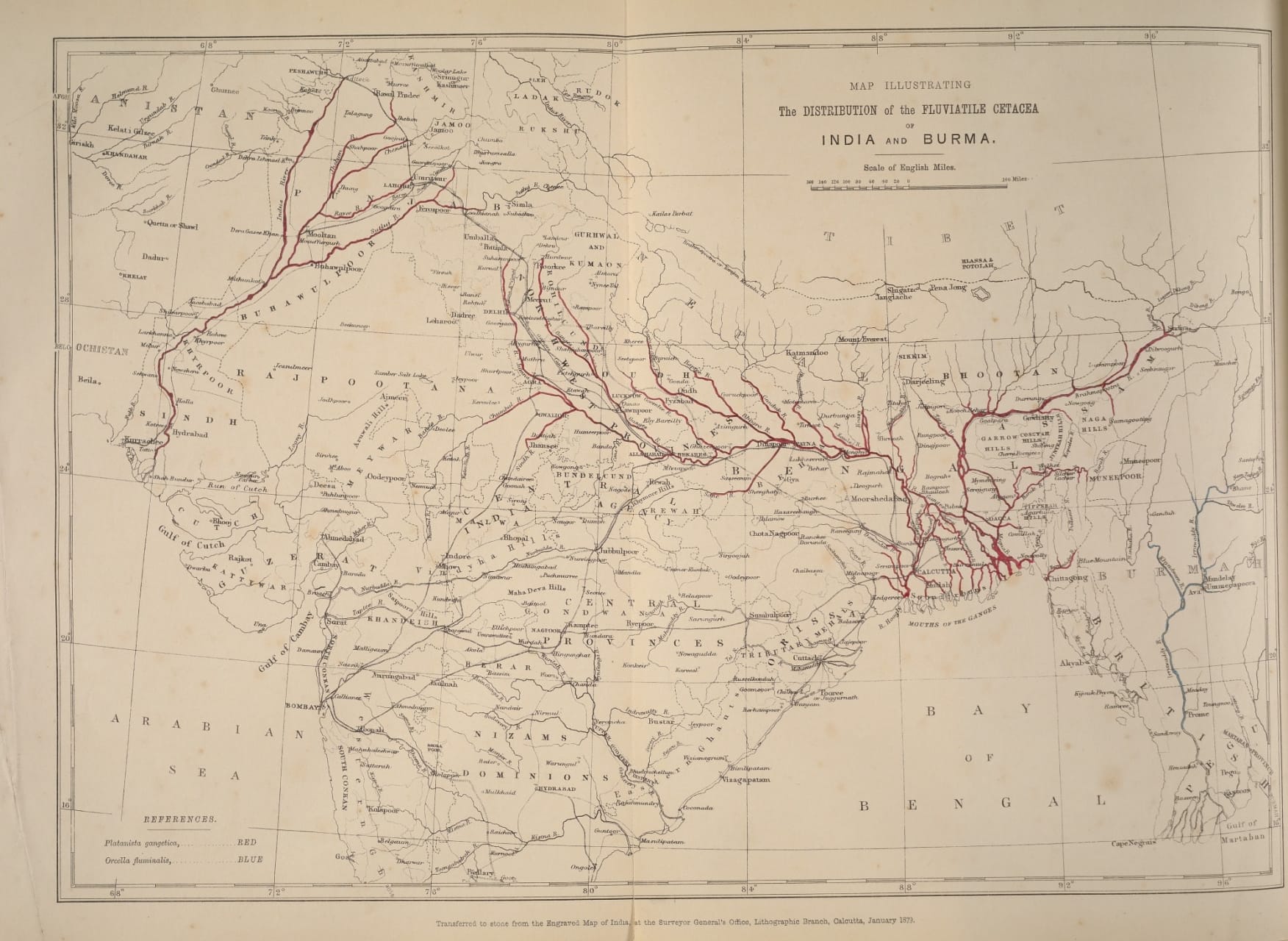
While the dolphin continues to elude us on the river, it is much easier to find in the archives, especially in a remarkable colonial account. In 1865, John Anderson, a Scottish anatomist and zoologist, became the first-ever curator of the Indian Museum in Kolkata. From his office, he could see the Hooghly River, where Ganges river dolphins breach the waters, forming perfect arches. Fascinated, he wrote to every contact he knew within the Empire to report any sightings or even bring back bones or skulls. In 1878 and 1879, Anderson carried out two surveys and tallied about 10,000 dolphins across Indian rivers, drafting the first-ever detailed map of their range. Rivers where the dolphin existed were marked in red, like blood arteries rushing across the map. It shows that the Indus river dolphin swam freely in the Indus and its main tributaries. The dolphin’s geographic range stretched from the foothills of the Himalayas, through “Umristar” (Amritsar) and “Loodhiyana” (Ludhiana) in India, crossing over to present-day Pakistan, to Lahore and “Mooltan”, to the Indus that empties near “Curachee” (Karachi). I notice one distinctive feature is missing on the map — no borders slice through the rivers. Anderson’s voyage is probably among the last documented travels across these free-flowing rivers.
Colonial rule was built on an ecological paradox. It laid the foundations of modern ecological research in India, while tightening control over land, forests, and people. While Anderson mapped the rivers for dolphins, a project to engineer the vast irrigation system in what they described as the arid, “uninhabited wastelands” of the undivided Punjab province was taking shape. By the 1940s, the British had carved the world’s most intensive network of canals and barrages, irreversibly altering the dolphins’ natural range. And then, the Partition dealt another blow. On August 14, 1947, the British partitioned the British Indian Empire into the Dominions of India and Pakistan. The new international border, carved in five short weeks along religious lines, sliced the six rivers, sparking immediate water conflict.
In the years that followed, disputes over canals, irrigation infrastructure, and water rights escalated.
In 1960, to placate simmering cross-border tensions, the World Bank brokered the Indus Waters Treaty. Under it, India retained rights over the waters of the Sutlej, Ravi, and Beas, while Pakistan controlled the Indus, Chenab and Jhelum. Since then, both countries have built extensive dams, barrages, and canal networks to maximise their use of the rivers allocated to them. Today, the Indus River System is one of the world’s most heavily dammed landscapes, providing water to some of the world’s most water-stressed regions. While the British turned the heavily irrigated landscape into the breadbasket of the colonial empire, post-Independence, Punjab continues to be the primary source of government grain reserves on either side of the border. The rivers are at the heart of this transformation. Dammed and rerouted, none of them flows their natural course. In summer, the Indus dries before it reaches the Arabian Sea.
Through these years, nobody knows how or when the dolphins disappeared. But records show that today all six rivers have been sliced by at least 20 barrages and dams, guarded by mechanised gates and connected by kilometres of dry riverbeds. Sliced by dams and barrages, the dolphins’ range is fractured into 17 sections. Of these, only six sections have dolphins. Five lie in Pakistan. Its most stable population lives between the Sukkur and Guddu barrages, where at least 2,000 dolphins or 99 per cent of the world’s entire Indus river dolphin population, live in a single stretch. The riverbanks that Patti and I are walking along are the only part of this puzzle left in India.
The dolphin is one of the oldest river-dwelling mammals on Earth, its lineage stretching back 50 million years. (For context, modern science says our specific species, Homo sapiens, evolved only approximately 3 million years ago.) And yet, in less than two centuries, the Indus river dolphin has lost 80 per cent of their habitat, and about 90 per cent of their population has vanished without a trace.
For a long time, even the small population in India was unknown. Since the 1930s, Indus river dolphins were assumed to be locally extinct in India. They were rediscovered in 2007, when local boatmen mentioned the presence of a large fish to a forest official. Extensive surveys showed that a small population — no more than a dozen — still lived in the Beas. The locals called “her” the “bulhan” or the thick-lipped one.

In search of the dolphin
in November 2024, I return to the banks of the Beas again. This time, Karm Singh, a naturalist and guide with the forest department, offers to take me to the spot where the “bulhan” was rediscovered and to meet the boatmen who had led forest officials to the dolphins. In the villages along the Beas, Singh is fondly known as Gore Pa for his light skin tone, silver beard, and cheeks that turn red like plums on a hot day. Dolphins, I learn from him, are mostly seen around the twin villages of Gharka and Karmuwala; until at least five years ago, they regularly followed the bedi or small boat that ferried people across the river.

We hitch a taxi to the rediscovery site, driving through straight roads flanked by endless, rolling fields on either side. After a bend, the tar road gives way to a dirt path. We get out of our taxi and follow people pushing their bikes down to the riverbank, where a bedi is waiting for passengers. The bedi is a slender wooden boat with red and green chipped paint, rowed by a taut, tanned boatman. To my surprise, five bikes, a cycle, and seven people hop on.
The boatman navigates us across muddy waters using a pole pushed into the riverbed. When the pole digs into the bed, it flushes out worms and crustaceans. The dolphin once followed bedis to feed on the food they churn up, Singh tells me. Will the dolphin follow us today?
The waters are still.
When we cross the river to the other side, I meet 70-year-old Dilbaug Mohammed. Six feet tall, Mohammed has broad shoulders and the arms of a wrestler, but his toothy grin is the first thing you notice. “Do you know how we cross the river?” he asks rhetorically. “We let our buffaloes in, and then we grab on to their tails and hitch a ride,” he says with a laugh. Mohammed and Baaz Khan, 65, were among the first boatmen to take forest officials on their boats to spot the dolphins in 2006. “The bulhan has been here before us. But they (the officials) wanted to see it to believe it!” says Mohammed.
After several surveys, the government declared the “rediscovery” of the dolphins in 2007. A series of conservation initiatives followed. WWF-India (World Wide Fund for Nature India) started surveys led by scientist Gitanjali Kanwar and enlisted locals to provide daily reports of dolphin sightings. Patti quickly became one of their most reliable informants or “dolphin mitra”. Other protections followed. By 2017, a 185-km stretch of the Beas River was legally secured as the Beas River Conservation Reserve. The sanctuary, created for the dolphin, today safeguards at least 300 species of birds and 40 other animals — among them the endangered mahseer, hog deer, fishing cat, and the vulnerable smooth-coated otter. The gharial, a crocodilian that had disappeared from the river at least 50 years ago, was reintroduced in 2018. The reserve also shields the river from unchecked development along its banks. In turn, its waters nourish the fields that line it.
As we return from yet another failed dolphin-spotting attempt, from the bedi I spot a solo figure waiting for us on the other side of the bank. Dressed in a bright-red sports jersey and matching red pants, Patti is hard to miss, even from a distance.


In the summer, the river is lined with shimmering wheat crops ready for harvest, standing proud, swaying with the gentle wind. On the bank’s walls, bee-eaters, mynas, and reptiles claim holes as nests. More than once, I spot a myna trying to raid a bee-eater’s hole, leading to a full-blown airborne scuffle. The Beas is alive, I realise, but Patti has no time to stop and stare. He is speeding ahead of us without explanation. “This way,” he says as he darts into the ten-foot-tall maze of the sarkanda grass, appearing and disappearing like a dolphin.
In the sea of gold, we finally see a man standing in the sun, like a scarecrow dressed in white cotton pants, a loose white kurta, and a white turban. The sun beats down on his wrinkled brow, but he remains surprisingly still. Patti asks him if he has seen the bulhan, and very casually, he shrugs, saying “Subah vekhi” (Saw her this morning). We rush in the direction he points. After hours of waiting in vain, we head back. Patti insists Singh and I go to his home for a meal and meet his wife, Haseena, and daughter, Mariyam.
Witnesses to the dolphin’s decline
Three generations of Patti’s family have lived along the Beas. His family lived here before the Partition, and after, when some relatives crossed to the other side. Over the years, the Beas has shifted course, as rivers do, and the family has moved with it. Today, Patti’s home is a set of unconnected rooms grown around a common courtyard and a kitchen that faces his farms, which lie in the river’s floodplains. Beyond the farms, the Beas glints in the sun.
Patti leads us into the only room with an air-conditioner. The walls are plastered with large medals and trophies Patti has won in kabaddi competitions across the state. A few years ago, a bike accident left him unfit to play. Since then, when he isn’t farming, he trains young kids in the sport.
As we settle down, Haseena brings us a spicy curry made with fish from the Beas and hot rotis made from wheat grown in his fields. Patti, for the first time in days, makes eye contact. I ask him how long he has known the bulhan, and he says, “Since my childhood. My grandmother told us that the bulhan is like family and we must watch out for her”. The Beas River in Gharka and Karmuwala is often referred to as the Khwaja pir or the holy one, he tells me. It is loved and worshipped. “Our relationship with the river is ancient,” he says. Over the next few days, Patti leads me along the banks of the river to spot eagle owls, to shrines of river saints that protect them from floods and, most importantly, spots where the dolphins once frequented. “This was the bulhan’s favourite ‘adda’; you were sure to see a couple here,” he says, pointing to the calm, uneventful waters. “She is happiest in spots where the two waters meet,” he says, echoing what scientific studies have shown — river dolphins are drawn to confluences and deeper channels. One of his favourite moments was when a dolphin gave birth to a calf. Dolphins, much like us, are warm-blooded mammals. They give birth to a single calf once in 2-3 years. Females nurse their calves with a thick cheese-like milk. Dolphins are solitary creatures, but a mother and calf will travel together until the calf is weaned. “We’d see them swimming side-by-side. It felt like we had a new family member,” he says.


Over three generations, Patti’s family has seen the number of dolphins in the Beas decline. A 2022 research paper used scientific models to predict the potential trajectory of decline of the small population of the Indus river dolphin in India under different scenarios of future water availability under climate change and intensification of irrigation. Along the Beas, the steepest declines are estimated to have followed the construction of the Harike Barrage in 1953. Between 52 and 87 dolphins are estimated to have lived in the river at the time. By the time they were rediscovered in 2007, fewer than a dozen remained.
While river pollution and fishing added to their decline, the paper argued that the dolphins had disappeared from every river except the Beas and the Indus, largely because of barriers and diversions that locked in populations.
The dolphins persisted in the Beas probably because the waters turned deeper after being blocked by the Harike Barrage, and the river remained relatively free from industrial pollution compared to other rivers in Punjab. But the isolation from the main population in Indus in Pakistan pushed them to the edge.
Dams are perhaps one of humankind’s most ambitious interventions in nature. They provide water for drinking, irrigation, industry, and power generation. The Harike Barrage reroutes water some 800 km away to 7,500 villages in the deserts of Rajasthan. But dams spell disaster for a river’s ecology, attempting to turn rivers into mechanised pipelines. The obstructions change the river’s current, depth, and riverbed permanently. Free-flowing water absorbs oxygen, stays cool, and filters pollutants. But dams create reservoirs of still waters that may turn oxygen-deficient and abnormally warm. In stagnant waters, pollutants settle and fester. These conditions make survival difficult, particularly for what scientists call “specialist species”.
River dolphins are steadfast “specialists”. They prefer specific riverine habitats such as confluences, meanders, narrow channels, deep stretches. Without this diversity of habitats, survival is a constant battle.
But it's their separation from other, stronger populations that makes them vulnerable. The dolphins in the Beas have been cut off from the dolphins in the Indus for at least 70 years. Trapped between dams, the small group has been forced to inbreed. Over generations, this slowly weakens the gene pool. A poor gene pool means weaker immunity, lower fertility rate, and the inability to adapt. “No matter how hard conservationists may have tried to protect the dolphins in the Beas, we had less than a dozen animals at the edge of the species’ range. The odds were already stacked against them,” says Nachiket Kelkar, ecologist with the Wildlife Conservation Trust and an expert on river dolphins, and one of the authors of the 2022 research paper.
Now weeks go by before Patti sees any dolphins. “I feel restless,” he says.

The vanishing
If dams turn rivers into pipelines, like all pipelines, they need maintenance. In March 2017, maintenance work at Harike Barrage halted the release of water from Pong Dam upstream for 25 days. The river almost dried up and was reduced to a few shallow pools, triggering mass fish deaths. One year later, the waters were halted again for repairs. As the river was recovering in May 2017, a molasses leak from a sugar factory on its banks turned the water red. An estimated 10,000 kilolitres of molasses flowed through the river, depleting oxygen levels in the waters, killing over 60 tonnes of fish. No dolphin mortalities were officially recorded.
On March 3, 2025, World Wildlife Day, Prime Minister Narendra Modi unveiled the results of independent India’s first-ever river dolphin survey. It estimated that about 6,324 Gangetic dolphins survive in the country. However, it said, only three Indus river dolphins survive. The survey noted that a pregnant female was found dead after the survey concluded. That leaves only two.
Soon after the announcement, two seemingly unrelated events foretold how much worse things could get — a war, followed by a flood.
In April 2025, following a terror attack in Pahalgam, Kashmir, India suspended the Indus Waters Treaty. The suspension is set to lead to the construction of more dams, sending an already ecologically fragile river system into flux, impacting the lives of its inhabitants. During the three-day-long war that followed, border towns saw drones light up the sky. I call Patti to ask if he is okay. “We’ve been going to the roof to see the ‘fireworks’ at night,” he jokes.
Three months later, an exceptionally heavy monsoon intensified by the climate crisis hit the basin. Major reservoirs upstream ran at 99 per cent capacity, forcing the release of large quantities of water at short notice, and triggering the region’s worst floods in four decades. Punjab drowned on both sides of the border. Four million people were affected, hundreds were reported dead. Patti lost all his crops. “The family is safe,” he told me over the phone.
Wild species as political beings
The story of the Indus river dolphin is as much about dolphins as it is about our rivers, and us. Scientists call river dolphins “indicator species”. If they thrive, the river thrives. But Kelkar argues that it is time we look at species as more than just ecological indicators. Consistent studies reveal a lot more. “They are also political subjects at the mercy of human political decisions,” he says. The dolphins, much like rivers themselves and the people who live along them, exist within a matrix of simultaneous crises — climate change, unchecked development, geopolitical collapse, and wars. How do you campaign for a species that is barely heard or seen?
After the floods in Punjab, no one knew if the dolphins had survived. Then, weeks later, Patti sent me a grainy video with an underwhelming splash at the very last second.


Desperate search for hope
Over two years and multiple trips, Patti, Singh, and I have walked the banks of the Beas, documenting its biodiversity, all the while secretly and desperately hoping that the waters would part and a fin appear. In February 2026, I return in search of its newly introduced fish-eating crocodiles — the gharials. The golden wheat farms have given way to a sea of neon mustard fields, famous backdrops for Bollywood romance films. While Singh and I are on the road, we receive a call — Patti has seen a dolphin. We rush to the river, spill out of the car, and follow Patti into the maze of sarkanda, walking where wild boar and jackals have left a trail of pugmarks. “The bhulan is here,” he says. “Wait.”
We watch the steel-grey waters. And then, we see a fin, the perfect curve of its back, followed by a splash. River dolphins do not leap like oceanic dolphins. You only see quick teasers. Like a shooting star, it vanishes as quickly as it appears. You can never be sure if you’ve seen it until you see it again and again.
Patti, Singh, and I settle on the bank’s crumbly edge, our legs dangling over the waters, watching one of the last Indus river dolphins of the Beas breach for at least 30 minutes. I ask Patti if he’s heard of surveys that say there are only two dolphins left in the river.
“There are many; don’t worry,” he says dismissively.
“How many are many?” I ask.
“Five. Or even six!” he says.
“What will happen when they all disappear?”
“They won’t. God has a plan for everyone.”
I wish the world ran on Patti’s optimism.