


 Listen to this article
•
15:34 min
During my MSc days at the Forest Research Institute, Dehradun, I caught my first glimpse of pikas on one of our wildlife exposure study tours in 2011. Senior scientist Dr Arun Pratap took us to Uttarakhand’s Chopta region, in and around the Kedarnath Wildlife Sanctuary. It was long before the era of social media reels, and the place was refreshingly free of crowds. We spotted the small mammals on the first steps of our trek to the picturesque Tungnath temple. There were 15-20 pikas on each step. While other scholars of my batch hurried up the stairs in search of the elusive Himalayan monal and Himalayan tahr, I lingered for a while, focusing on the anatomy and behaviour of the busy nibblers.
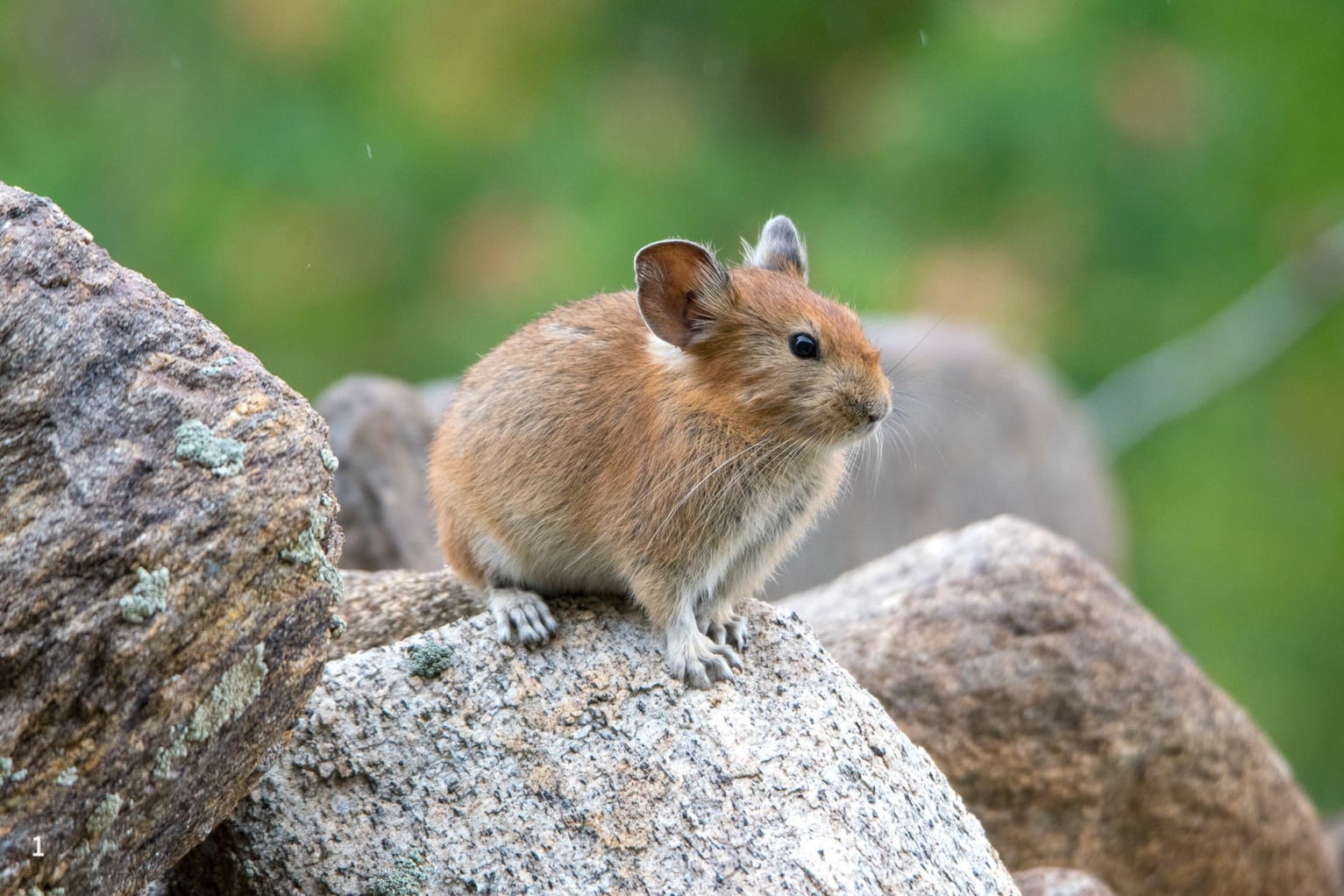

Cover Photo: Royle’s pikas are herbivorous mammals that forage on dried grasses and other vegetation and store it in haypiles to eat in the winter. Photo: Shreeram MV
The faculty identified them as Royle’s pikas (Ochotona roylei), often called “tailless” mice. Hearing the name brought back childhood memories of seeing different types of mice. Born and brought up in western Rajasthan, I was well-acquainted with the Indian desert jird (Meriones hurrianae). I often watched them near their burrows in the dunes of Bikaner, clutching food in their forelimbs as they ate. Those jirds always seemed to be in a hurry; when caught mid-meal, they looked almost like tiny, famished humans. I had also seen the thousands of holy rats (Rattus rattus), commonly known as kabbas, at the Karni Mata Temple in Deshnok, along with the ubiquitous house mice.
Watching the pikas, I tried to find the common thread between all these creatures I had seen. To my surprise, I learnt that these tiny mammals were “mouse-hares”, of the order Lagomorpha, which has only two living families: Leporidae (rabbits and hares) and Ochotonidae (pikas). Although Rodentia (the taxonomic order of rats, mice, squirrels, beavers) and Lagomorpha both belong to the clade Glires and appear similar at first glance, lagomorphs differ in key ways. Lagomorphs possess four upper incisors instead of two, small peg teeth behind the incisors (that no other mammals possess), and all their teeth grow continuously. They are strict herbivores, have more cheek teeth (than rodents), and possess fur-covered paw bottoms and distinct anatomical traits that set them apart from rodents. Around the world, there are more than 30 species of pika, most of which are very similar to one another, with only slight morphological variations, and because they also have overlapping ranges, which makes identifying pikas difficult.


Royle’s pikas are small, round mammals native to the high-altitude regions of the Himalayas, including parts of India, Pakistan, Nepal, and Tibet. One can distinguish them from rabbits and hares by the absence of an external tail, short limbs, and rounded ears. They are roughly 15-20 cm long with grey-brown fur and appear as furry, tailless, mouse-like creatures. They inhabit rocky slopes, boulder fields, and alpine scree habitats, where numerous crevices offer shelter and protection from predators. In India, they are typically found between 2,400 and 4,200+ metres above sea level.
These “Himalayan mouse hares” are silent sentinels of the alpine cold, spending their brief, sun-drenched summers in a frantic race against time. Unlike many of their neighbours, they do not hibernate during the winter. Instead, they survive by building temporary “haypiles,” carefully collecting and drying grasses on sun-warmed rocks and storing them in rock crevices, which provide both a food reserve and protection from predators. Royle’s pikas do not appear to build very large haypiles as do pikas in colder regions, such as Ladakh, possibly because they experience longer and harsher winters. These creatures are as spirited as the legends that surround them, often also called the “whistling hare” due to their shrill, high-pitched alarm calls. Local mountain mythology reveres these small lagomorphs as “spirits of the wind”.
Pikas serve as vital prey for red foxes, weasels, martens, and golden eagles, and their decline threatens the entire biological chain. The humble mammal maintains a precarious physiological balance despite their rugged surroundings. A study on American pikas shows that their naturally high body temperature sits at approximately 40 degrees C, leaving them with a dangerously narrow thermal window where exposure to ambient temperatures above 25 degrees C for even a few hours can prove fatal. Their sensitivity to rising temperatures makes them an essential sentinel species, giving scientists vital early warning signs of climate change impacts on mountain ecosystems.

Though still listed as “Least Concern” by the IUCN, Royle’s pikas are increasingly caught in a race against time. Warming temperatures are believed to be pushing their thermal boundaries, forcing these alpine specialists to move to higher elevations as their native habitats shrink. A friend who recently trekked through their rugged domain noted a worrying decline in sightings; a quiet testament to the mounting anthropogenic pressures and the shifting climate of the peaks. One cannot help but worry that a mammal so remarkably adapted to surviving where the air is thinnest is being pushed from landscapes it has long inhabited. While these mammals may look like a trick of the light or a hybrid of species, there is nothing else quite like them; a singular spirit caught perfectly between a hare and a mouse.
About the Author



