Listen to this article
•
15:34 min
Listen to this article
•
15:34 min
I never imagined anyone would try to bribe me to save a tree. Especially the one that stood on a street in Guwahati, not on private property, existing in the commons, meant for everyone and no one at the same time.
My journey with street trees began in March 2022 when I started collecting data for my master’s dissertation under the supervision of Dr Narayan Sharma. Our work also became one of the pioneering efforts to study street trees of a Northeast Indian city. I was assessing their diversity, distribution, and health along different roads in Guwahati.
Until March 2022, the sidewalks and median of National Highway 37 were lined with trees — krichnachura (Delonix regia), jamun (Syzygium cumini), ejar or Pride of India (Lagerstroemia speciosa), kadamba (Neolamarckia cadamba), and rain tree (Samanea saman). This stretch of highway, passing through the outskirts of Guwahati, was one of the major roads slated for widening. It had over 5,000 trees, many of which the government had marked for felling to expand the road. The news stirred unease across Guwahati, sparking protests and conversations throughout the city.

One afternoon in the same month, while waiting for the coordinates of a kadamba tree to stabilise on my GPS device, I overheard a group of street vendors discussing the news of the impending felling of trees. The trunks had become firm poles to tie their makeshift stalls from which they sold chai and roti-sabzi. I found myself drawn into their conversation. One of the women called out to me, her voice cutting through the hesitation of the others: “If we pay you, can these trees be saved?”
I felt uncomfortable. The vendors had assumed I was from the forest department — someone who perhaps had the authority to save the trees that served them in simple yet vital ways. Perhaps I was someone who could be paid off to save their tree? I dispelled their misunderstanding, but we became unlikely companions of loss. For me, the trees were empirical data points; for them, they were fragile anchors of their livelihoods.
The authorities had given the vendors an ultimatum to dismantle and shift their stalls within 10 days. This information became crucial for my research, as I reorganised my fieldwork, prioritising documentation before those trees disappeared.
“Who planted this one?” I asked, pointing to the copperpod or konokchura (Peltophorum pterocarpum), which stood out among neat rows of newly planted weeping figs. “I did,” said Baruah da, who ran a small eatery with two benches and a few plastic chairs. He ran a bustling shop serving fresh chai, roti-sabzi in the day, and bread pakoras and samosas in the evening. A diverse range of people throng his shop, from daily-wage labourers to officegoers (including me, his regular customer). He is always there, warm and unhurried. He said he had planted the tree so that one day it would provide shade to customers of his establishment, and also help keep dust out. Its yellow flowers would brighten the place. No formal tree planting plans, but a shopkeeper’s understanding, shaped by his living, felt more purposeful than the entire row of weeping figs beside it.

As a capital city, Guwahati’s infrastructural development is considered “growth” at the cost of better living conditions for its people. Surrounded by 15 hills, the city often attracts wildlife such as leopards, elephants, deer, and pythons. This highly modified landscape needs rigorous maintenance; floods, pollution, and waste management are constant problems. But the city has become a place for administrators and not for the people. Trees such as krichnachura and sonaru (Cassia fistula), whose red and yellow flowers once gave the citizens a sense of belonging, have been replaced with low-maintenance yellow trumpet and Indian beech trees. As an economic hub, the city is increasingly diverse, but its trees are being homogenised.
Among all these trees, however, the one I grew most attached to is an ejar. For me, it carries a deeply personal meaning. Its flamboyant purple blossoms revive memories of a song I used to sing with my mother: “Ejar fula dekhi bejar kiyo kora” (Why are you sad seeing the ejar flower bloom?).
During my fieldwork, its star-shaped seeds scattered among the leaves often drew my attention upward; looking through the canopy felt like a quiet moment of “stargazing” between the branches. It was one of my favourite things to do while my grandmother told us folktales in our courtyard on hot, starry nights. On city streets, the tree is a reminder of childhood memories, offers shade and aesthetic pleasure, and helps the city cope with waterlogged monsoon days.

In June every year during the days of Ambubachi (annual menstrual cycle of Kamakhya Devi), the trees on the medians and sidewalks around the Kamakhya Temple, especially from Maligaon to Bharalu, become home to devotees of Maa Kamakhya. As the monsoon rain nourishes the roots, the tree shade becomes a communal living room for pilgrims as they wait for the temple door to open.
Under common street trees such as sacred fig (Ficus religiosa) and banyan (Ficus benghalensis), faith quietly takes root. A fig tree more than 500 cm in diameter stands strong in the Panbazar area. On one side, people offer prayers, and on another, is the main kitchen of Reboti Chat House, a fast-food eatery. Gods, carried through streets during festivals such as Laxmi Puja, Ganesh Chaturthi, and Vishwakarma Puja, often find their final resting place beneath these trees. Statues are placed at the base of a trunk, and the tree is venerated as both god and protector of gods.
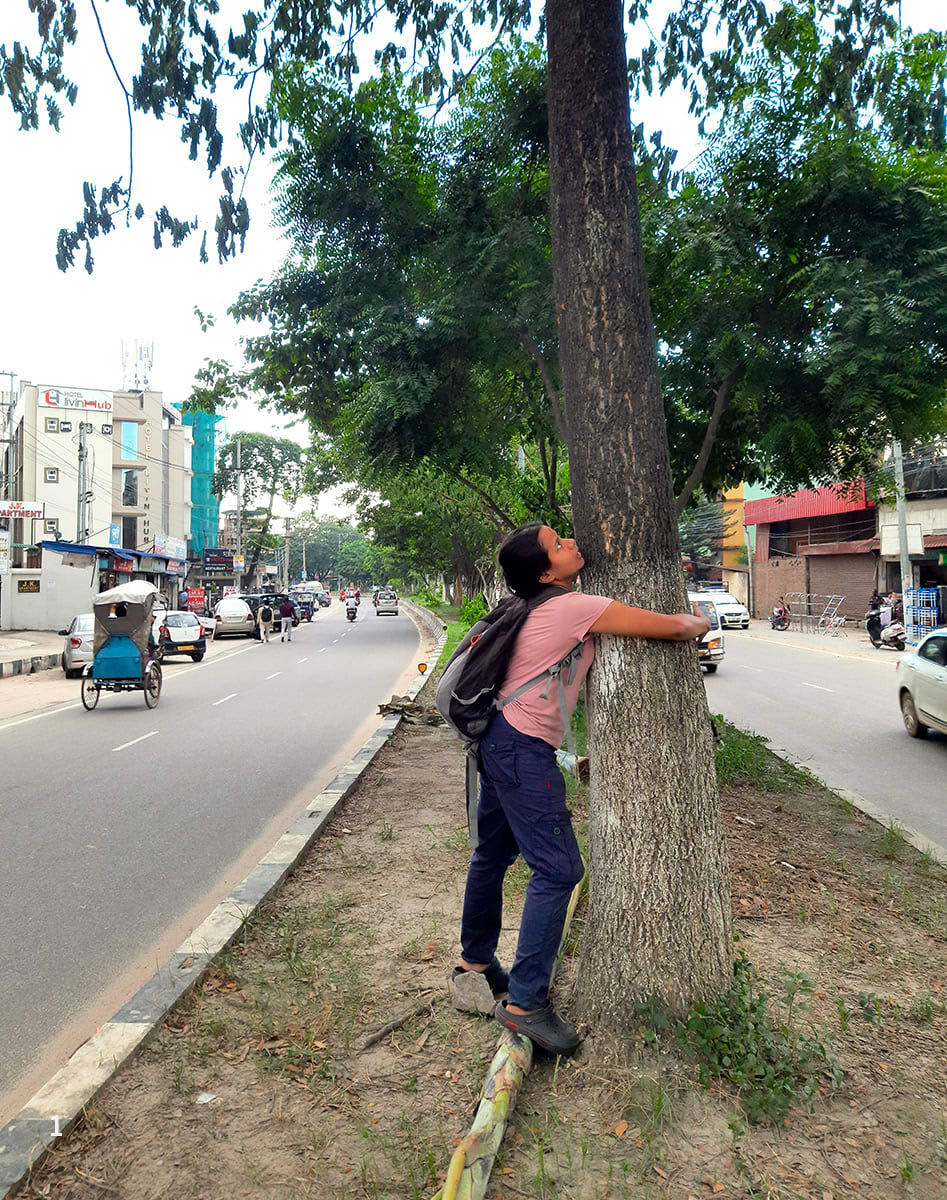
One of the most important parts of my project was measuring the circumference of tree trunks by stretching a measuring tape around the trunk. One day, a passerby stopped and watched for a moment. “Why are you hugging the tree?” he asked. His question lingered: Why did that image of hugging feel strangely meaningful rather than the scientific act of collecting data? Was this quiet act a subtle form of solidarity with trees that were increasingly threatened by widening roads and rising flyovers? Or perhaps, in some small way, it made me a tree satyagrahi through the gentle act of holding the trees I studied close to me, long enough to acknowledge their existence in my life.

In late 2024, yellow crosses appeared on the old rain, ficus, and sheesham trees lining the banks of Dighalipukhuri lake. The crosses indicated the trees were slated to be axed for the proposed flyover over GNB Road. While the flyover promised speed, it was at a cost many refused to accept. More than a recreational and tourist spot, the pond holds the city’s layered history, carrying memories from mythological times to the present. As news spread, the site transformed into a ground of resistance. Students, professors, artists, and residents gathered, forming human chains and holding candlelight vigils beneath the threatened canopies. Their voices echoed through the streets: “Flyovers can wait, nature cannot” and “No trees, no culture, no lives.” A Public Interest Litigation (PIL) in the High Court, along with the force of public will, eventually compelled a retreat. The government announced a redesign, sparing the iconic trees from the yellow marks of “progress”. As of 2026, the Maharaj Prithu flyover has been constructed and inaugurated for public use. Thanks to resistance, the rain and ficus trees were saved. Seventy-seven trees (sheesham and some false ashokas) were transplanted at Lachit Ghat. Only a few have survived.
My fieldwork ended in July 2022, but the trees I had measured and recorded stay in my heart. They had been reference points to give directions to those unfamiliar with the area by saying, “near the rain tree” or “beside the ejar tree”. Now they are gone.
Whenever I pass along those roads, I find myself trying to recall the exact places where they once stood; like the giant monkey pod under which I used to wait for buses to get to the university. People once saw them, lived with them, and cared for them, but their quiet generosity went unnoticed, overshadowed by the louder demands of a growing city.
This piece was developed as part of the writing module of Canopy Collective's Future Full of Forests Fellowship (2026), supported by the Coexistence Champions Program. The writing module was designed and mentored by Roundglass Sustain.
About the Author