


 Listen to this article
•
15:34 min
Like most hill towns, the churn of Kodaikanal is constant. Crowds spill over, especially on weekends. Most head to the star-shaped Kodai Lake, which is the centre of all activity. I wasn’t expecting much more than a staycation or brief outings during my week-long stay. A visit to Kiki’s bookshop on the first day changed that. When I picked up a 150-page booklet entitled Meet the Trees of Kodaikanal by Robert Stewart and Tanya Balcar of the Vattakanal Conservation Trust, I figured it would list a few prominent trees in the area. Instead, I found colour pictures and descriptions of the trees, with walking trails laid out by local naturalists to explore Kodaikanal’s flora. Happily, after that, my vacation morphed into something entirely different.
In the city, you meet, but only a handful of trees you can recognise. The copper pods that line my street mark the seasons, as do the squished jamun and beech flowers (Pongamia pinnata) in the nearby park. There are banyans, with a line of threads around, revered, spared. There are gulmohar, peepal, amaltas, and the fig in the wider area. Sananda Mukhopadhyaya’s Mumbai Overstory walk in South Mumbai introduced me to a few more: the burflower tree (Neolamarckia cadamba), rain tree (Samanea saman), portia (Thespesia populnea), and the Indian almond (Terminalia catappa).

Cover Photo: The tiny hamlet of Vattakanal is a leisurely walk from Kodaikanal. Lined with plantations and rare tree species, the roughly 3-km walk from Pambar Cottage leads further to Dolphin’s Nose, offering amazing valley views. Photo: Sadiya Upade
In Kodai, it was different. A sense of discovery fueled me. I wasn’t following a person around, keeping pace, listening to them or making notes. Like in the good old days, I followed a map, one trail at a time. One tree at a time. Walking at my own pace, breathing in the fresh air, fending off the stares of passing cars and locals. For once, adhering to the adage of stop and stare. Stopping to take in the views of the lake, the Palani Hills when the mist relented ever so little, the houses, the streets, and, of course, the trees.
It was surprising how many of the trees were still there in the location mapped. On the first leg, just behind the telephone exchange, was the pink ball tree (Dombeya wallichii). I might have noticed it even without the map, but would I have done more? Would I have tried to know its lineage, characteristics, age? Definitely not. It would have been an incidental meet, photographed, and forgotten in no time. That I can recognise these clusters of pink flowers from Madagascar and South Africa now is a testament to what a good field guide can do.


My trail along the Upper Lake Road was lined with different kinds of pines and cedars, cypress and champaka trees. The ones I remember had quirky names. Inside a lovely cottage called Rosebank was what was locally called the monkey puzzle tree (Araucaria bidwillii), but really the bunya-bunya from Australia. Further, on the gates of a property called Meenakshi, was the woollybutt (Eucalyptus longifolia), which can even be spotted from the top of Observatory Hill. On a section of the shola forest in Kodaikanal (called the Bombay shola) was the South Indian marble tree (Elaeocarpus variabilis), with large olive-like fruits that gave it the moniker Nilgiri mock olive.
I would be lying if I said I wasn’t overwhelmed by the number of trees lining the route. Some made an impression, some I glossed over, some I walked back to, some I couldn’t find or register. I settled the tab for the day at the nearby luxury resort, The Tamara Kodai, with an underwhelming spaghetti alfredo, but satisfied to have met the property’s historic jamun tree (believed to be over 500 years old).
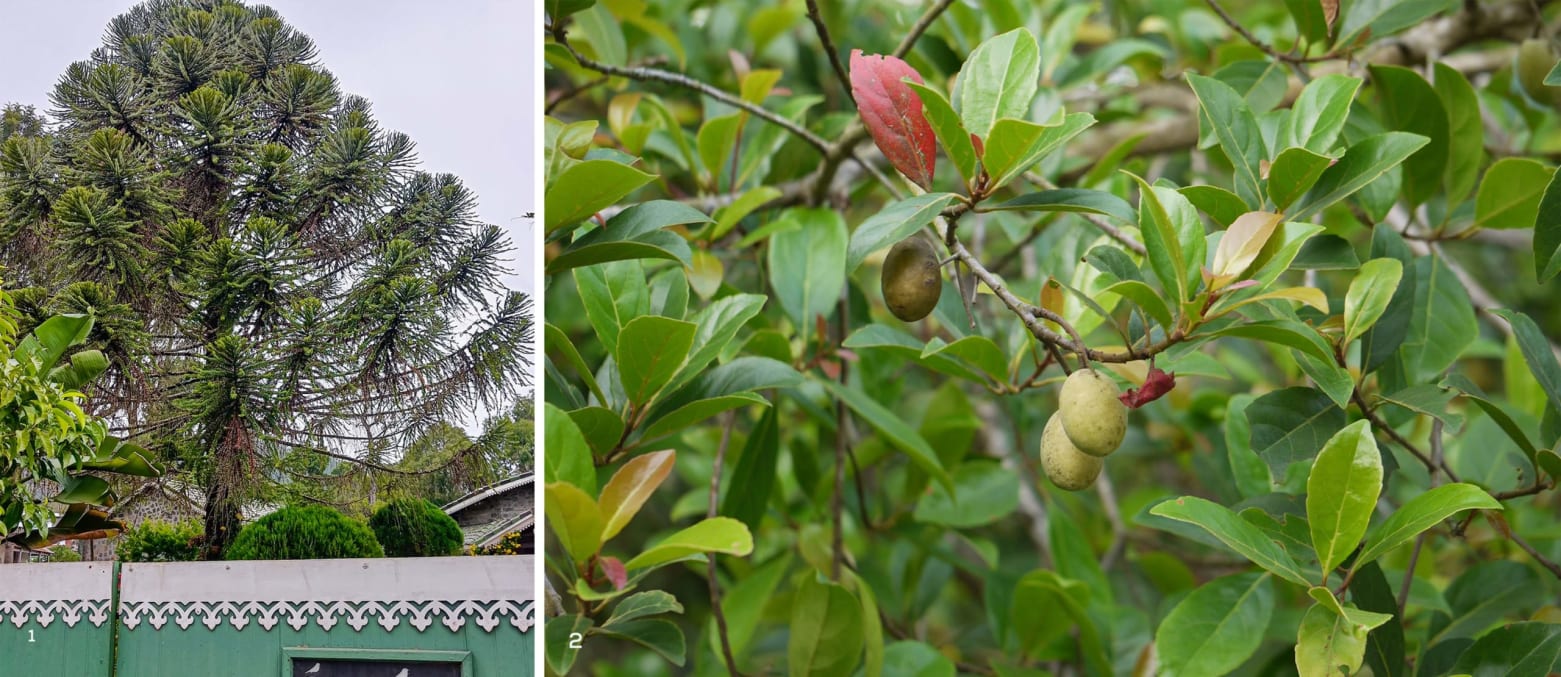
One of the things I loved about this semi-guided trail was not just having a repository in my hands. Maps are not a novelty. If anything, Google Maps has become a handicap, leading us to back alleys and even non-existent bridges, and steering us away from conversations with locals. I was enthused that someone had thought to educate mildly curious visitors, giving them the tools to understand the depth and diversity of these evergreen forests. The concept of using QR codes to guide one digitally was the cherry on the cake. These weren’t working on my second trip a few months later, but the booklet was succinct, with pictures and descriptions to identify the species.
On the second leg of the trail, which leads to the lakeside, I learnt about the spreading branchlets of the forest orange (Toddalia asiatica var floribunda), which protect shola regeneration. Past hotels, houses, even cemeteries, I made note of some names to study: the ironwood (Memecylon randerianum), the chilla (Casearia zeylanica) (whose orange fruits are used as fish poison), and the elderflower (Sambucus nigra) (which reminded me of Tolkien’s Dragon Tree).

The last stretch was the popular one, taking you back to Pambar Cottage, one of Kodai’s oldest compounds, and on to Vattakanal. Along the route, the fragrance of the lemon-scented gum tree (Eucalyptus citriodora) from Australia lingered. The wind whipped around, dancing with the leaves. The approach of shops soon marred the serenity, but the trail continued. I met the evergreen mottumookkan (Viburnum coriaceum), called “mother of shola” for nursing young shola species and the Palni Rudraksha, which came up from an unknown seed.
In three days, I had met more trees than in my entire lifetime. Each day I went back to the room, flipped through the pictures, and used the guide to learn more and plan the next day’s walk. I was smitten. I had spent more time outdoors, walking the trails than sampling local cuisine or collecting souvenirs. The words of the early American conservationist John Muir came to me: In every walk with nature one receives far more than he seeks. I certainly had returned with more than just chocolates and cheese.
Note: Meet the Trees of Kodaikanal is available at local Kodaikanal bookstores (Rs 200).
About the Author



