


 Listen to this article
•
15:34 min
There are those who insist that conservation is a stern and dispassionate enterprise, one in which sentiment has no rightful place. According to this view, there should be no room for romanticism, no trace of anthropomorphism and no personal affection – only austere statistics and impersonal data to justify the need to preserve species. Yet how can one remain untouched by emotion after dedicating a lifetime to saving a living creature from oblivion? I have never known a true conservationist who was not, in some deep and private way, profoundly attached to the species or the landscape they sought to protect.
Why else would Valmik Thapar devote his life to the tiger or Bittu Sahgal spend every waking hour spreading the message of wildlife conservation? What else could explain Jane Goodall’s 70-year commitment to the chimpanzees of Gombe, Bernard Grzimek’s unbroken vigilance for the Serengeti even after losing his 21-year-old son in an air crash, Salim Ali journeying by train at the age of 88 to Solapur to observe the courtship display of the Great Indian Bustard or B.C. Choudhury’s half-century of advocacy for gharials and turtles? If not for emotional attachment, what force could sustain such devotion?
Though I do not compare myself with these towering figures, I must acknowledge that I too have been bound by sentiment to every species I have attempted to protect – most especially, the Great Indian Bustard. In my book Living with Birds, I recounted my long association with this magnificent bird, now standing at the brink of extinction and classified as critically endangered. At times, I feel a personal sense of failure that the bustard, affectionately known as the GIB, has reached such peril. Or perhaps the prophecy of the late Dharmakumarsinhji has merely fulfilled itself.
I remember meeting him in 1981 at his penthouse overlooking the Oval Maidan in Mumbai, soon after beginning my study of the Great Indian Bustard – both the meeting and the study were suggested by J.C. Daniel. Dharmakumarsinhji received me with great warmth, and the three hours we spent in conversation passed as if they were minutes. He expressed immense pleasure that the BNHS was continuing the work he had begun 45 years earlier as a young prince of Bhavnagar. But his prognosis about the species’ future was not good and his words – ‘Whatever we do, wherever a vehicle can reach, the bustard disappears’ – have stayed with me ever since. Over the ensuing decades, I watched that foretelling unfold in the harsh reality of our landscape.
The Great Indian Bustard once roamed a vast swathe of the subcontinent, from the plains of Punjab, Haryana and Uttar Pradesh to the drylands of Tamil Nadu and from Odisha across to Gujarat. In 1990, with my colleague Ranjit Manakandan, I documented the species’ historical and contemporary distribution. At that time, it still survived in six states – Rajasthan, Gujarat, Maharashtra, Andhra Pradesh, Karnataka and Madhya Pradesh. Today, it has become ecologically extinct in five of them. Fewer than 120 birds now persist, largely confined to two pockets in Rajasthan: Desert National Park and the Field Firing Range in Pokhran.
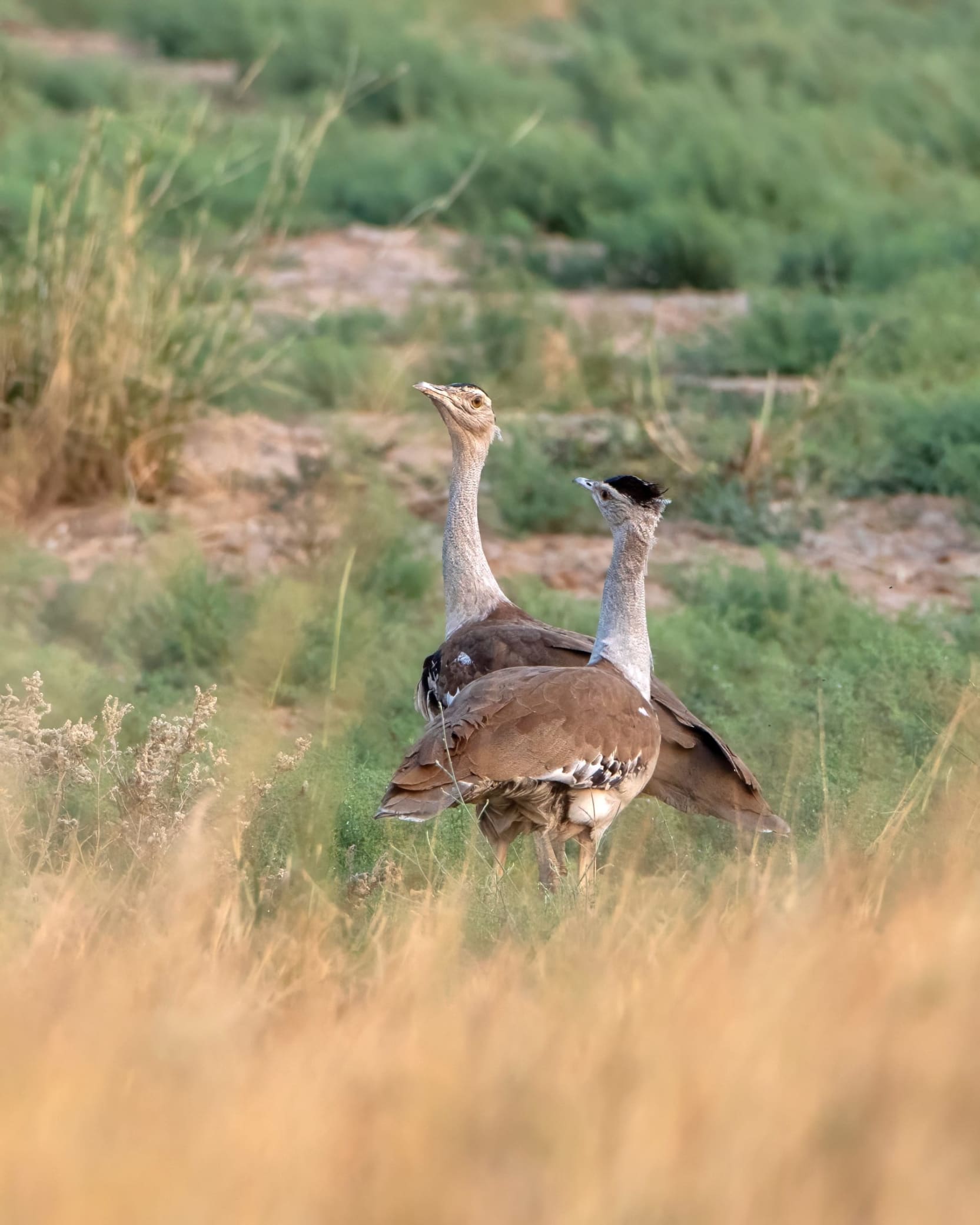
I must acknowledge that state forest departments exerted sincere effort to conserve the bird within the limits of their mandate, declaring eight sanctuaries and conservation reserves.Yet these measures could not control the wider landscapes beyond their boundaries – landscapes where the bustard spends most of its life. Nannaj in Solapur illustrates this dilemma poignantly. This site has enjoyed strong protection for nearly 45 years, and the reserve itself remains secure.4 But the world around it has transformed into a mosaic of settlements, industries, intensive farms, orchards, roads, canals and a lattice of transmission wires.
None of these new elements offer refuge to a species that requires wide, undisturbed grasslands. Rollapadu Grassland offers another telling example. When I observed 35–40 bustards there in 1983, the Andhra Pradesh Forest Department, under the energetic leadership of Pushp Kumar, swiftly notified a 6-square-kilometre sanctuary. Initial breeding successes lent an air of optimism, yet a quiet upheaval unfolded just beyond the sanctuary’s borders. A canal system and dam transformed agricultural practices, and with it the surrounding landscape. Today, only two solitary females are occasionally seen in Rollapadu – bereft of males, they are effectively ecologically extinct.
The species’ fate was confirmed rather starkly in 1991–92, when the last bustard at the Karera Wildlife Sanctuary died. A sanctuary bearing the bird’s name was left without its emblem. In its place now run canals and roads – the bustard is gone, but development advances inexorably. A similar tragedy unfolded in the Naliya grasslands of Gujarat.
In the early 2000s, I recall watching 10 or 11 adult males. Now, none survive; only three females remain, laying infertile eggs year after year – life prolonged, but hope extinguished. As long-living birds, bustards may endure for years after their breeding prospects have vanished, giving some observers the comforting illusion that the species still holds its ground. But a lone female at Nannaj – can it truly kindle hope for recovery?
In effect, history has repeated itself. The tragedy that occurred 60 to 100 years ago in the bird’s former territories of Haryana, Punjab, Uttar Pradesh and beyond has now unfolded in 5 of the 6 states where it lingered until a few decades ago in small numbers.
One of the subcontinent’s most stately birds, the Great Indian Bustard inhabits broad sun-drenched plains where the horizon stretches unbroken and the light falls clean upon the earth. It dwells in the arid and semi-arid realms of western India, where grasslands of 30–70 centimetres sway in tawny waves, dotted with low shrubs and bordered by great expanses of cultivation.8 Here, the wind carries the smell of dry soil and rustling grasses, and the bird moves across a landscape that appears empty to the hurried eye, yet hums with life for those who pause and listen.
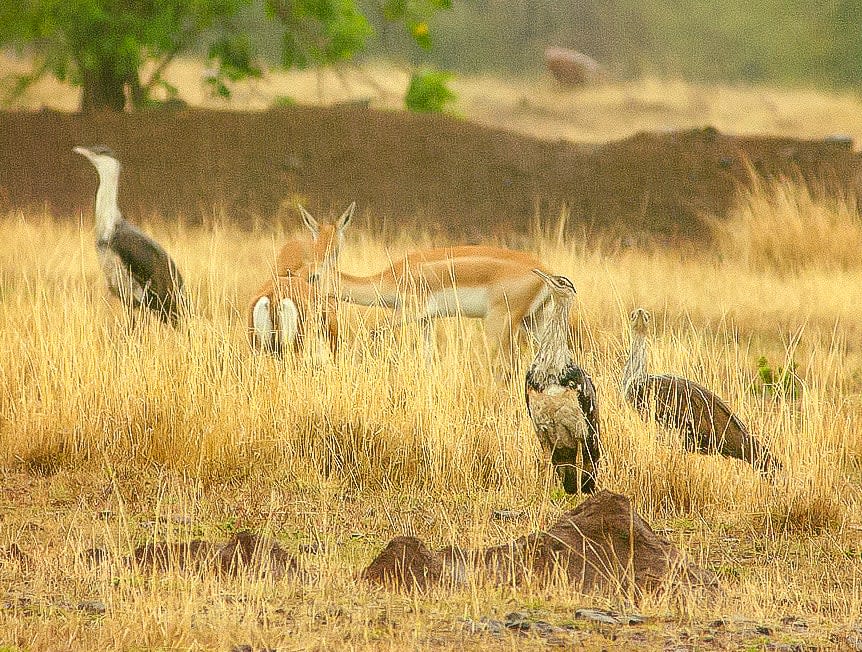
Its ecological needs shift with the season, each having its own rhythms of life. Outside the breeding months, the bustard wanders widely through a mosaic of fields, grass tracts and scrub, as though surveying its ancestral domain. But as the breeding season arrives – its timing differing from region to region – it gathers in long-established pockets of undisturbed grassland. These breeding grounds are a living tapestry: stands of tall grass, lightly grazed and favoured by nesting females for their sheltering veil, lie interwoven with cropped, low pastures where the males parade and display.
Despite their preference for partial concealment, females have at times been observed nesting in shorter vegetation. By day the bird prefers shaded spots for rest, yet roosts at night on bare ground beneath the stars. It is entirely diurnal, most active in the cool hush of dawn and again in the burnished glow of evening. During moonlit nights, the display calls of the territorial males can be heard, as I experienced many times while camping in the Sudasari area of Desert National Park. Its social life is marked by distinct segregation between the sexes; adult males move together, while females with juveniles form separate flocks. Male and female birds mingle mainly when breeding duties require them to be together. At roosting time, these gatherings are most conspicuous, a quiet congress of birds outlined against the fading sky.
The bustard feeds with the adaptability required of a true denizen of harsh landscapes. Its diet spans plant and animal matter alike: seeds of grasses, Ziziphus berries, Eruca sativa and cultivated crops including millets, groundnuts and legumes; and a broad array of animal prey such as orthopteran and coleopteran insects, lizards and small rodents. I have even seen it eating two eggs of the Chestnut-bellied Sandgrouse! Though the Great Indian Bustard is well suited to desert living, it drinks when water is found and does so more frequently under the fierce heat of summer.
With the onset of breeding, the males transform from austere wanderers into performers of remarkable spectacle.8 From chosen display sites they inflate their gular pouch, releasing deep, booming calls that carry far. Tails are cocked, feathers lifted and when rivals trespass, they meet in ritualized contests, the dust flying as though the earth itself were stirred by their rivalry. Yet for all this extravagance, reproduction remains slow: the female lays but a single egg upon bare ground, in isolation and without any assistance from the male in guarding the nest. She incubates for roughly 22–23 days, and the precocial chick, once hatched, takes its first unsteady steps into a world of peril. It fledges in about 45 days, remaining at its mother’s side for nearly a year, learning the art of survival from her quiet vigilance.
Excerpted with permission from Where Have the Birds Gone published by Indian Pitta, Juggernaut. Price: Rs 370



