Listen to this article
•
15:34 min
Listen to this article
•
15:34 min
“Once upon a time, the elephant and the human were good friends. One day, some children were playing at the riverbank when the elephant said, “Let me take a nap”, and fell asleep nearby. While the elephant slept, the children picked up a few crabs from the river and put them in the elephant’s trunk. The elephant woke up with a squealing trumpet, chased the children away, and went on to kill some humans in the area. Since this incident, elephants have been chasing and harassing humans whenever they see them.”
This Kadar folktale was recounted to me by Babitha, a member of a tribal community settled in the Vazhachal forest upstream of the Athirappilly Falls in Thrissur, Kerala. Once narrated to her by her grandmother, this story very simply encapsulates the human-elephant conflict in and around Athirappilly and across the Western Ghats.
Visiting Athirappilly in mid-December, I know I have little chance of seeing the famous waterfalls in full spate, but I hope to see a plethora of wildlife. When I arrive at Chalakkudy station one evening, I’m picked up by Akhil, a local who drives me to Athirappilly through a matrix of oil palm and rubber plantations interspersed with forest patches. In such a mixed landscape, humans and wildlife are often brought into close contact, and these interactions can sour when large mammals such as elephants are involved. On the way, Akhil tells me about an incident that occurred a few days earlier. In Chaippankuzhi, a town 10 km from Athirappilly, an old man encountered a herd of elephants on his way to a teashop and was trampled to death. The incident was followed by local protests, which claimed that the forest department had done little to prevent human-elephant conflict. News from the area highlights many such encounters between elephants and people (both tourists and locals).


Cover photo: The Chalakkudy-Anamalai road runs through Athirappilly’s matrix of plantations, homes, and forests, making it a likely stretch for human-wildlife encounters as elephants and other animals navigate between habitats.
Despite knowledge of such conflict, I continue to harbour a rather selfish desire to see elephants during my visit. This wish is granted almost immediately when local naturalist and guide, Nidheesh Chenchery, shows me around town. Driving down the main road early in the morning, Nidheesh receives a phone call informing him of an elephant sighting in an oil palm plantation nearby. I learn from him that there are several wildlife enthusiasts in town, many of whom are specifically fascinated by elephants. These people keep track of the herds and lone tuskers that frequent the area, naming each individual and following their rough movements. They inform each other of elephant sightings via a WhatsApp group, so interested folks can drop by to watch.
We slow to a halt when we see a tusker named Ganapathi working calmly on a toppled palm tree. Groups of people – a mix of locals and tourists – watch from a safe distance as he tears off pieces of the trunk and munches leisurely. Ganapathi and other elephants venture into the plantations from forests nearby, feed on oil palm and jackfruit, and return once they’ve had their fill. According to Nidheesh, the tuskers typically vanish deeper into the sanctuary when they enter musth, the periodic hormonal cycle male elephants experience after reaching maturity. While my interactions with the elephants of Athirappilly remain uneventful, the story doesn’t always unfold this way. Nidheesh tells me about sporadic incidents of young boys getting too close while filming elephants, thus triggering them to give chase. Such foolhardy attempts by a few people stress an already precarious relationship and are likely to worsen the situation for those who must coexist with elephants.


Nibu, an oil palm plantation worker in Vettilappara, sees these elephants a few times a month, but he tells me these sightings have become commonplace only in recent years. “When I was growing up in Kannamkuzhi, we used to walk 2-3 km into the forest to collect firewood. Even then, I never saw elephants. The tribal people (Kadars) living in the forest may have seen them more frequently, but we started seeing them near human settlements outside the forest only 10-15 years ago,” he says. According to Babitha, elephant behaviour inside the forest has changed as well. People from the Kadar community walk through the forest to collect non-timber forest products such as wild honey on a seasonal basis. Their run-ins with elephants have escalated recently, with the elephants becoming aggressive and attacking them. In early 2025, one such attack near the waterfall led to the deaths of two Kadars as they ran from the herd.
As human-dominated areas expand across the region, they tighten the noose on wildlife corridors that are meant to provide animals with safe passage between forest fragments. Major roads and steady traffic plying through forested areas have increasingly thrust elephants into contact with humans and may have altered their perception of humans as threats. This constant forced interaction could partly explain their change in behaviour, according to research by Friswold et al., published in the journal Ecology and Evolution in 2023. They show that increased stress-related vigilance and passive-aggressive behaviour occur among elephants that face more vehicles and higher noise levels at close quarters. The effect is evident not only in their attitudes towards pedestrians but also in their aggression towards vehicular traffic. In October 2025, vehicles along the Athirappilly-Malakkappara road slowly piled up on either side of Kabali, a 33-year-old elephant in musth who knocked a palm tree onto the road and stood feeding on it, holding up traffic for over 18 hours. Kabali is reported to have shown such behaviour in the past as well, having blocked an ambulance and injured a biker the previous year. Similar stories of elephants charging vehicles, knocking over parked cars, and destroying property continue to feature in the news and on social media.


Elephant populations have expanded their range across India, a trend documented in several studies. This expansion is likely driven by human-induced land-use change and habitat loss, bringing elephants into human-dominated areas that are unlikely to sustain them over the long term. Methods of conflict prevention, such as erecting physical barriers, are of little use if they are not consistently maintained. Sometimes people use firecrackers, bombs, and high-voltage live electric fences to deter elephants, which may injure or even kill them.
Despite the frequency of sightings in Athirappilly, locals don’t appear to blame the elephants for conflicts. Nibu states that elephants are startled when they unexpectedly encounter humans or vehicles and may destroy anything in their path when frightened. This thought echoes patterns seen in other parts of India, such as certain districts in Karnataka and North Bengal, where elephants are part and parcel of daily life. Rather than viewing these animals as the source of the problem, citizens believe that it is the responsibility of forest officials and the state government to properly implement measures that mitigate conflict.
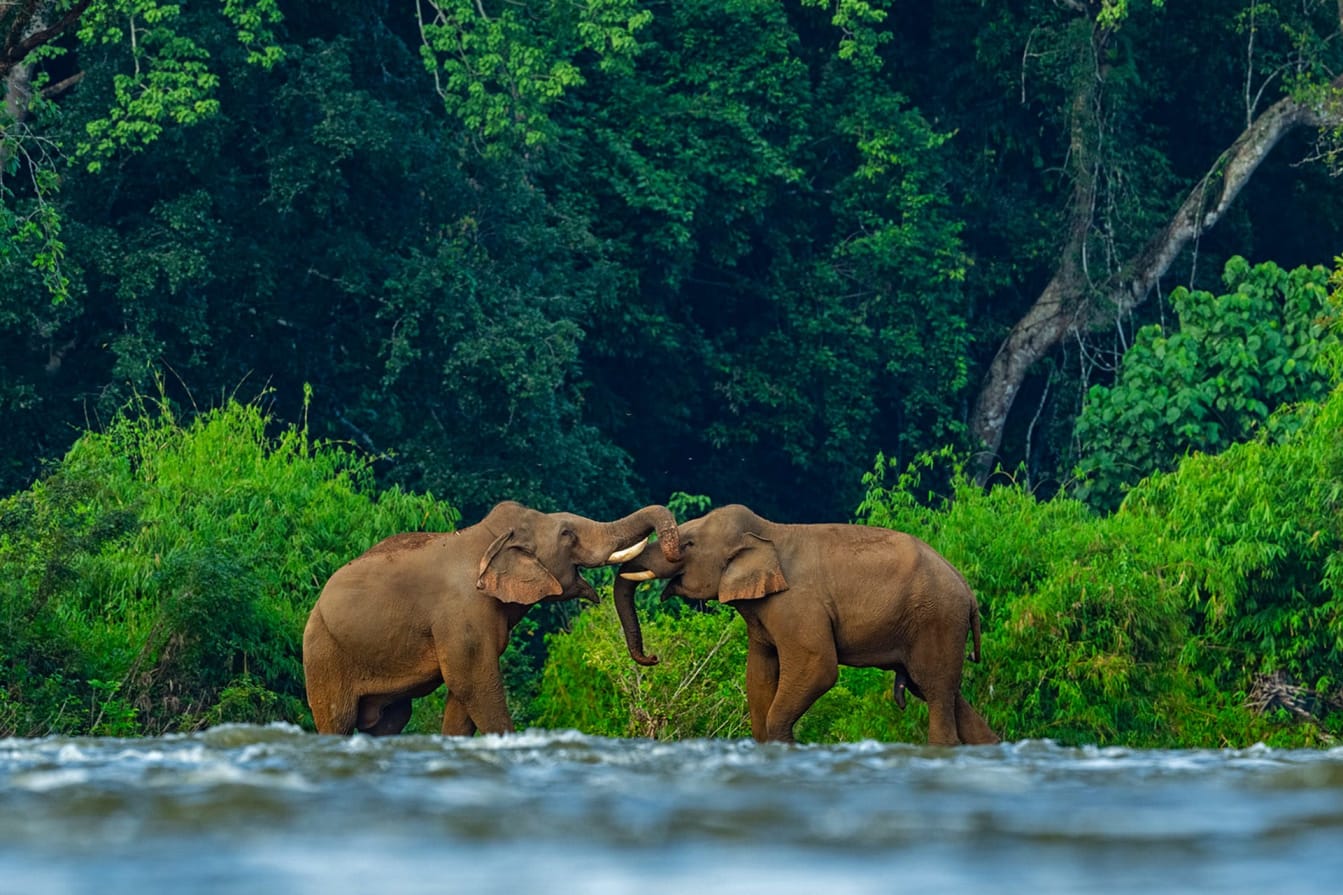

On my last day in Athirappilly, I join a long line of people watching a pair of elephants feed and meander through a plantation. In the fading evening light, one of the elephants twists his trunk along the ground, scooping up mud and letting it loose in a great red shower along his back. Watching him amble in the distance, it’s easy to see why people living alongside these animals continue to be fascinated by them. While it is heartening to see such positive attitudes towards elephants, fostering this understanding is only part of the solution.
The rapidly changing landscape of the Western Ghats has cascading effects on land use, pushing elephants into closer contact with humans. The effects of this sustained contact are felt primarily by people like the Kadars who live in and around forested areas, and whose lives have been intertwined with forest creatures for generations. In such changing habitats, preserving elephant corridors and ensuring that people behave responsibly around wild animals is crucial for minimising conflict.
The Kadar folktale narrated by Babitha succinctly illustrates that the people of Athirappilly understand the root cause of human-elephant conflict — a loss of mutual trust between the two species driven primarily by human actions. Real coexistence, however, cannot rely indefinitely on people’s considerate attitudes — it must be bolstered by actively examining the larger forces precipitating this issue in and around Athirappilly. The consistent implementation of conflict-prevention measures, when combined with how locals understand their elephantine neighbours, could go a long way towards safeguarding the future of both elephants and people in the Athirappilly landscape.
About the Authors

Smriti Mahesh
is a project assistant at BEE Lab in IISER Thiruvananthapuram. Besides deceiving ants for research purposes, she enjoys pottering about in the forest and fiddling aimlessly with her violin.