 Listen to this article
•
15:34 min
Listen to this article
•
15:34 min
At the centre of a triangle formed by Jaisalmer, Jodhpur, and Bikaner, lies a village where dust and heat linger between the motions of time. Between April and August, Khichan appears as just another settlement typical of the Thar, marked by an ageing fort and the slow passage of desert days.
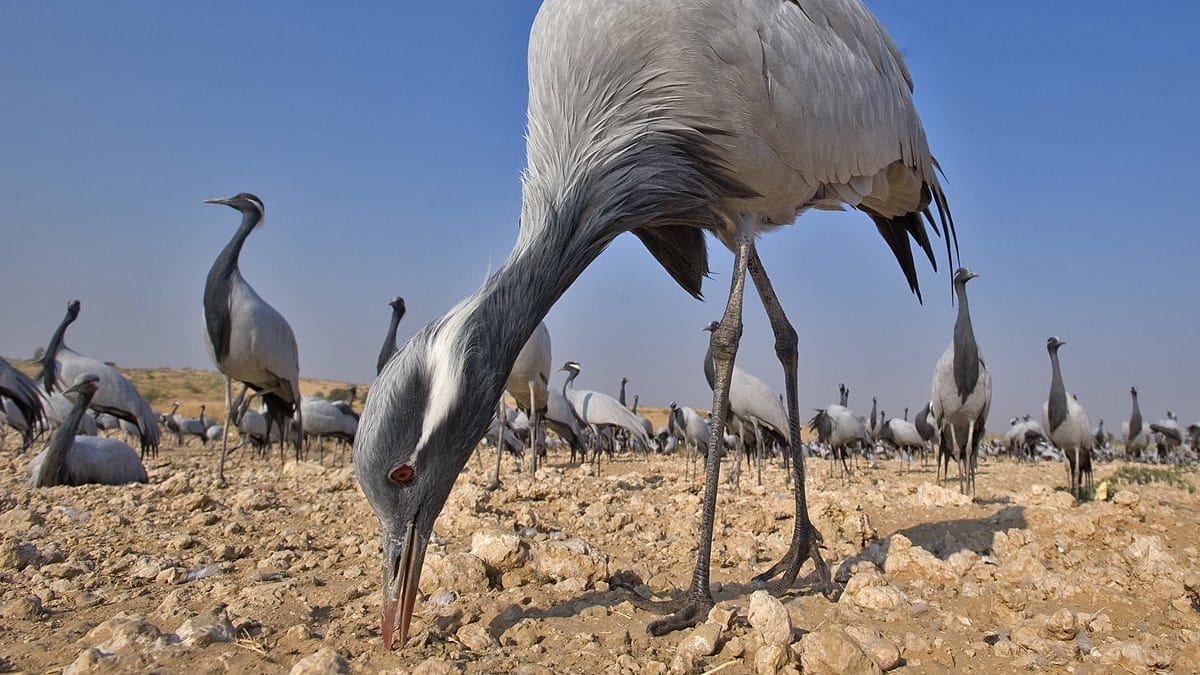
But in September, something transformational happens. The air resounds with guttural purrs and loud trumpets, as wave upon wave of demoiselle cranes (Grus virgo) descend from Central and East Asia. They turn Khichan into one of the most remarkable pilgrimage sites of feathered flesh in India.
Garbed in tasteful grey, black, and white, the visitors look as if they’ve nailed a MET Gala brief. They’re, of course, not here for “fashion’s biggest night”. The world’s smallest cranes have migrated thousands of kilometres — crossing the Taklamakan, the Hindu Kush, the Himalayas, and the Tibetan Plateau — to reach one of their wintering sites, for rest and bouts of feasting.
For 240 years, generations in Khichan have stood witness to the arrival and departure of these flocks. But their witnessing has never been passive.
Of Stewards and Acts of Stewardship
Khichan was established in 1741 as a jagir of the Akherajot Rajpurohits, land stewards under the Rathore dynasty. Khichan Kot, the local fort, still stands as a physical reminder of these beginnings: a testament to humble foundations and a way of life entwined with the desert.
“Our ancestors were fundamentally environment and bird lovers,” recalls Bikhamsingh Rajpurohit, retired bank manager and Rajpurohit community elder. “Under their rule, ponds were constructed, and a strict hunting ban was implemented to protect wildlife.”
Reservoirs like Vijaysagar Talab, Ratri and Teejaniyo ki Naadi met domestic water needs, while also serving migrating and local fauna. Fields were cultivated only in the monsoons, left open to wildlife in other seasons. Handfuls of grains scattered in the fort courtyard and a tolerance to crop raiding embodied the Rajpurohit ethos, “Unke hisse ka khaya” (they ate their share).

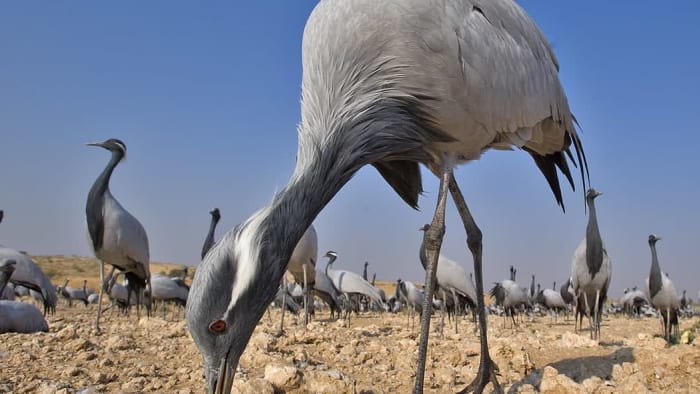
Cover photo: Demoiselle cranes are the world’s smallest cranes. English naturalist Eleazar Albin in his illustrated book- A Natural History of Birds, stated that these birds were “called Demoiselles by reason of certain ways of acting that it has, wherein it seems to imitate the Gestures of a Woman who affects a Grace in her Walking, Obeisances, and Dancing”
These principles and practices bolstered wild animal populations, including small numbers of the cranes, locally known as kurja, who came and went. Khichan thus stood in stark contrast to neighbouring Bikaner, where the Maharaja and his guests hunted demoiselle cranes, blackbuck and bar-headed geese in the wetlands of Tal Chhapar.
“Due to secure land ownership and the liberal views of the Rajpurohit landowners, the Jain community settled here and started businesses,” explains Bhikamsingh. The Jains brought with them financial resources and a deep cultural reverence for life. “They built beautiful artistic mansions, constructed hospitals and schools, and began feeding the birds,” he reflects.
The Birdman and the Feeding House
It wasn’t until the late 20th century, however, that Khichan truly became the “village of cranes”. In 1991, while conducting fieldwork on the great Indian bustard, Dr Asad Rahmani, of the Bombay Natural History Society (BNHS), met Ratanlal Maloo. Fondly nicknamed “Birdman of Khichan”, Ratanlal, a devout Jain, had instituted a feeding system for the visiting cranes.
“Once they started feeding them regularly, more and more cranes came, which became apparent in Ratanalal’s time,” says Dr Rahmani.
From a few dozen in the 1970s, their numbers swelled to thousands in subsequent years. In 1979, Ratanlal persuaded the panchayat to designate a dedicated feeding site. By 1983, the Chugga Ghar (feeding house) was established, stocked with jowar (sorghum) procured from across Rajasthan, even Gujarat.
After Ratanlal’s passing in 2009, Khichan’s Jain Samaj carried on his legacy. Premchand Jain, one of its members, describes their winter rituals, “In the peak season during December and February, we feed them 30 quintals of jowar every day. The cranes wait in batches outside, entering only once we leave. We are on duty from 6.30 until 10 am when they take off for the talabs,” he says.
What began as a handful of grains in the courtyard grew into a system so robust that by the winter of 2023, Khichan was feeding nearly 23,000 cranes, according to a report by Mali et. al. published in Journal of the Bombay Natural History Society (2023). Feeding them costs more than 50 lakh rupees annually, funded almost entirely by anonymous donations from Oswal Jains, industrialists who have migrated out of the village.

According to Dr Rahmani and other scientists at BNHS, the large-scale feeding doesn’t adversely affect the cranes, as grains form a natural and significant part of their diet. They do, however, suggest that some safeguards, such as regular testing for pesticide residue and periodic health screening of the cranes for diseases like avian influenza, are put in place. These precautions will help keep the tradition both responsible and sustainable from a conservation standpoint.
For the Jain Samaj, that responsibility is also deeply moral. Their 40-year-old system of charity remains guided by the Jain tenets of parasparopagraho jīvānām (souls render service to one another) and jiva-daya (compassion for all living beings).
And it doesn’t stop at feeding. When free-ranging dogs began attacking the cranes, the villagers, together with the Rajasthan Forest Department, fenced the Chugga Ghar and the main waterbodies. The two-metre-high fenced areas are patrolled jointly by locals and forest guards. In recognition, BirdLife International declared Khichan an Important Bird Area in 2004 for hosting around 4 per cent of the global wintering population of cranes.
“It is a collective wisdom of the villagers that has led to the cranes’ protection,” says Dr Rahmani. “But some people take more of a lead than others...”
Power Struggle: A Battle for the Cranes
The sun-rich, open expanse of the Thar has become prime acreage for renewable energy production, particularly solar and wind power. Threaded with dense webs of power infrastructure for electricity transmission and renewable energy projects, the desert is becoming a death trap for a multitude of birds.
The Thar, according to Dr Sujit Narwade, Deputy Director of BNHS, supports a wide range of wildlife, especially birds. It is found in the collective embrace of three important biogeographical regions — the Palearctic, the Oriental, and the Saharan — which contribute to its unique ecology. The desert also falls under the Central Asian Flyway, an important migration corridor for birds. “Migrating birds from the Middle East enter India through the Thar and Kutch. If they find everything suitable, they will stay here,” he says.
And they have. Demoiselle cranes adapt easily to grasslands, crop fields, and even deserts, provided there is some water about. In Dr Rahmani’s words, “They may forage in the crop fields and grasslands, or eat grains provided by villagers, but they have to go to the waterbody to drink, socialise and loaf about.”

Dr Narwade’s association with Khichan began in 2017 when the Jodhpur High Court intervened in a case about power lines and cranes. The court directed a committee of representatives from the Forest Department, BNHS, and the Wildlife Institute of India (WII) to investigate the on-ground situation. Khichan resident Sevaram Mali Parihar filed the petition.
A self-described “Bird lover, Bird rescuer, Wildlife Defender, Guardian, Illiterate,” Sevaram has been at it since 1997. “When I started my work, electricity wires crisscrossed the village. I wanted to remove them. Like people say, ‘polythene-free zone,’ I envisioned a Khichan free from dangerous electricity wires.”
Relentless in the pursuit of that vision, his petitions, hunger strikes, media outreach, and repeated court battles have had a lasting impact. Several high- and low-tension lines were removed or cabled. “I was responsible for the first undergrounding of an electricity line in Rajasthan. It was an 11KV line which had electrocuted 12 cranes in 2012,” he declares proudly.
The 2017 petition was his biggest victory. Acting on the expert committee’s advice, the High Court ordered five towers to be shifted, the Chugga Ghar expanded, and water provisioned in Vijaysagar talab and Ratri Naadi from the nearby lift canal. Most significantly, 250 acres of land were earmarked for India’s first Crane Conservation Reserve, which was declared in 2020. “Since then, three more high-tension lines have been placed underground, including one inside the Conservation Reserve, covering around 3,500 metres,” Sevaram adds.
The Keeper at the Gates, the Watcher in the Dark
Five years later, in June 2025, the momentum that had been building over centuries of care culminated in Vijaysagar Talab and Ratri Naadi being recognised as a Ramsar site. The designation acknowledges the fact that these desert waterbodies are lifelines for one of the world’s greatest migrations.
Though he dropped out of school after the 7th standard, Sevaram has meticulously recorded crane arrivals and departures, ringing and tagging data, media coverage, and court wins in multicoloured files at his home. “So much credit goes to him,” says Dr Narwade, who now advises both Sevaram and the local Forest Department. “Local community members like Sevaramji monitor, rescue, and ensure treatment for the cranes, continuously highlighting the issues they face.”

Ramsar recognition doesn’t shield the cranes from other dangers. In the Government Veterinary Hospital in Phalodi, Dr Bhagirat Soni, Veterinary Doctor, regularly treats injured and sick birds. “Every season I treat at least 100 birds,” he says as he examines two demoiselle cranes brought in by Sevaram. “After electrocution and dog attacks, pesticide poisoning is the next big killer. We’ve detected banned pesticides such as monocrotophos in dead birds.” He and Sevaram are now working with local farmers to raise awareness on this. “If the diet is good, the population remains resilient,” he affirms.
People like Ratanlal, Sevaram, Dr Soni, the Jain and Rajpurohit communities have safeguarded Khichan’s cranes for decades. Alongside scientists in BNHS and the forest department, they’re carrying forward a conservation legacy deep-rooted in cooperation. As Dr Soni puts it, “When you are connected with some living being, you are a better person.”
At dawn in October, Daoo Devi’s kitchen is already steaming — chai on the left, poha on the right. Her daughter Neha ushers the golden-hued tea in a mismatch of steel tumblers and ceramic cups out to her father, Sevaram, on their roof — like a baton being passed in a relay race.
Their terrace, despite the early hour, is an assembly point for a large gathering of bird enthusiasts who must be kept alert and warmed for what is to come. The dawn chorus that begins is suddenly discordant with honking. Sevaram beams, “Dekho KURJA…CRANES!”.
A version of this story was first commissioned by Frontline Magazine and published in the November 30, 2025 issue.
About the Authors

Rithika Fernandes
drives outreach and impact at Roundglass Sustain. With a background in ecology, she's drawn to the evolving relationships between people and nature.