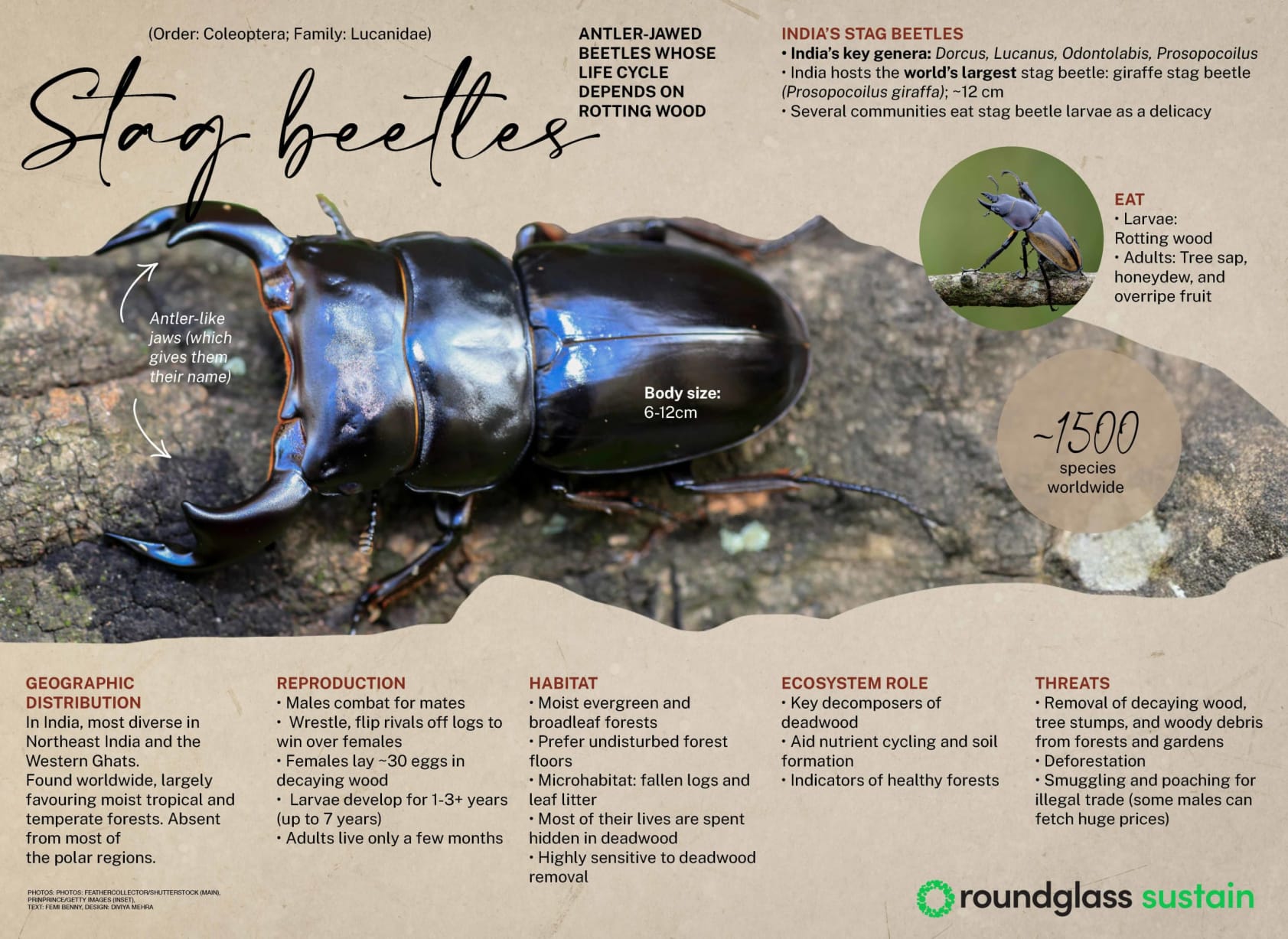
What are stag beetles?
Stag beetles have antler-like jaws which give them their name. Their larvae survive by eating rotting wood. Adults eat tree sap, honeydew and overripe fruit.
Are there stag beetles in India?
India is known for hosting the world's largest stag beetle: the giraffe stag beetle (Prosopocoilus giraffa). India's key genera of stag beetles includes Prosopocoilus, Dorcus, Lucanus and Odontolabis. Several communities in India eat stag beetles as a delicacy.
Where are stag beetles found?
Stag beetles are found in moist evergreen and broadleaf forests. They prefer undisturbed forest floor and make microhabitats in fallen logs and leaf litter. They are found worldwide, except in the polar regions. In India they are most diverse in Northeast and the Western Ghats.
What is the ecosystem role of stag beetles?
Stag beetles are key decomposers of deadwood, aiding nutrient cycling and soil formation. Stag beetles are indicators of a healthy forest.
About the Authors

Femi Ezhuthupallickal Benny
Femi is a PhD student at University College London (UCL), working on the ecology and behavior of Asian giant hornets. Passionate about insects, especially wasps, she loves fieldwork in underexplored places, studying how insects interact with their environment and discovering new species while at it!