
 Listen to this article
•
15:34 min
Listen to this article
•
15:34 min
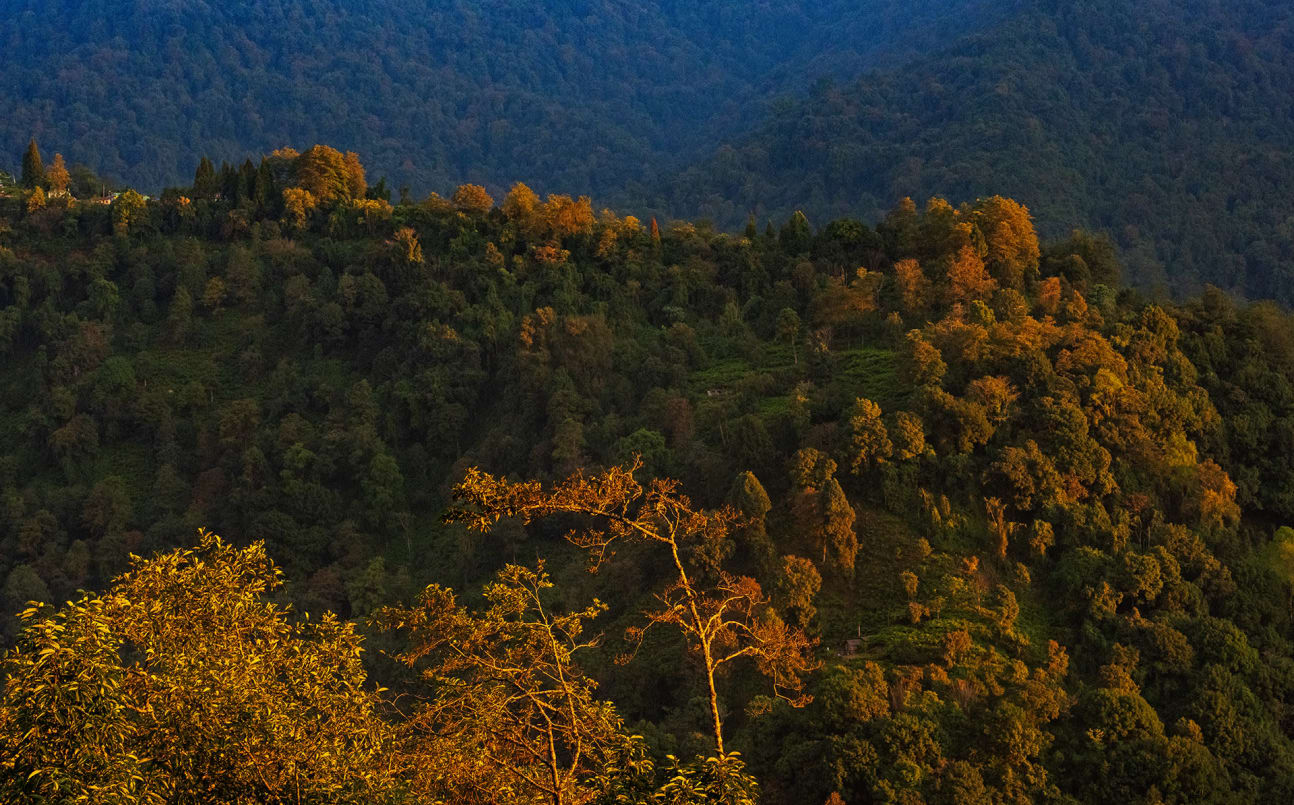
Our homestay in Phadamchen village in East Sikkim sits on a slope. From the backyard, the land drops into a dense subtropical broadleaf forest. From the steep valley, trees rise, their trunks studded with purple and pink orchids, wrapped in lianas, and scaled by shelf-like fungi holding beads of morning dew. Below, an under-construction road cuts through the forest. All afternoon, the grating of drill machines and cranes echoes across the valley. But Ranjit Subba, guide and resident, asks us to be patient. When the night falls, and the machines pause, a nocturnal, furry-tailed, beady-eyed rodent glides through the canopy.
At dusk, the sky first turns grey, then bursts into dramatic purples, pinks, and oranges, until the sun disappears behind the snow-clad peak of Kanchenjunga. Birds dart through a darkening forest. A honeyguide passes through the canopy. A red-faced liocichla emerges briefly. Green-backed tits move through the branches. Deeper in these forests, beyond the tar roads, Subba says, Himalayan black bears, red pandas, and leopards live.
I am here with wildlife photographer Dhritiman Mukherjee, filmmaker Siddarth Goswami, and Subba, who grew up near this village. Day turns to night. Fog hugs the forest. We grab a cup of steaming chai, pull out our torches and disappear into the mist. As we disperse, all I can see are halos of yellow light drifting through the dark. “Aa gaya! It’s here!” says one excited, glowing circle. It sounds a lot like Subba.
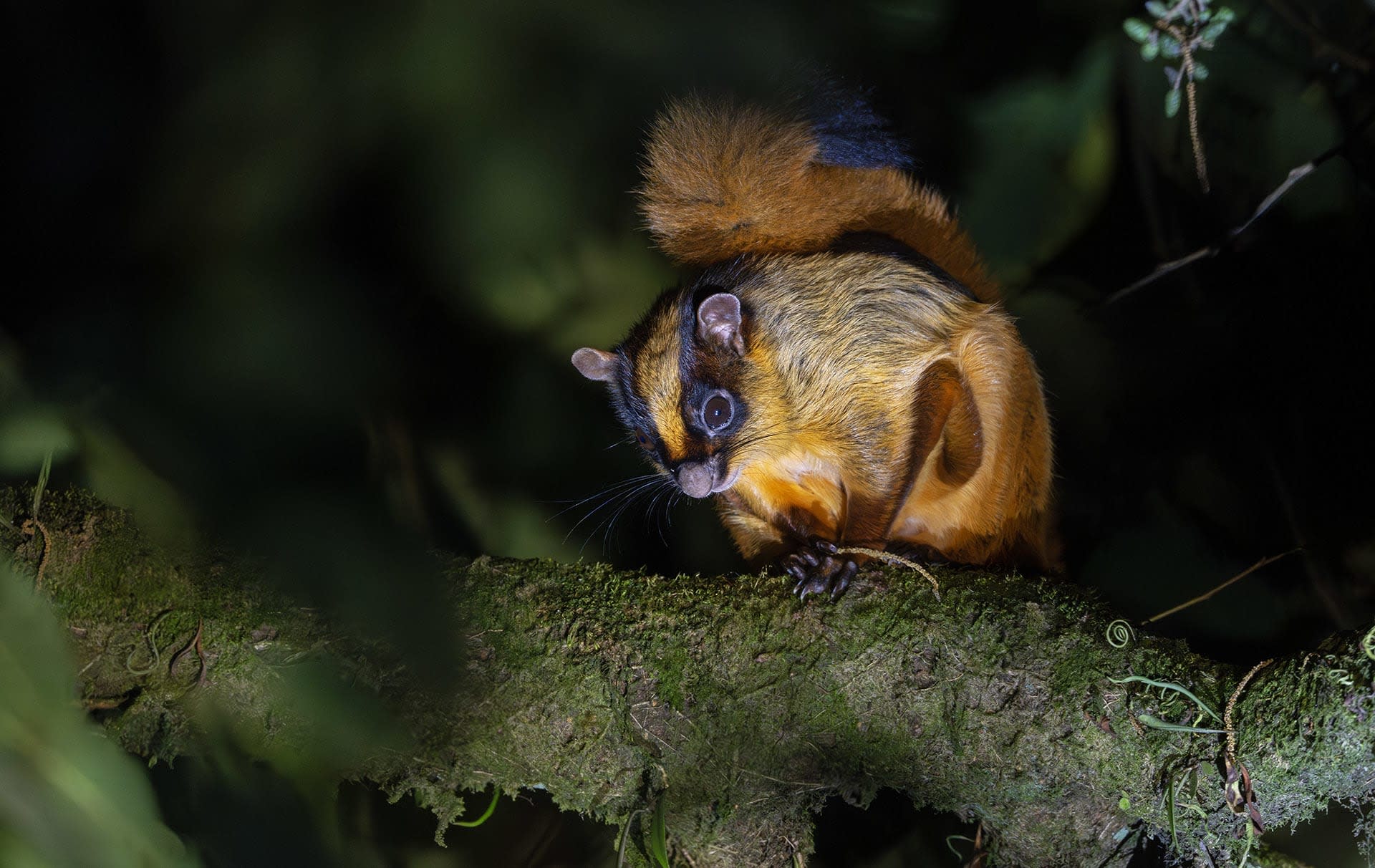
Cover photo: The Bhutan giant flying squirrel with its tail curved on its back.
A Glider in the Dark
We rush to Subba and follow his torch beam high into a dense canopy. Two eyes, like tiny festive string lights, shine. And then the Bhutan giant flying squirrel comes into focus, like a star under a spotlight— a supersized version of its city cousin, three times fatter, fluffier, and ridiculously cute. Mukherjee scrambles for his camera. Goswami sticks his tripod into the mud. Subba is calm. He has seen them in forests around his home in the neighbouring village of Nimachen since he was a child. He has always called it rajpankhi. In Nepali, “raj” stands for night, and “pankhi” for wings, he says. In several parts of the Northeast, especially in Assam and Sikkim, several species of gliding squirrels are referred to by this name.
Around 50 flying squirrels are found across the world. The tropical forests of South Asia are a hotspot with over 40 species found here. The Bhutan giant flying squirrel (Petaurista nobilis) is restricted to a narrow range in the Eastern Himalayas, from Bhutan, Nepal, and Sikkim, northern West Bengal, and Arunachal Pradesh in India. The species prefers mountainous forests between 1,500 and 3,700 metres. Phadamchen sits at about 2,400 metres.
The Bhutan giant flying squirrel is one of the largest gliding squirrels. Stretched from the tip of its nose to tail, it can reach almost four feet in length. But you rarely see it stretched like that. Most of the time, it is curled high in the trees, like a stubby ball of fur.
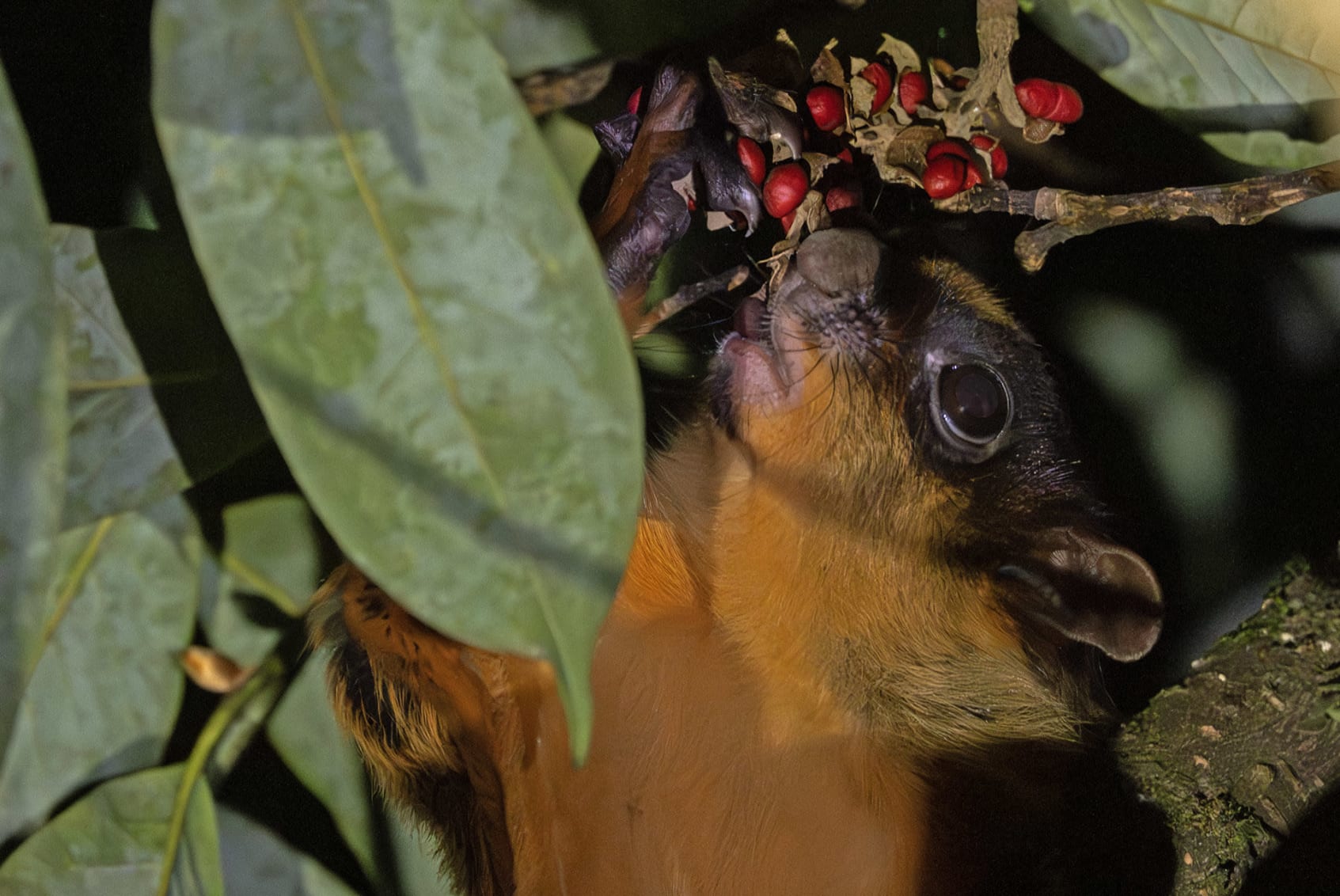
In the beam of our torches, its colours stand out. The shoulders glow orange-buff while a deep chestnut “saddle” or fat column runs along its back. For several minutes, it grooms itself, licking its limbs in long slurps. Then it tucks its tail over its head, like someone rolling up sleeves before a hearty meal, and with dexterous fingers plucks leaves and seeds. Subba mentions that the squirrel loves chaap (Magnolia champaca) trees (commonly champa in other parts of the country). Though primarily a folivore, or leaf-eater, it has also been observed feeding on bark, fruits, and sap from tree trunks.


“Gliding squirrels are nocturnal and show bimodal feeding, with peaks at certain times of the day,” says Murali Krishna, a small mammal ecologist who has been studying gliding squirrels in the Indian Himalayas. The squirrel feeds most intensely when it first wakes at dusk. After periods of rest, it moves through the canopy, occasionally chasing other squirrels. Just before dawn, it feeds heavily again, storing enough energy to last through the daylight hours when it sleeps in tree hollows or nests made from clusters of leaves high in the canopy.
In the winter, the chaap’s dry pods split open to reveal red seeds. Flying squirrels are considered seed predators since they consume seeds as a food source, but they also help plants reproduce by dropping seeds that regenerate forests. For several minutes, we watch the squirrel gingerly pick them out, discard the pod and chomp furiously. Just as it reminds me of the urban squirrel, the furball flattens into a flying carpet, the folds beneath its arms pulled tight. Its large face suddenly looks small compared to its stretched-out body with its curved tail sticking out behind like a rudder. Slowly, a grey shadow takes flight and sails above us, across the road, before it lands softly on the other side. We follow it with our torchlight, but it vanishes quickly. We are back to square one, walking slowly through the dark, searching for eyeshine.

A Parachuting Patagium
The Bhutan giant flying squirrel, like other squirrels, glides using a furry membrane called a patagium that stretches from the wrists of its forelimbs to the ankles. In a single flight, it can travel for 100-200 metres. Scientists suggest that squirrels may have evolved the patagium both as a strategy and a defence. “Gliding is thought to have evolved both as a way to escape predators on land and as an energy-efficient way to travel along the canopy,” says Murali.
When it leaps and spreads its legs, the membrane opens into a broad surface that generates lift, like a paper plane catching air. It adjusts its limbs and uses its long bushy tail as a rudder to steer. The tail also acts as an “air brake”, helping the squirrel slow down before landing. “All gliding squirrels glide with precision, almost always landing on a clean part of the trunk or large branches with intention,” says Murali. In reality, the animal doesn’t “fly” at all, but glides. He has therefore started calling it the Bhutan giant gliding squirrel in his research papers, which is technically accurate, “but very unhelpful if you are trying to find my papers online. It just doesn’t show up on search engines as they are popularly termed as flying squirrels globally,” he says.
Over the course of the night, we follow rustling in the trees and flying carpets, turning into awkward, fumbling acrobats. Mukherjee climbs over the open ledge of a roof, and we cautiously follow behind. We knock on the cook’s door, startling him, before sticking our necks and lenses out of his only window for a better view of a recent rustle. We stand between two garbage dumps, our shoes digging into rotting vegetable waste, while our torches firmly point skywards. We scale the steep road, then scramble back down, and up again, and then back down. Four hopeful halos floating in a valley on a misty December night.
And then we spot two locked in a thrilling chase, racing up and down a tree trunk. We gasp as they chase, jump, and glide with incredible agility.
A Case of Data Deficiency
Despite the drama we witness, we know very little about the squirrel itself. It breeds from February to March, but little is known of its courtship or breeding behaviour. It is listed as “Near Threatened” by the IUCN, and its numbers are declining because of logging, mining, and human expansion. More needs to be done for its conservation.
Studying flying squirrels is particularly difficult, says Murali. They emerge only after dark, and the most reliable way to find them is through “spotlighting” or scanning an impossibly dense canopy for eyeshine. When Murali first began studying the giant squirrels in Namdapha National Park in Arunachal Pradesh, electricity was scarce. He relied on solar-powered torches to search for them at night. And without proper roads leading into the forest, most surveys had to be done from village tracks, limiting how far researchers could travel. “You can expect neck pain from all the looking up you do,” he jokes. Giant flying squirrels are typically strict forest dwellers and mostly arboreal but also appear close to human settlements in some areas. Around Namdapha, for instance, they have been observed near villages, sometimes licking kitchen waste or food scraps. “My basic observation is that they seem to be drawn to the salt,” says Murali. Like many rodents, they appear capable of adapting to some disturbance. How much disturbance they can tolerate, however, remains largely unknown. There are very few studies that are done in these parts.
That night, for four long hours along a one-kilometre stretch of pockmarked road, we see at least eight or nine flying squirrels feeding, grooming, and gliding. Our excitement ebbs and flows, often reaching a crescendo when one takes off from the edge of the road to cross over. As the temperature drops closer to midnight, the squirrels settle down. Their fat tails, which steered them mid-flight, are now tucked in like a muffler, curling over their back and resting on their heads like a mohawk. They sit motionless, like round statues. It is time for us to wrap up, too.
About the Authors