 Listen to this article
•
15:34 min
Listen to this article
•
15:34 min
COVID gave us a lot of grief and loss, but it also gave us Work from Home (WFH), which has become the new normal. However, one species is the OG of WFH, even its common English name is based on this. It is none other than the ubiquitous, just around the bookshelf, common house gecko (Hemidactylus frenatus). There are 221 species of geckos in India, with new species being discovered nearly every year, but only a few species can live in close proximity to humans.
While adjusting space on an old bookshelf, I found signs of another book lover, or rather bookshelf lover, the common house gecko (or Asian house gecko). There were broken eggshells, roughly the size of a small coin. Clearly a sign that not so long ago, baby geckos had successfully hatched and were now prowling the house, devouring insects.

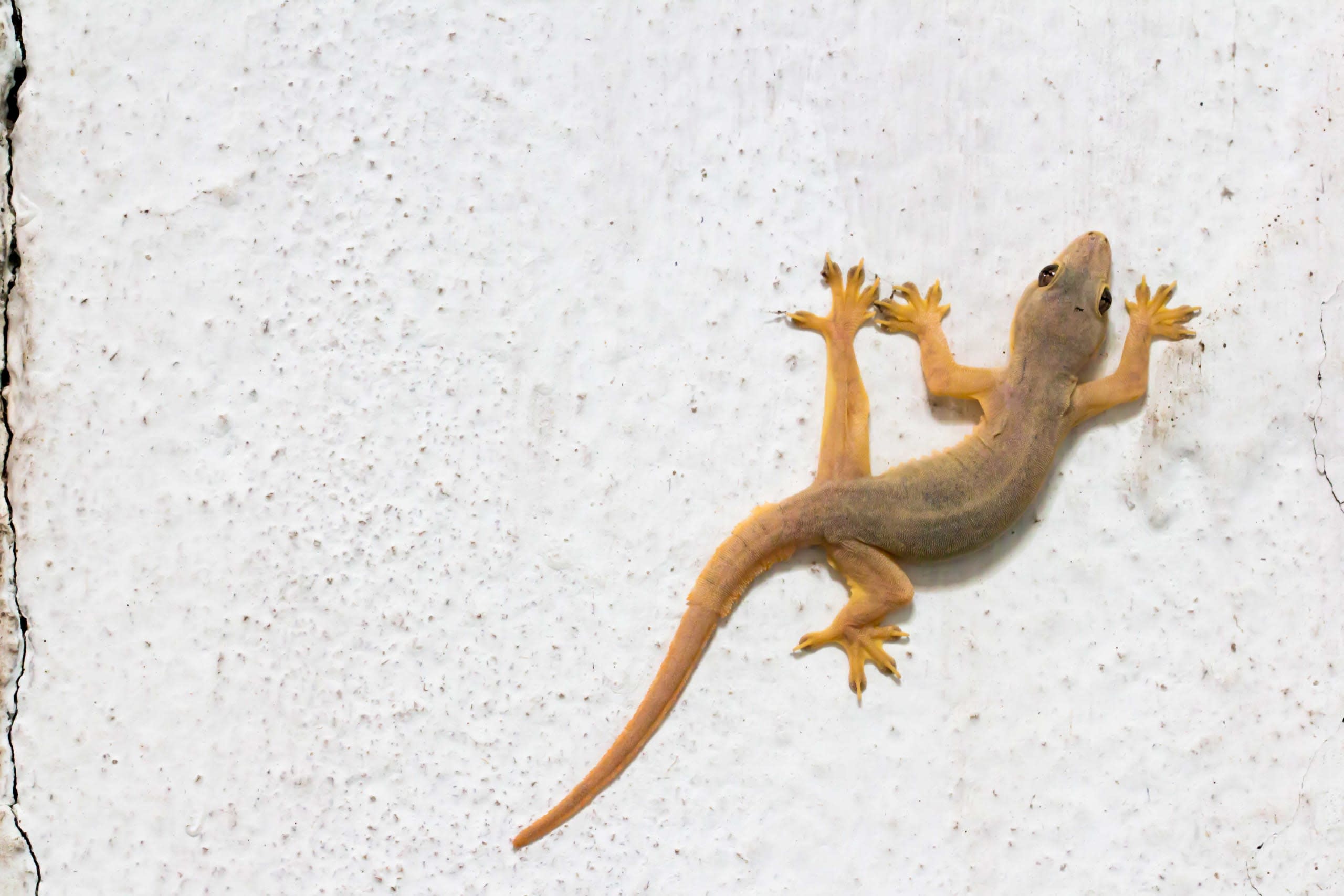
Cover Photo: House geckos that live on white walls are usually pale yellowish. Photo: juffy/Getty Image
Everyone seems to know at least one person with an extreme gecko phobia. I remember the time a friend discovered a gecko just above the door of the room she was in. She screeched, attracting everybody in the house. However, the door was latched from the inside, and in her extreme panic, she was unable to come close enough to open it. I don’t remember how we finally got her out, but I’m sure the poor gecko was traumatised by her screams.
This phobia is an unjust reaction to the house gecko’s mere presence. It is actually one of the most interesting creatures you will come across. It exhibits skills that put Spider-Man to shame, as it is almost always walking on plain vertical walls and often darts upside down across ceilings, defying gravity. Have you wondered why it doesn’t fall? This is thanks to the large number of nanoscale hairs (setae) that line every toe. Taken together, the millions of setae on a single gecko can theoretically generate enough force to support the weight of two 60 kg humans. This fantastic adaptation of geckos has inspired scientists to look for ways to mimic this cling-ability, improving everything from medical bandages to self-cleaning tyres, and even designing gecko-inspired wall-crawling robots.


Geckos have another unique trait. They can voluntarily discard their tail. I remember as a child harassing a gecko and being horrified to suddenly find a desperately wriggling tail left behind by an awkward, tailless gecko scrambling away. Typically, the tail is discarded when the gecko is under attack; it continues to wriggle rapidly, distracting the predator, who then attacks the tail instead, giving the gecko enough time to escape. How do geckos do this? Geckos are born with a line of weakness in their tail (fracture plane). If a point on the tail is hit or stressed, the muscles along the fracture plane pull away from one another — this is known as a reflex muscle spasm — causing the tail to fall off. This behaviour is called self-amputation (or autonomy), and there is no blood loss. However, losing a tail is a big loss for the gecko. It is an energy-intensive process to regrow a whole tail, but the tail also stores nutrients and fat and acts as a protection against times when food is scarce. Additionally, it acts like a fifth leg, helping the gecko negotiate its gravity-defying lifestyle. Despite this profound loss, the gecko would rather lose its tail than its life. The lost tail skeleton is replaced by a rod of cartilage with new muscles growing along it. The tail regrows over six months to a year, though it’s usually shorter and lighter coloured than the original.
Encounters with pale-coloured geckos comfortably perched upside down on the ceiling and abandoned tails wriggling away have probably inspired the instinctive fear many humans feel toward them. There are also other completely unfounded fears that house geckos are poisonous.

Geckos are peaceful, like to be left alone to quietly go about their insect business, except during the breeding season, when you can hear their “chuck chuck chuck” sound for hours. They are primarily nocturnal, and when you find them in the day, all they want to do is to scramble away into a dark nook or corner. Their eyes are up to 350 times more sensitive to light than human eyes. In bright light, the pupil appears like a narrow vertical slit; under dim light, the pupil is round and fully open. House geckos don’t have eyelids; they have fixed membranes that cover their eyeballs. They lick this membrane to keep it clean and moist.
Geckos don’t want to be seen and will take on the colour of their surroundings. Those found in darker nooks with wood or brick surfaces will have a darker, speckled-brown look. Inside homes, they take a light cream or pinkish, partly transparent look. Researchers have found that their skin (not their eyes) senses their surroundings and changes colour/pattern to resemble it. Their greatest love in life is the tube light and bulb, which they defend as their exclusive territory against other geckos. The tube lights and bulbs return the love by attracting insects, which the gecko happily devours. Like frogs, geckos’ tongues are made of long, flexible muscle with a stickiness at the end that grabs prey. Though sometimes they simply snap their mouths at the intended victim and catch it in their jaws. Geckos are insect-catching machines, consuming up to 50 insects in a day/night and between 63-109 mosquitoes per day (in an experiment), helping keep our homes insect-free.
Despite being a nature lover, I admit I was once a bit scared of the common house gecko, but now, I look forward to saying hi to this beautiful, peaceful, and truly unique creature. Lately, I have seen some young geckos scrambling around my house; they may have come from the eggs I saw in the bookshelf. I feel grateful that the ultimate WFH specialists are around and that they find our home a safe place to live in and procreate.