Listen to this article
•
15:34 min
Listen to this article
•
15:34 min
For many, “intelligence” conjures up an image of a brain. Few, perhaps none, would think of a blob of slime creeping slowly across damp soil, leaf litter, rotting wood, desert sands, or even surviving under the snowpack in the Arctic.
Sounds like alien-centric science fiction? It’s not.
Slime moulds are not plants, animals, or fungi. Slime moulds are myxomycetes: tiny, unusual organisms that feed on decaying matter and other microorganisms. They can live as single cells but also form multi-celled masses that behave like a single creature with no brain or nervous system. And yet, they can solve puzzles, build efficient transport networks, adapt to changing conditions, and even exhibit learning and memory.
Slime moulds have forced humans to rethink what “intelligence” can mean. They also serve as a reminder that nature works in stranger and perhaps smarter ways than we imagine.
What is a slime mould?
Despite their name, slime moulds are not fungi or mould. They are more closely related to amoebas than fungi and belong to a group of organisms called Amoebozoa.
One species of slime mould, Physarum polycephalum, begins life as an individual cell. Later, many cells fuse and form a large swarm that merges into a single giant cell called a plasmodium, the feeding and growing (vegetative) stage of this myxomycete. This giant cell may range from a few centimetres to several square metres and often appears as a brightly coloured network of slime. It moves around by pushing cytoplasm (the jelly-like material inside every living cell) back and forth in rhythmic, pulsing waves.


Cover Photo: Anvay Nakade
As it creeps around, its whole surface detects physical and chemical signals from its surroundings. These signals tweak the rhythm and direction of the cytoplasm pulsing inside it. When it senses food, the internal pathways leading toward that smell get reinforced and pulse stronger, while useless pathways fade away. This automatic feedback loop smoothly guides the organism straight to its meal.
Survival and reproduction
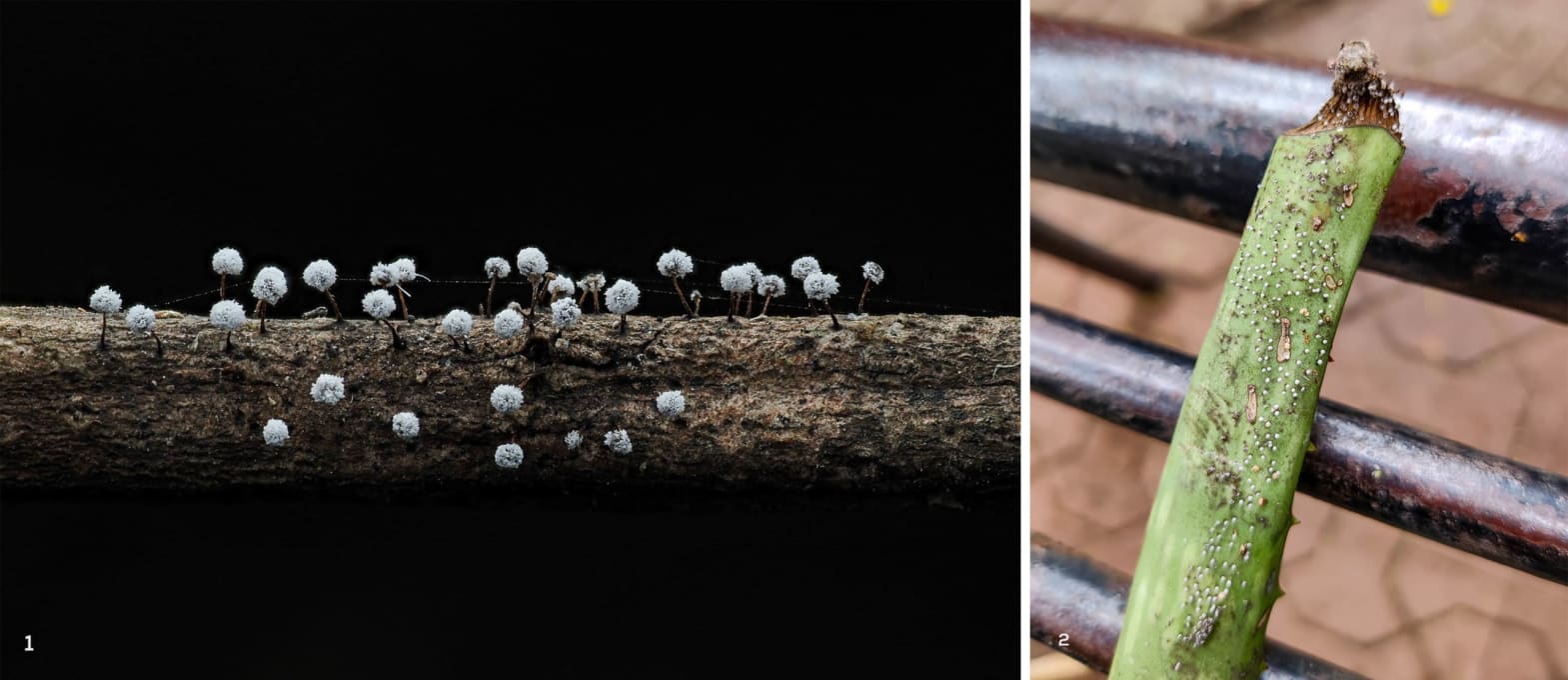
When food is scarce, or conditions become harsh, the plasmodium forms a “fruiting body”. This consists of a base and stalk made of dead cells, and a bulbous top filled with dormant spores. Wind and water disperse these spores to new places where they germinate into single-celled organisms that eventually aggregate to form a new plasmodium and continue the life cycle.
Ecological role
Overall, slime moulds are vital to maintaining healthy soil and the functioning of various ecosystems. They have two important ecological roles. First, they act as nature’s clean-up crew by feeding on decaying organic matter; and second, they are predators that feed on bacteria and fungi, keeping their populations in check.
How do slime moulds “think”?
Slime moulds solve problems using the principles of basic physics and chemistry. Scientists describe their “thought processes” and behaviour as “distributed cognition” or “embodied intelligence”. Simply put, this means their entire body processes information. As they move, their body constantly scans the environment for physical and chemical signals.
The slime mould doesn’t “decide” to find food in the way a human chooses to go to the kitchen. Instead, its “thoughts” are just physical reactions — chemical signals changing the flow of cytoplasm until the most efficient path to food is the only one left.


Therefore, the “decision-making” emerges from simple local interactions rather than any central command system. In other words, the slime mould does not “plan” in the human sense. Instead, intelligence emerges from the network itself.
This form of decentralised problem-solving also appears in ant colonies and flocks of birds, where no single part controls the whole system, yet coordinated behaviour emerges collectively.
Solving mazes without a brain: optimising networks for urban planning
Japanese researchers first reported slime moulds’ ability to solve mazes in 2000, when they placed a slime mould inside a plastic maze with food at the two openings. There were four possible solutions, each of different lengths, to get from one opening to the other. The slime moulds chose the shortest route every single time.
As the organism spread through the maze, it explored several possible paths. Over time, it withdrew from dead ends and strengthened the most efficient route connecting to food sources.
The experiment amazed scientists because the slime mould appeared to be “computing” a solution without any brain. This stunning ability arises from local interactions that reinforce feedback loops within the plasmodium, so the entire network reorganises itself into an optimised structure.


For engineers and computer scientists, slime moulds became an unlikely model for solving complex optimisation problems. One such problem was balancing efficiency and connectivity in urban planning. In another famous experiment, scientists placed oat flakes on a flat map representing the locations of stations in cities around Tokyo. When scientists placed it at the centre of the map, it grew towards the food, forming a network of connections between them. Remarkably, this network closely resembled Tokyo’s railway system. The slime mould arrived at a surprisingly efficient solution simply by responding to local conditions, while Tokyo’s railway network was designed over decades by engineers and planners.
Now, researchers use slime moulds to solve problems in transportation, logistics, and communication networks. Unlike rigid centralised systems, slime mould networks can adapt quickly when disrupted; if one path is damaged, resources flow through alternative routes.
Learning without neurons
An even stranger discovery about slime moulds, beyond their problem-solving skills, is that they can learn.
When researchers exposed slime moulds to salt, which is harmless but unpleasant to them, these organisms “learned” to tolerate it. At first, the slime moulds retreated by dramatically shrinking away from a salt barrier, but after repeated exposure, they stopped retreating and crossed the barrier.

Surprisingly, scientists found that this “learned” behaviour was retained as a “memory” for at least one month. Even more surprising was the discovery that this “memory” could be transferred when one slime mould fused with another.
These findings challenge long-held assumptions about intelligence and memory, suggesting that they may arise simply from the way living things interact with each other and their environments rather than a centralised brain system.
Sustainability lessons from a thinking slime?
At first glance, slime moulds may seem too alien and obscure to teach humans anything useful. But their behaviour can offer powerful sustainability lessons.
Simply put, slime moulds achieve efficiency simply by adapting to changing conditions and building resilient networks. They avoid single points of failure and solve problems by having different parts of the organism respond to local conditions through decentralised intelligence.
As climate change creates more unpredictable conditions, the flexibility of slime mould networks may offer ideas for building roads, transport systems and other infrastructure that can adapt to change. Perhaps resilience, whether in forests, cities, or societies, comes not from control but from connection.
For an organism without a brain, slime moulds certainly have surprisingly profound things to teach us about planning, efficiency, and resilience.
About the Author