 Listen to this article
•
15:34 min
Listen to this article
•
15:34 min
Before dawn sighs over the Kro mountains, in the shadows of a sacred oak forest, a gathering commences. A simple stage has been prepared: prayer flags contrast starkly with the whitewashed stone walls of the courtyard of Lagang Gompa, a Buddhist monastery
The green mountains gleam from a polishing by the monsoons the night before.
Lagang Gompa sits inside Shergaon, a village in Arunachal Pradesh’s West Kameng district located on the slopes of the Eastern Himalayas. Temperate broad-leaf and mixed forests of oak, rhododendron, pine and fir hide an understorey of medicinal plants, clouded leopards, marbled cats, red pandas, Asiatic black bears and other elusive wildlife.
The elders take their places. One holds brass cymbals, chelm. Another steadies the ching, a sheepskin drum, by its tall handle carved with ornate patterns. They are the dance masters. They mark the North, setting the ritualistic compass of what is to come. The ching-kho, a hooked drumstick, strikes the ching. The cymbals clash. A rhythm is set. In the diffused light, a pantomime begins.

Two figures wearing black, fierce, skeleton masks with even fiercer black wooden phalluses thrust themselves into the courtyard. They kick their legs, flex their arms and rock their pelvises, following the pace of the chelm and ching. The sun rises, bathing the dancing skeletons in light as they spread metaphorical seed all around the courtyard. So begins a living story told through masks, dance and ceremony on the day of Prewdo Chepchi.
Shergaon is the southern bastion of the Sherdukpen tribe, a small Buddhist-animist community that number about 6000. Despite their small size, they have their own language, faith traditions (although Buddhism is now a significant religion), and customary laws which guide everyday decisions. For the Sherdukpens, the forests are a managed commons that encompass a mosaic of community woods, grazing grounds and sacred groves. Their village council, the Jung, still largely regulates access to the forests, rivers and wild game. Religious beliefs reinforce these rules. Taboos and totems limit hunting and harvesting of certain species. Sacred days keep people out of forests, rivers and fields on the 8th, 15th and 30th day of each lunar month. The sacred oak forest that overlooks the Gompa remains untouched because logging and hunting are forbidden there. These customs together, form an ethic of use and pause, that links spiritual duty with ecological care.
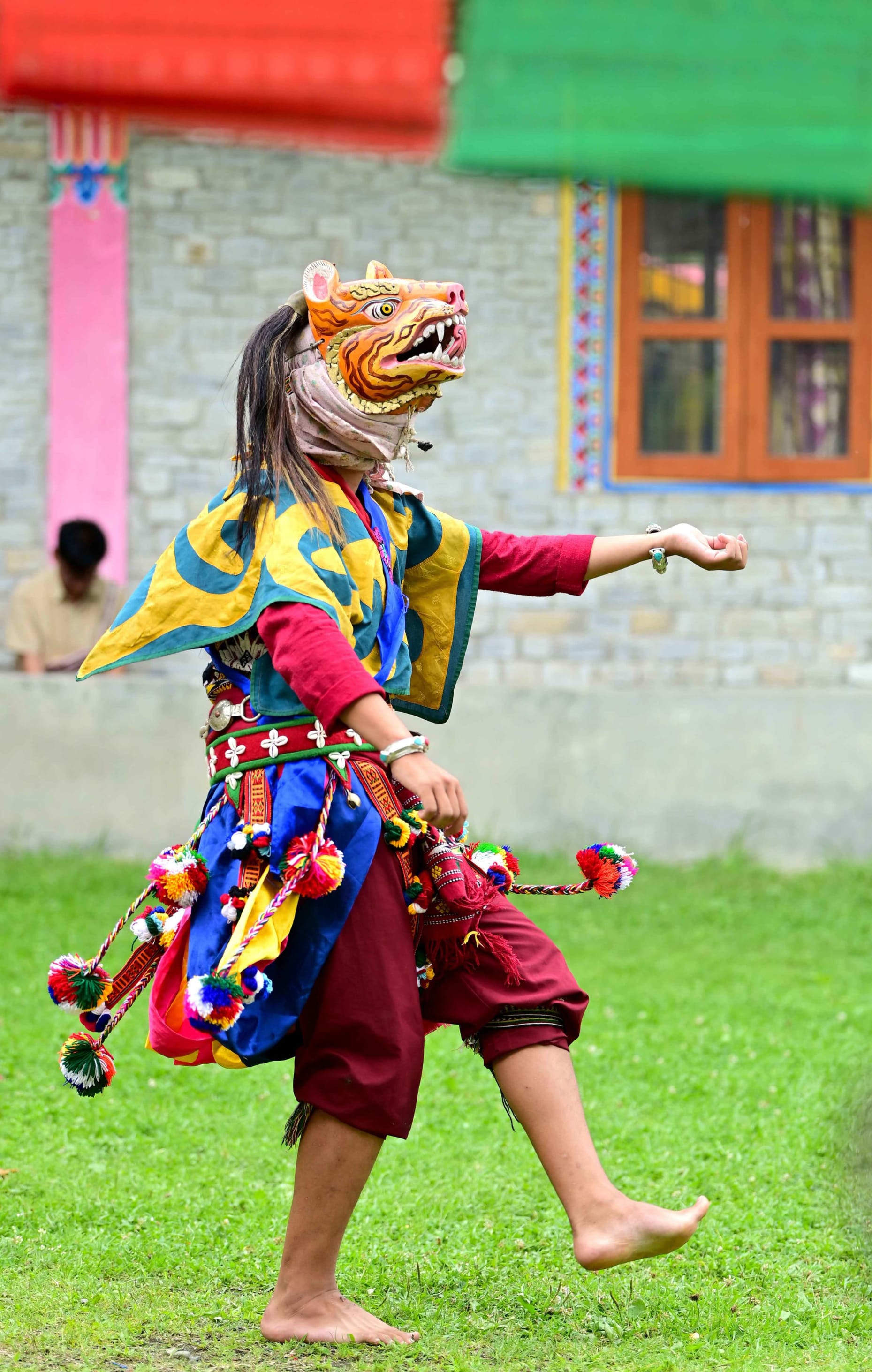
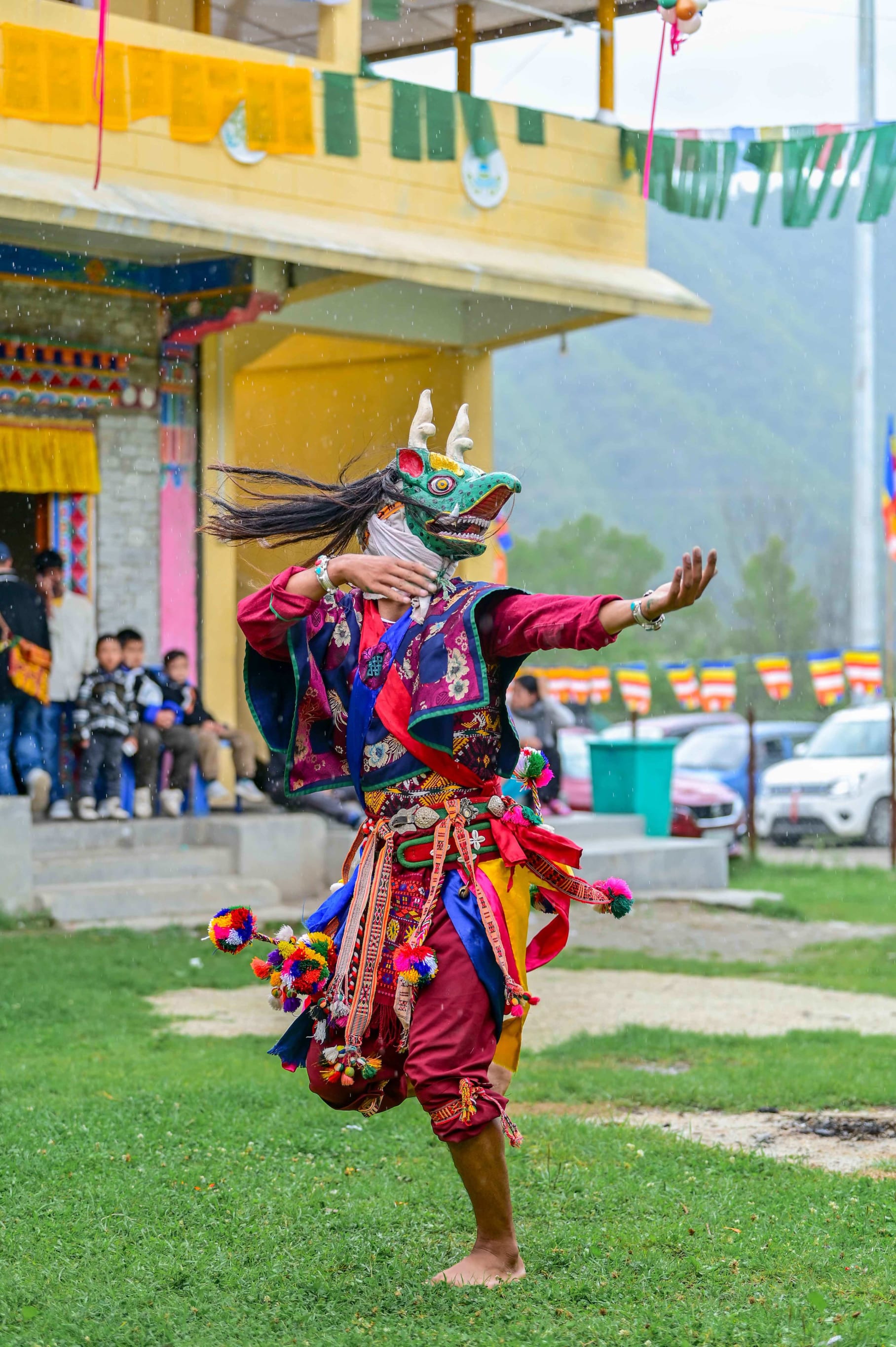

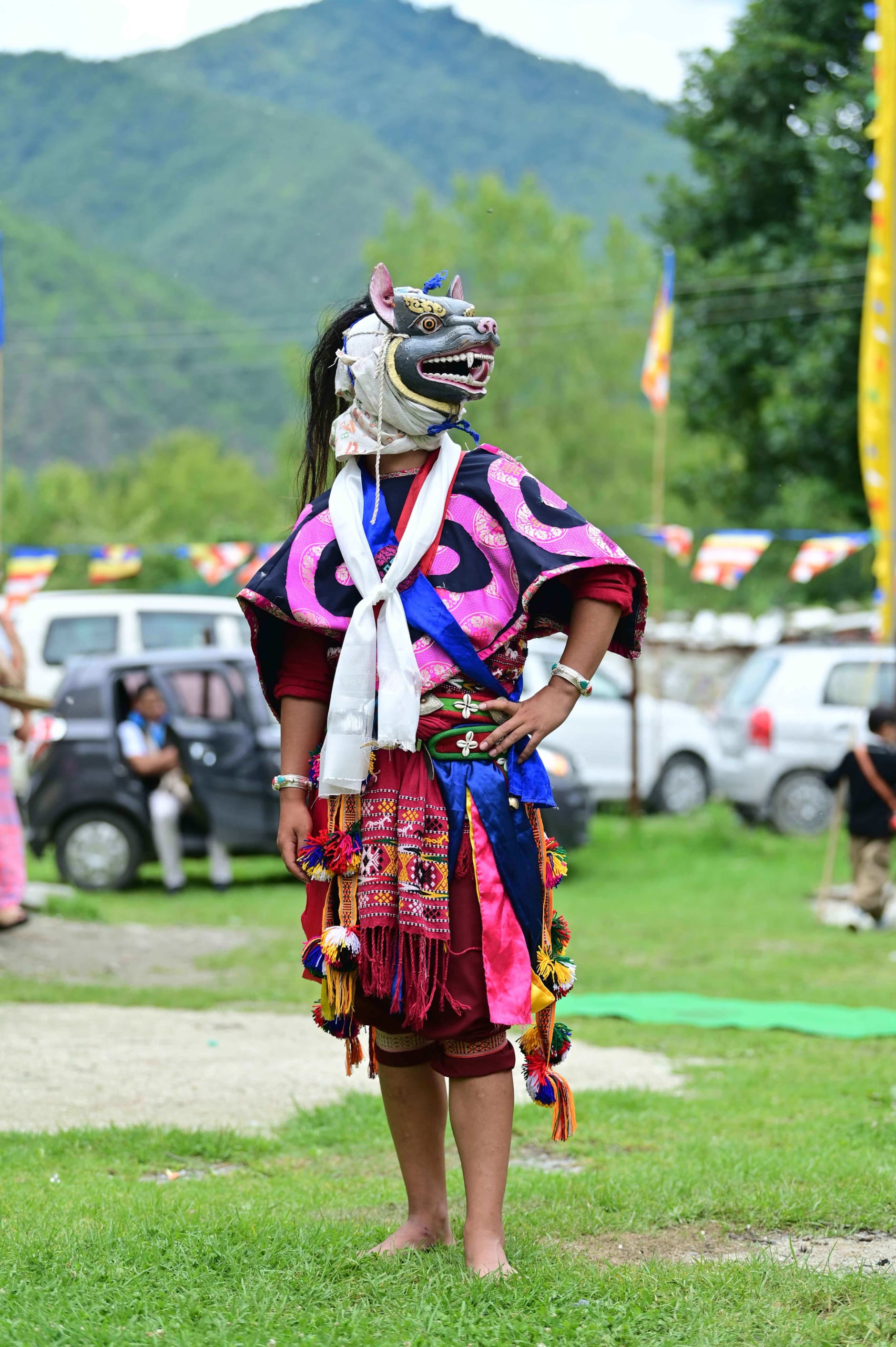
And within that same cycle sit the festivals, carrying lessons about restraint, balance and reciprocity through story and performance. The Buddhist festival of Prewdo Chepchi—a day of prayer, dance, community and honouring the dead is one of them. Its centrepiece is the dance of transition: the Bardo Cham.
The Kengpu (skeleton) dance is the first of three in a purification ceremony known as Saanti Satpa. Pho Cham, the dance of the wild boar follows. A dancer in a boar mask snuffles and roots about, cleaning the space. Finally, red masked dharma protectors, Zaam, wrest control of the stage, bringing it under their protection. These dances sanctify the area, clearing the way for the Bardo Cham.

When the sun has a firmer hold of the sky, puffs of crowds drift into the Gompa wearing traditional weaves of silk and cotton. Steaming hot cups of butter tea are passed around. Lamps are lit, Pedang (incense) sticks waft fragrant smoke into the courtyard. The ching begins its familiar beat, dum…dum… broken by—tak tak taktaktaktak—when the ching-kho hits its wooden side. Eurasian tree sparrows join in, their chittering loud enough to cut through the percussion. A long brass trumpet is blown, the Bardo Cham begins.
The Bardo Cham is a didactic depiction of the soul’s journey between life, death and rebirth and the impact of choices made. It tells the story of Apo Dikchung, a hunter and an atheist whose life is a catalogue of sins. He hunts indiscriminately, empties rivers, destroys bridges and temples. He treats people and animals with cruelty. When he dies, Cheygepu, Lord of Death, sends his messenger, Sangtong, to bring him to judgement. Along the way Sangtong meets the twelve animals of the zodiac, each a victim of Dikchung’s brutality and greed. Eventually he is captured, judged and sentenced to hell to be tortured by these animals. In his rebirth, he becomes a monk who seeks redemption by restoring what he destroyed.
In a chamber next to the courtyard, young men transform into the characters they will portray through dance. Draped in robes of different colours, hollowed out wooden masks in startling greens, golds, blacks and crimsons, complete their transformation. Pema Khandu Thungon, fondly known as Chachu, is donning his third mask of the day, the zodiac animal—Yosh, the rabbit.

reprieve between dances backstage.
Chachu spends all the academic year in Delhi, 2000 kilometres away. Like many of his peers, his life in hostels started when he finished high school. But where many lose touch with their roots, Chachu and his friends seemed determined to hold onto them. “We didn’t have access to mobile networks when we were younger, and we didn’t have much to do.” Watching and copying the elders as they rehearsed and performed, his friends group tried to learn. “In the beginning I was afraid of dancing in front of everyone. Then, when all my friends decided to dance together, I got the courage.”
During the COVID19 lockdown, the gang returned to Shergaon. A government grant allowed them to learn the Cham dances in earnest. Today, Chachu and his friends are part of the ensemble who hold the crowd’s attention at cultural events. “We don’t need a club or a dedicated space to learn,” Chachu says. “We just need interest from parents and a circle of supportive friends to keep our culture alive.”
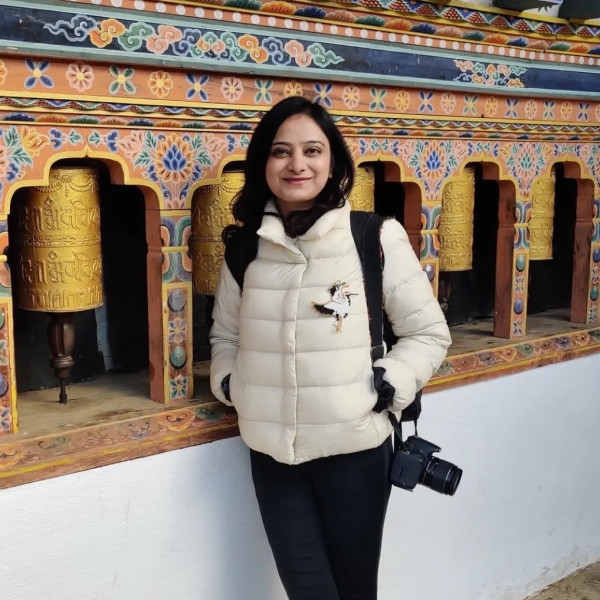
When conservation artist Tripti Shukla first experienced the vigour of the Bardo Cham in 2022, it wasn’t the dance that captured her attention, but the masks. “I wanted to know what they represent, who crafts them and where I see can them being made,” she says. “I like to document these cultural aspects.”
Shukla, a Delhi resident, is on a mission to capture and preserve the indigenous art, culture, and heritage connected with the cause of nature conservation. Her search uncovered a tragic truth. The skill of mask-making had disappeared in Shergaon. Dancers relied on old masks passed down across generations.

Enlisting the help of Garung Thuk, a local community NGO, she approached Pema Tashi, a Monpa artisan from neighbouring Morshing village to teach mask-making. The first workshop was electric. The community library filled with the scent of the wood of White Siris as chisels rasped, and daos scraped to give form to imagined faces. The craftsmen-in-training learned how to choose the right wood, harvest and treat it before carving it into masks. For Shukla and Garung Thuk, these sounds became promises of revival.
The following year, with support from the Wildlife Trust of India, a wildlife conservation institution working in the landscape, a second workshop was organised with a focus on animal masks, particularly the tiger, an important character in the Bardo Cham. In Shergaon, WTI’s project combines conservation and community-driven efforts to protect the wild cats found within its surrounding forests. Investing in the workshop is their way to strengthen local skills and restore cultural knowledge linked to conservation. By 2024, Shergaon had ten new artisans where there had been none.
For Shukla, the goal is self-reliance and continuity: the ability to carve masks in Shergaon, for Shergaon. She also hopes the craft will travel beyond the village—"A beautiful souvenir that reminds visitors of Shergaon and how nature is so interlinked with culture."
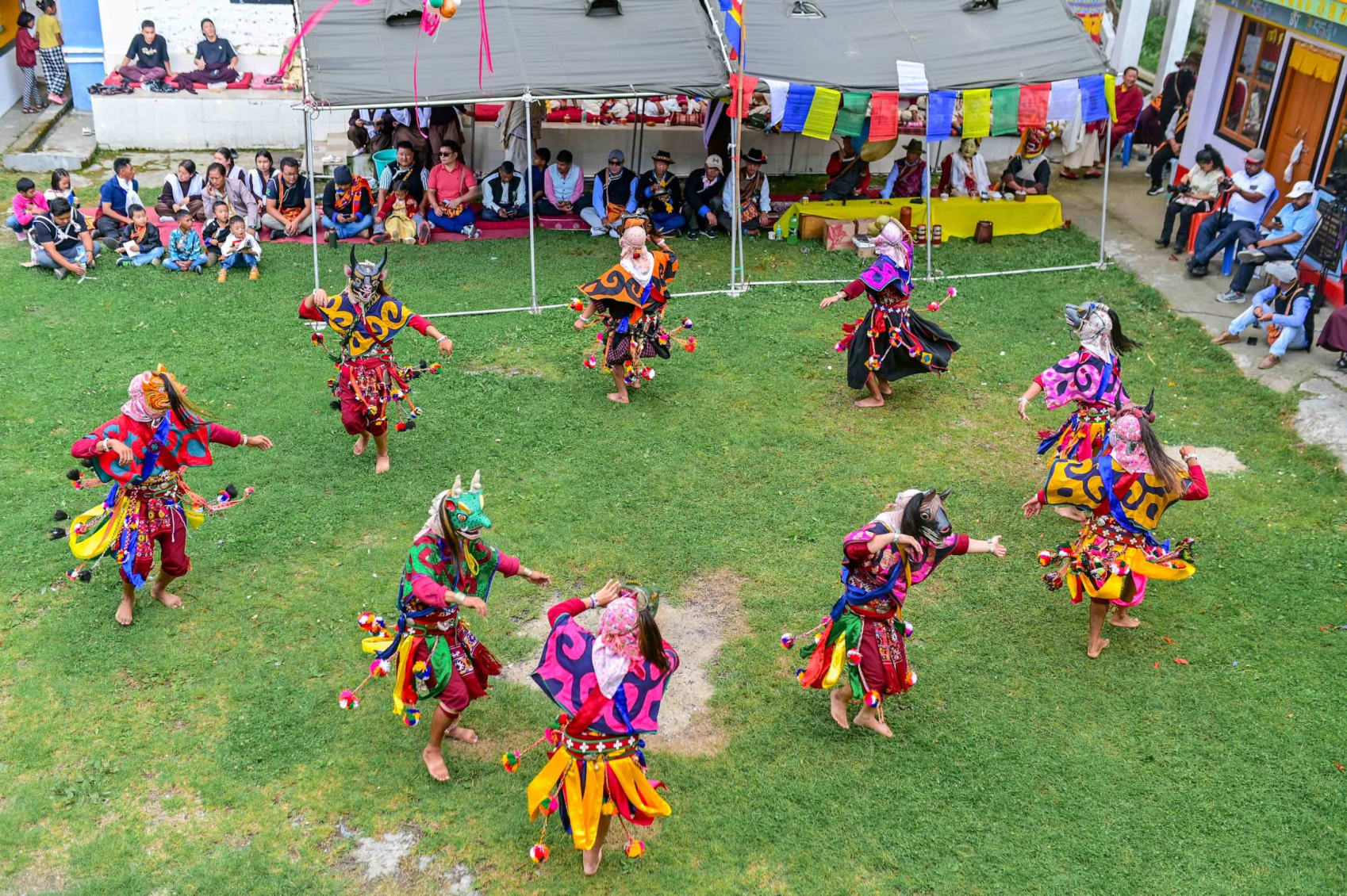
To sit amongst the audience as the Bardo Cham unfolds feels like being folded into a living story that is both ancient and ongoing. The warmth of the chai, the fragrance of incense, the reverberations of the ching, the rhythmic circling of the masked dancers carries beyond ceremony into memory. Children hover at the edges, mimicking the steps, unconsciously rehearsing their own cultural inheritance.
Dikchung’s sins are not abstract vices. They are overconsumption, destruction of forests and separation from community. His punishment comes from the very animals he wronged. Between 2021 and 2023, Arunachal Pradesh lost 91 sq.km. of forest cover and more than 160 sq.km. of dense forest degraded into open scrub. Roads, logging, and unchecked development have reshaped once-intact mountain slopes. A 2024 study notes that the state is in a high future deforestation risk, made more precarious by its vulnerability to climate change. For the Sherdukpens, the story is less allegory and more instruction: live without respect for nature, you doom both yourself and the world around you.

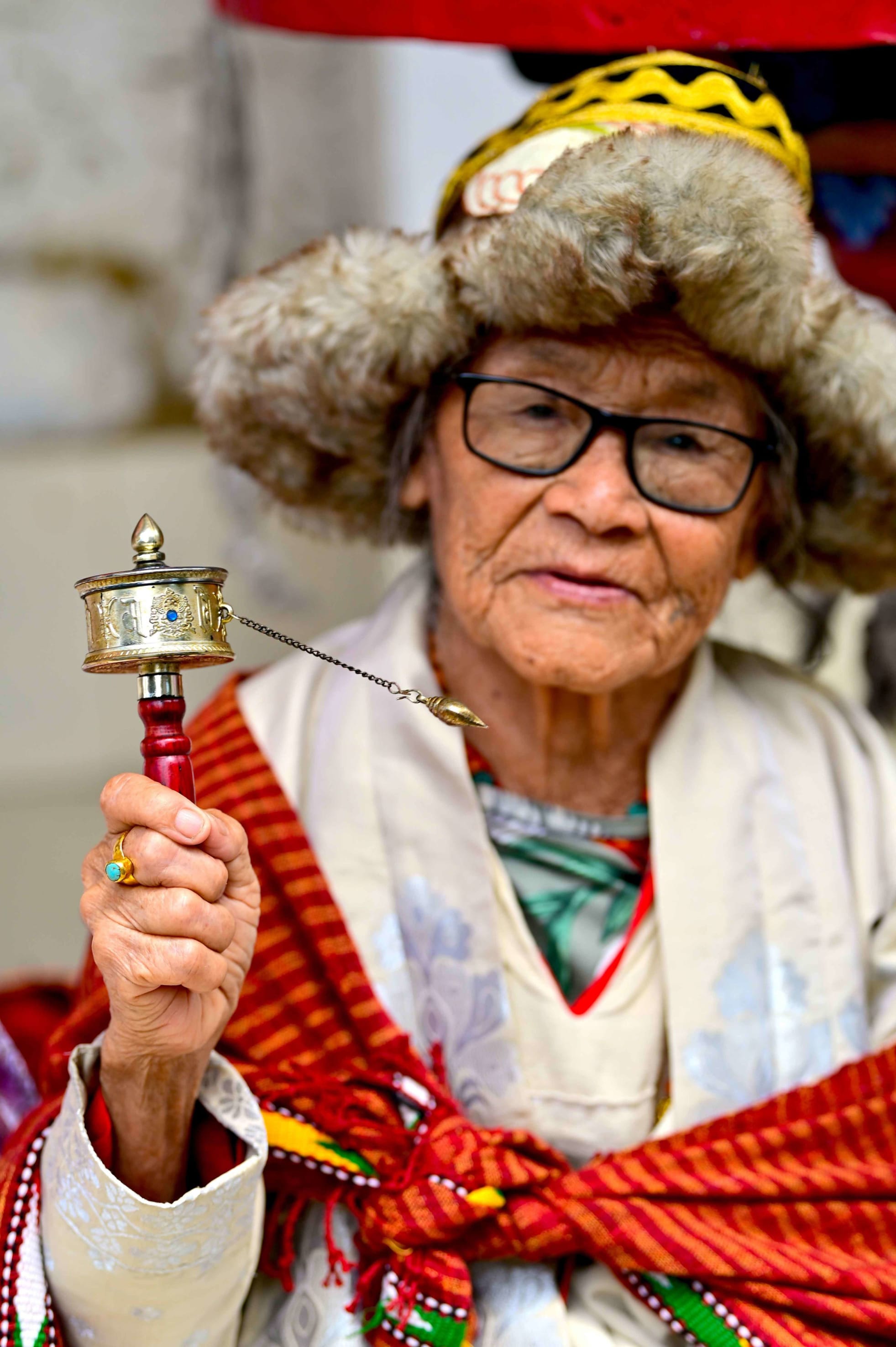
Through the carving of masks, rehearsing dances, and the effort of sustaining the festival year after year, the Bardo Cham has become a point of convergence for disparate groups. Dancers, artisans, youth, elders, community organisations and not-for-profits are drawn into the same orbit, attentive to a shared story, even as they bring different meanings to it.
The revival of mask-making is as much about cultural continuity as it is about creating livelihoods and relationships beyond the village. Celebrations like the Bardo Cham offer conservation partners a way to situate their work within a living cultural landscape that is less extractive and more collaborative. The festival may not directly promise ecological protection, but it creates the conditions for it by slowing time, calling people home, and making space for dialogue across generations and institutions.
The continued vitality of the dance suggests something hopeful. In a world where younger generations are often pulled away from tradition, Shergaon shows that culture can be upheld in ways that speak to today. In a region where forests are thinning and futures feel uncertain, a centuries-old dance becomes a place to gather long enough to listen for a different conversation. And a story offers a pathway to reimagine conservation through the eyes of those who have lived in stewardship with this land, the longest.
About the Authors

Rithika Fernandes
drives outreach and impact at Roundglass Sustain. With a background in ecology, she's drawn to the evolving relationships between people and nature.