 Listen to this article
•
15:34 min
Listen to this article
•
15:34 min
“Ye toh maccha pheng hai”, exclaimed James mama, our field staff member, while looking at one of the camera trap photos of a wild cat. He had never seen it in the wild, yet his knowledge of the forests and trails of the Garo Hills was unmatched. To him, the photograph wasn’t just an image; it was proof that the stories elders whispered about this cryptic cat were real.
We were looking at a photo of the mysterious clouded leopard (Neofelis nebulosa), an enigmatic wild cat known for its elusiveness and unique cloud-like blotches on its body, which give it its name. It roams quietly in the evergreen forests of Northeastern India, far less celebrated than the charismatic tigers and majestic snow leopards, yet just as remarkable. Popularly called the “modern-day sabretooth” for its long canines, it remains one of the least understood cats in the world, even though it faces threats just as severe as its larger counterparts.
Early accounts by naturalists and native hunters who caught fleeting glimpses of it high in the canopy described it as living entirely on trees, earning it the vernacular name among Malay and Indonesian communities, rimau-dahan, which means “tree tiger”. But recent studies suggest a more grounded truth — the cat is as comfortable walking forest trails as it is climbing through the trees.

The semi-evergreen forests of Balpakram form a mosaic of ridges, valleys, and hidden trails, sheltering some of Northeast India’s most elusive wildlife in a layered wilderness where animals can remain hidden even in broad daylight. Photo: Tribhuwan Singh ‘Tree’
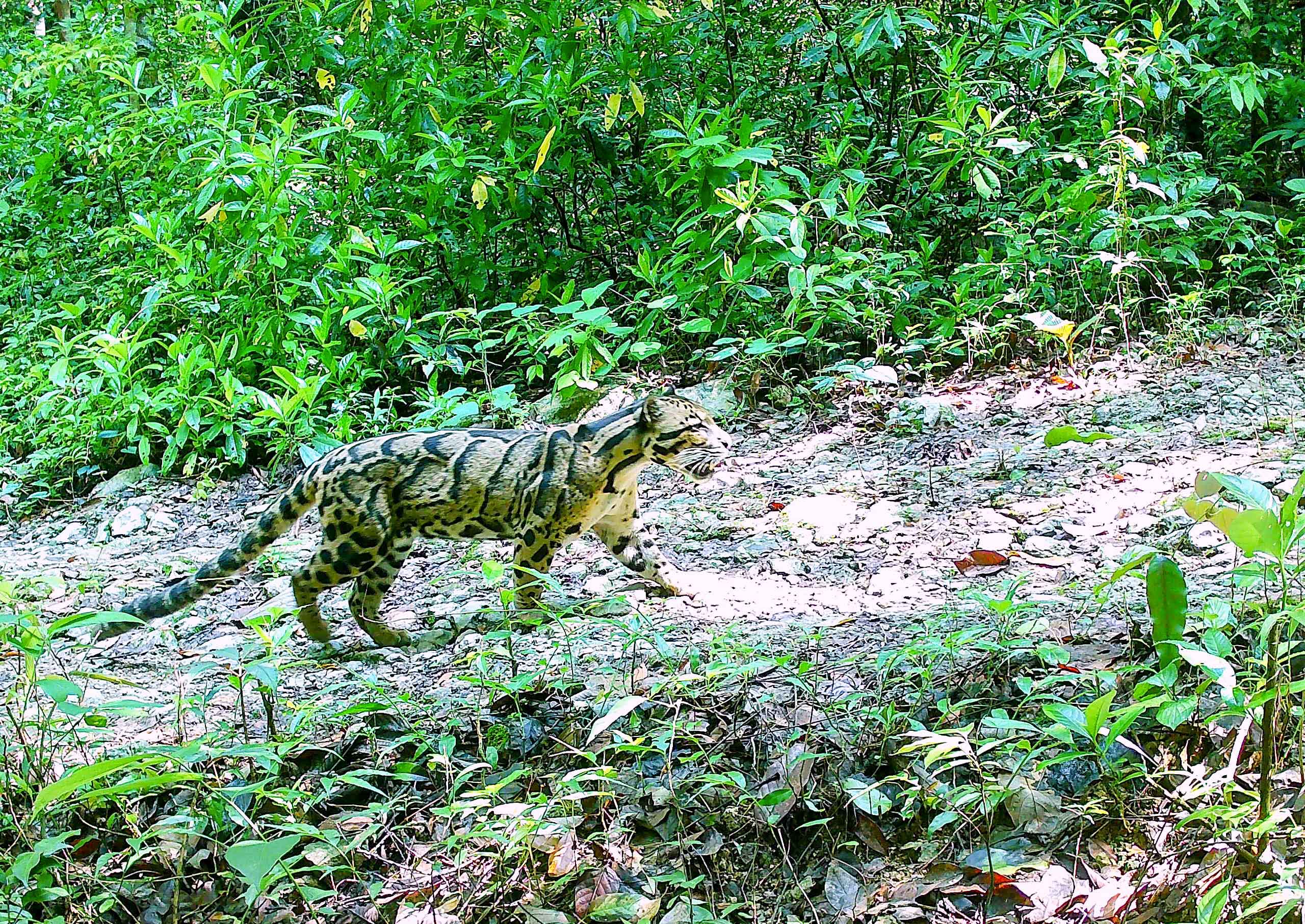
Cover Photo: Balpakram ka Raja, a dominant male clouded leopard, patrols a forest trail in Balpakram National Park, part of a range he regularly traverses, across nearly a third of the park. Clouded leopards often prefer such trails, which offer easier movement through dense forest. Photo: WII/IDWH- Clouded Leopard Team
Spread across eleven countries of South and Southeast Asia, its Indian stronghold lies in the Northeast, where people call it by many names: ningaley in Sikkim, maccha pheng in the Garo Hills, kelral in Mizoram, and ghodaphutuki bagh in Assam. This feline is so reclusive that only a handful of researchers have seen it in the wild. Clouded leopards thrive in forests with dense, closed canopies —the kind where sunlight filters through in patches and shadows blend seamlessly with their clouded coats. From those shadows, this elusive predator hunts with quiet precision, preying on medium-sized deer, porcupines, primates, rodents, and birds. Much of what we know about it comes from anecdotal records, or the patient eyes of camera traps. Every image tells us a tiny fragment that pieces together the life of a cat we still barely know: a silent walk across a ridge, a pause to scent-mark a trail, or a curious glance toward the lens.
However, the very forests that keep it hidden are disappearing. Across much of its range, old-growth forests are being cleared for oil palm and areca-nut plantations. Roads, logging, and settlements now cut through what were once unbroken stretches of wilderness. These creatures have lost more than 60 per cent of their historical range. In some regions, the threat also comes from hunting. Its beautifully patterned skin and body parts are still traded illegally, much like those of the tiger. These mounting pressures have finally drawn national attention, and the species has been included in India’s PAN-India assessment of 22 threatened species, a long-overdue recognition of a felid that has remained in the shadows for far too long.
Into the Garo Hills
Our team at the Wildlife Institute of India (WII) is working to estimate the clouded leopard population across its Indian distribution range under the Integrated Development of Wildlife Habitats (IDWH) scheme of MoEF&CC. In early November 2024, we began a camera-trap survey to study the clouded leopard population in Meghalaya. Having just completed surveys in Sikkim and northern Bengal, we were hopeful of finding signs of the cat here, especially after forest department staff spoke of sightings in Balpakram National Park in the Garo Hills. Locally called maccha pheng, or sometimes maccha bolga, meaning “the big cat that lives on trees” the species holds a quiet place in local folklore.
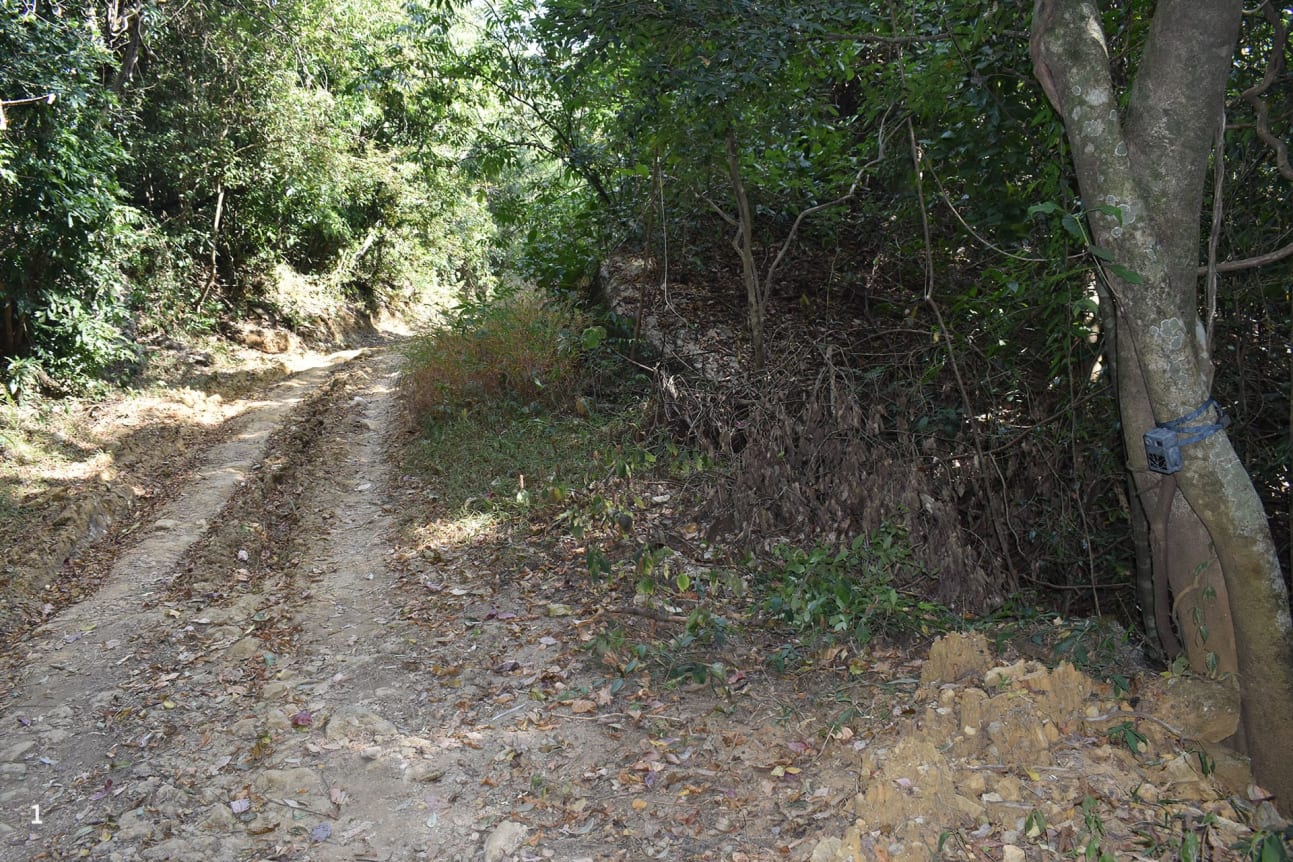

Yet, the forest kept its secrets well. During our reconnaissance, we searched for its tracks and signs, but the thick carpet of leaf litter muffled every trace. The dense canopy, alive with cicadas and filtered light, gave no hint of the elusive cat that might be watching from above.
Local folklore in the Garo Hills speaks of a place deep inside Balpakram National Park called Maccha Melaram, believed to be where leopards gather for their meetings. Another site, inside Nokrek National Park, is known as Maccha Nokpanthe, roughly translating to “the place where cats rest”. Such stories, passed down through generations, show how deeply these forests and their wild inhabitants are woven into local imagination.
We set up our camera traps across Balpakram and began monitoring them for two to three months. The first week tested our patience, with not a single photo capture of a clouded leopard. My teammate Daniel and I tried to stay optimistic; it was only the beginning, after all. Then, on 9 January 2025, while checking one of the cameras, we froze, staring at the unmistakable image of an adult male clouded leopard. His broad jaw and square muzzle gave him an almost regal look. We nicknamed him Gigachad (ultimate, handsome male), half in jest, half in admiration.
That first photo brought pure exhilaration. We combed the rest of the cameras, but there were no more. A week later, however, Gigachad appeared again, followed by another individual (in the same camera), this time near a village trail. It was surprising, since clouded leopards are known to avoid people, but perhaps the lure of easy prey or curiosity had drawn him close.
Over the next few weeks, the forest began to reveal more secrets. Encouraged, we expanded our coverage, trekking deeper into the park’s corners and setting up more cameras over the following month. Each new image that we checked felt like opening a gift — another glimpse into a world we rarely see.

By the end of the survey, we had identified several clouded leopard individuals, each distinguished by the unique blotches and shape of their markings. Yet, amidst the joy of these discoveries was a slight pang of loss; Gigachad never appeared again after our last camera capture in January. From the core of the park, we later recorded another large male, similar in build. Since it roamed across almost one-third of the park’s area, we fondly named it Balpakram ka Raja. Perhaps he had claimed the territory, quietly pushing Gigachad into a different part of the wilderness; I guess we will never know.
Whispers from the Villages
Although clouded leopards are rarely known to come into direct conflict with people, around Balpakram, a few Garo villagers shared anecdotes of a leopard that visits after sunset, targeting hens, and sometimes goats. When I showed them photos of both the clouded leopard and the marbled cat, which can look deceptively similar, they immediately pointed to the one with the cloud-like blotches and knee-high frame. It was indeed our elusive cloudy.
The villagers said the animal prowls quietly near the edge of their settlements, sometimes managing to grab a chicken but seldom succeeding with larger livestock due to their vigilance. Still, as forests shrink and habitats fragment, such fragile coexistence may not last forever, and the boundary between wilderness and human life grows thinner each year.

Beyond the Shadows
The true number of clouded leopards in the wild remains uncertain. The IUCN estimates a global population of around 3,700-5,500 individuals, but that figure may be far from reality. Our knowledge is still limited by the scarcity of focused surveys across their vast range. Expanding research that targets clouded leopards and other forest-dwelling felids will help reveal where they live, how they move, and what threatens them most.
This cat depends on intact primary forests, which means that saving its home could also safeguard many of the region’s most secretive mammals, such as the marbled cat, Asiatic golden cat, binturong, ferret badger, and spotted linsang. Listing the species under protection is only a first step; real conservation lies in protecting the landscapes that sustain these beautiful creatures, and in involving local communities to build stewardship (responsibility). Clouded leopards deserve a place at the centre of conservation planning as ambassadors for the silent, overlooked life of Northeast India’s dense forests. It is our shared responsibility to make this underrepresented species more visible, understood, and valued, both in science and in society.
About the Author

Tribhuwan Singh ‘Tree’
a doctoral candidate at AcSIR–Wildlife Institute of India, is grateful to tread the same forest trails as clouded leopards, marbled cats, and binturongs. He is currently pursuing a PhD in being professionally ignored by all of them.