Listen to this article
•
15:34 min
Listen to this article
•
15:34 min
It was a Sunday in late December, a morning where the world contracted to a radius of ten metres, the rest erased by a fog so profound it felt less like weather and more like a metaphysical state. We were driving 129 km northwest from Lucknow towards the Hardoi district. The road, usually a chaotic artery of agrarian commerce, was silenced by the mist. Ghostly Ficus and gnarled Acacia loomed out of the whiteness like apparitions. It was impossible not to recall the cinematic aesthetics of Bimal Roy’s 1958 classic, Madhumati. Just as Roy used fog to create a boundary between the real and supernatural, the mist on the road marked a transition from the frantic Anthropocene to a slower, more ancient geologic time.
Seated beside me was Dr Asad Rahmani, one of India’s renowned ornithologists and conservationists. “The fog is good,” he murmured, looking out at the opaque landscape. “It keeps the disturbance low. The birds feel safer.” His voice carried the weight of experience, a library of observations gathered from the salt pans of Gujarat to the rainforests of the Northeast.
The fog began to lift slightly, tearing into ragged wisps. The sun, a pale, diluted disc, was struggling to penetrate the white veil. Reaching for his binoculars, the legend was in his element. “Where are yours?” he asked. I felt the heat of a blush despite the cold. “I don’t have any, sir,” I admitted. He didn’t lecture. He smiled and handed me his pair. For a birdwatcher, lending your binoculars is like lending your eyes — a quiet gesture of mentorship I won’t soon forget.
Cover photo: The rich vegetation of Sandi Bird Sanctuary includes submerged, floating, and emergent plants that provide crucial foraging and nesting habitats for thousands of resident and migratory birds. Photo: Saurabh Dewan
The Bowl of Life: Dahar Jheel Formation
Sandi, locally known as “Dahar Jheel”, refers to a basin or a low-lying lake. In the Forest Department’s administrative lexicon, it is a 308.5-hectare bird sanctuary. To understand the biological richness of Sandi, one must first understand its bones — its geological and hydrological structure. Unlike the lagoons of Chilika or the floodplains of the Brahmaputra, Sandi is a freshwater marsh tucked into a distinct depression with no significant natural outflow. As the North Indian summer scorches the land, evaporation concentrates minerals within this closed basin, creating a unique chemical signature and fostering specialised microorganisms — anaerobes, cyanobacteria, and phytoplankton. They are the invisible foundation of everything we are about to see.
The Pulse of the Monsoon
Sandi is a rain-fed wetland that receives the bulk of its water from the southwest monsoon and operates on a “boom and bust” cycle, in which wet years trigger massive vegetation growth, while drought years cause immediate environmental stress. Dr Rahmani recalled the collapse in 2014-2015, when the sanctuary effectively dried out. “When the water goes, the birds have no choice; they bypass Sandi.” It reminds us that these systems are not static paintings; they are living, breathing, and occasionally dying entities.
This fragility led to Sandi’s designation as a Ramsar Site (site no. 2409) on September 26, 2019. This international recognition acknowledges Sandi’s role not just as a local lake, but as a wetland of global importance and an Important Bird Area.
The Green Architecture: Floristic Zonation
As the fog finally lifted, revealing the shimmering expanse of the lake, the “green architecture” became visible. A wetland is defined by its plants. They determine which birds can feed, nest, and hide. Sandi hosts over 200 plant species, creating a complex, layered habitat.


The water surface was broken by patches of green, invasive Eichhornia (water hyacinth), interspersed with delicate ferns of Azolla pinnata, a nitrogen-fixing plant that acts as a natural fertiliser. Further out, the “rooted floating” zone was dominated by the aesthetic heavyweights: water lily (Nymphaea nouchali) and lotus (Nelumbo nucifera), perfect for a bronze-winged jacana walking gingerly across lily pads.
Beneath the surface lay the sanctuary’s true engine: submerged vegetation like Hydrilla verticillata, Vallisneria spiralis (tape grass), and Potamogeton nodosus (pond weed), forming dense underwater forests. “This is the larder”, Dr Rahmani noted. “The herbivorous waterfowl — coots, gadwalls, and wigeons — are here for these plants. If you lose them due to pollution or turbidity, you lose the ducks. It is that simple.”
Surrounding the open water were tall stands of emergent Typha (cattails) and Scirpus forming the sanctuary’s “walls” and providing the necessary privacy for shy species like rails and bitterns to breed.
The Aristocrats and the Travellers: Waterfowl of Sandi
The water was alive. A cacophony of quacks, whistles, honks, and splashes rose from the jheel. Sandi supports over 40,000 waterfowl during the peak winter months. The diversity is staggering, representing a convergence of avian cultures from across the globe. “There!” Dr Rahmani whispered, pointing to a group of ducks near the lake’s centre. “The aristocrats.” He was referring to the northern pintail (Anas acuta), unmistakable even at a distance. Their chocolate-brown heads, white breasts, and long, needle-like central tail feathers (from which they derive their name) gave them a regal profile. “Why aristocrats?” I asked. “Look at the line. The neck is long, the tail is long. They carry themselves with a certain dignity,” Dr Rahmani replied. Unlike diving ducks, pintails tip forward, tails pointing skyward, to graze on submerged plants.


Farther out, lesser whistling ducks (Dendrocygna javanica) occupied the periphery. Locally known as sili or silhahi because of their wheezy, two-note whistling call (whee-whee). They are the “night shift,” largely foragers. During the day, we saw them huddling in tight-knit flocks on the water, more surprisingly, perching on Acacia branches. “Ducks in trees?” I asked. “They are Dendrocygna, literally ‘tree swans’,” Dr Rahmani corrected. “They nest in tree hollows to avoid predators like monitor lizards and jackals.” Their presence is a testament to Sandi’s structural diversity – water to feed, and old trees to breed.
The Drama of the Surface: Coots, Gadwalls, and Kleptoparasitism
A fascinating ecological drama at Sandi unfolded between the Eurasian coot (Fulica atra) and the gadwall (Mareca strepera). As we scanned a patch of open water dominated by submerged Hydrilla, the surface seemed to boil with activity. “Watch the coot”, Dr Rahmani said.
A coot disappeared for several seconds and resurfaced, its beak stuffed with green aquatic weeds. Instantly, a gadwall rushed towards it and snatched the weeds directly from its beak. “Kleptoparasitism”, Dr Rahmani said with a twinkle in his eye. “Thievery, plain and simple.” The gadwall is a “dabbler”; it cannot dive deep. The coot is a “diver”; it can reach depths of up to several metres. The gadwall has learned that this commensal feeding relationship is energetically cheaper than foraging for itself in deep water.
The Sentinels of the Shallows: Storks and Waders
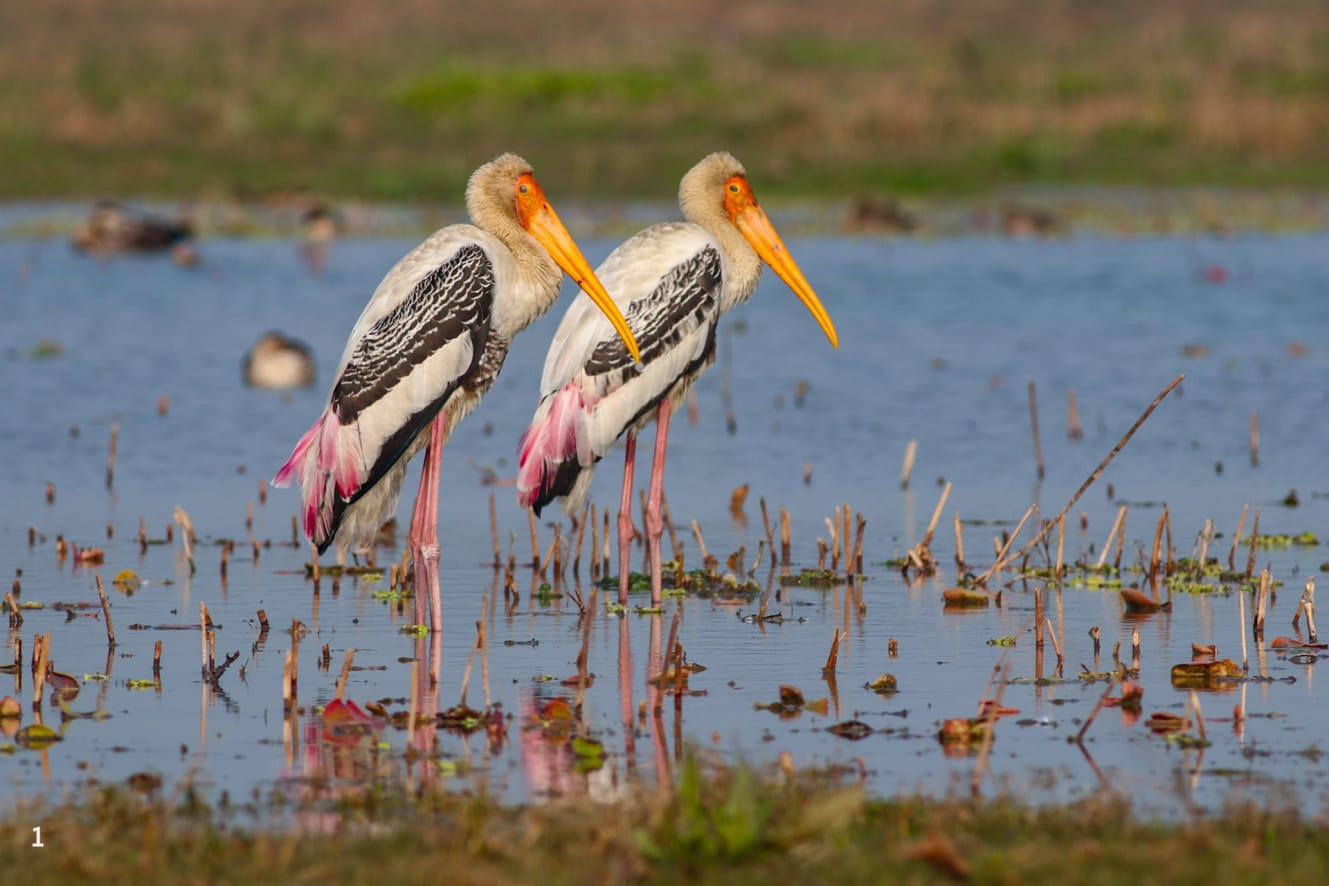
Moving from deep water to the muddy shoreline, we saw the avian architecture change. Here, long legs and specialised bills were tools of the trade. Standing sentinel in the shallows were painted storks (Mycteria leucocephala). “Watch how they hunt,” Dr Rahmani instructed. The stork was walking slowly with its bill submerged and partially open. “Tactile foraging,” he explained. “They don’t see the fish. They feel it. The moment a fish touches the inside of that bill, it snaps shut in a millisecond.” It is a reflex, faster than conscious thought, allowing them to hunt in Sandi’s turbid, muddy waters.

Nearby, a black-winged stilt (Himantopus himantopus) picked its way through the mud. It looked like a caricature of a bird. “Sixty per cent legs,” Dr Rahmani noted. “If humans had those proportions, we would be walking on stilts,” I joked. These extreme legs allow the stilt to forage in water a few inches deeper than other birds, granting it exclusive access to a specific band of aquatic invertebrates.
A Symphony in the Silence
The evening approached, and the white veil of fog began to return, reclaiming Dahar Jheel. The sun dipped below the horizon, painting the sky in hues of bruised purple and charcoal. The calls of the birds changed. The daytime chatter of the pintails is replaced by the eerie, wheezing whistles of the sili waking up for their night shift.
Sandi is not merely a collection of water and birds. It is a theatre of evolution. It is a place where the geology of a crater meets the physics of migration; where the chemistry of alkaline water dictates the botany of the reed bed. “It is a symphony”, Dr Rahmani said, looking one last time at the darkening water. “Every species has a note. If you remove the coot, the gadwall goes silent. If you remove the water, the whole orchestra stops.”
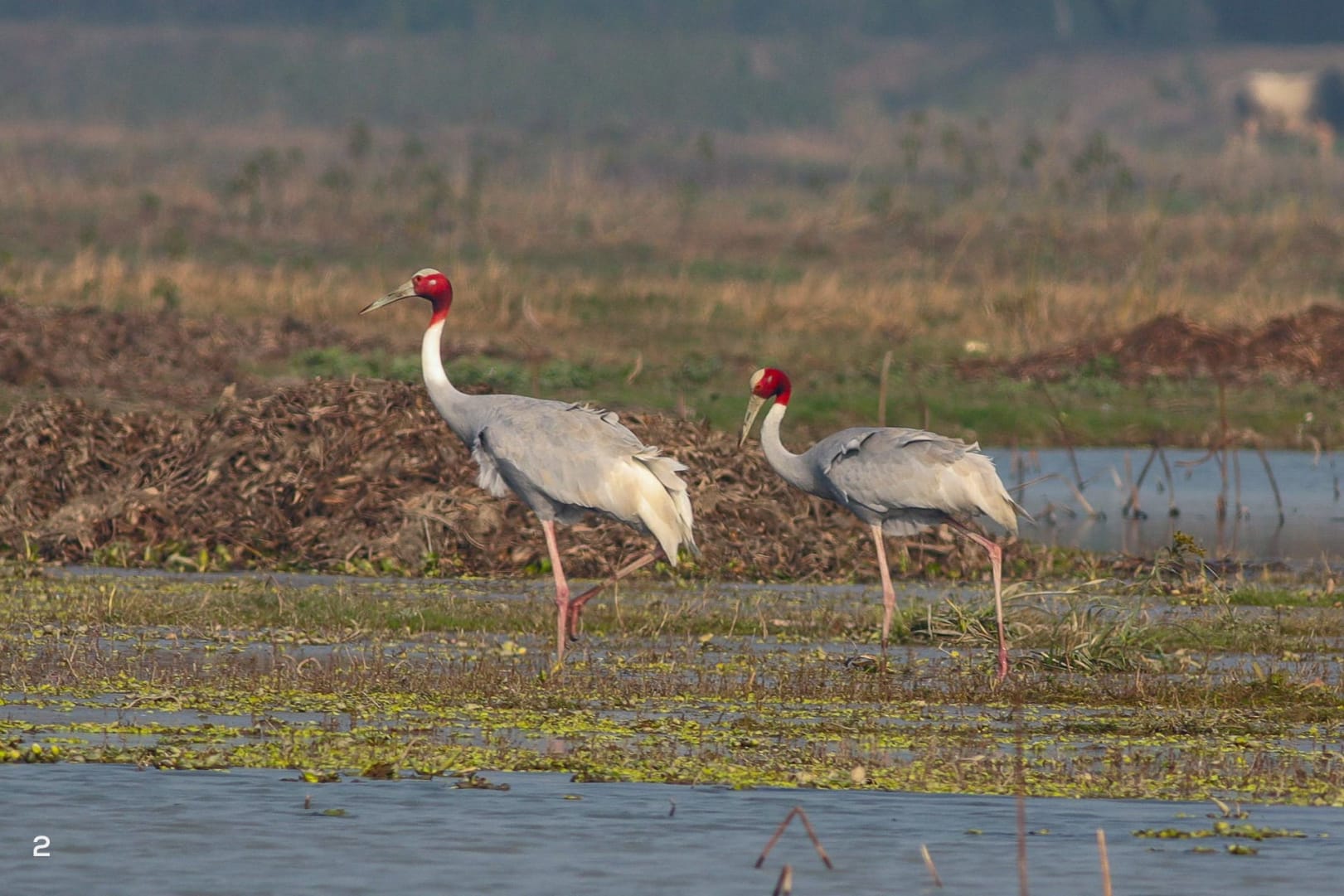
Mist swirled around our ankles as we walked back to the car. Somewhere, a sarus crane called out from the darkness — a sound of defiance and endurance. In the heart of the Indo-Gangetic plain, amidst the mist and the reeds, the wild heart of India was still beating.
About the Authors

Saurabh Dewan