Listen to this article
•
15:34 min
When did this begin, the owl-love?
It certainly was not love at first sight because, you know, owls are not easily seen. They are nightly creatures. Did I hear about them as a child? There were flowers, and fruits and parakeets, tigers, lions, but no, not owls. Neither my mother tongue, Sambalpuri, nor standard Odia uses “ullu” (the Hindi word for owl), intended to convey “stupid”.
My first memory of seeing owls, almost face-to-face, was during an early morning walk in Ahmedabad. It was the late 90s; newly married, three years from my thirtieth, we chose to live away from the perpetually awake big city. Once past the highway, the meandering Ambli-Bopal Road took us through patches of agricultural fields on both sides, sporadic lampposts, occasional patches of luminous gold escaping through an open door or window. I would gather my stuff and get down when the bus passed the “Ambali Gam” (village) sign. Few houses, fewer shops. We were often asked why we lived so far. It suited our temperaments perfectly. Yes, every destination took a bit longer, and on weekends we rarely went anywhere because everything was far! But the area still had the emptiness needed for walking, never mind the dominance of Neltuma (Prosopis juliflora or ganda babool, the thorny invasive shrub that thrives in dry and saline areas). We walked every day without fail, unless we travelled, or were unwell, or it rained. We took the non-tarred paths and walked further from the road, dusty, uneven but incredibly quiet.
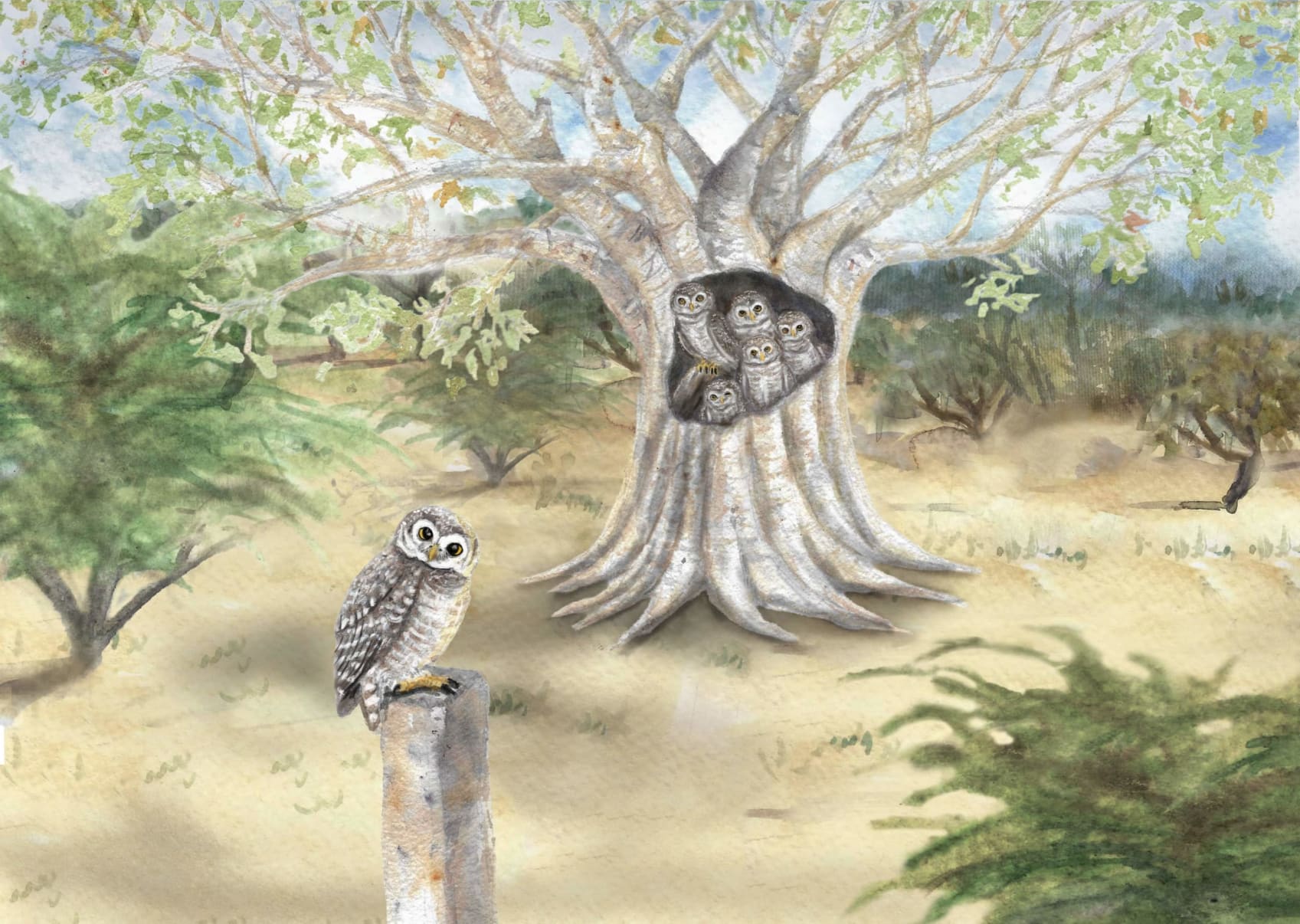
On one of those morning walks, we came face to face with an owl perched on a fence pole, almost at my height. I watched the owl; it looked back at me, then turned its head. I followed her gaze to a giant tree with many branches and whitish bark. In a cavity around 15 feet high, I saw a parliament of five spotted owlets (Athene brama); ten round eyes stared back. That memory has stayed with me. That sighting, aankhon hi aankhon mein, a meeting of the eyes, was the beginning of an intrigued love.
This was a time without mobile phones and no way to take pictures on the go. I started reading up about owls. We had one desktop computer in the office with an Internet connection, which we accessed in slots. I searched for owls. Among the standard boring office teacups, someone left behind a beautiful hand-crafted mug in the shape of an owl. I took it as a sign and labelled it as mine.
Looking back, my fascination with owls grew from the stigma attached to them. Owls were considered a bad omen. My education at the Tata Institute of Social Sciences, Mumbai, had instilled in me the urge to question everything humans (mostly men, because traditionally they were the ones with education, exposure, and privilege) assigned value to for their convenience.
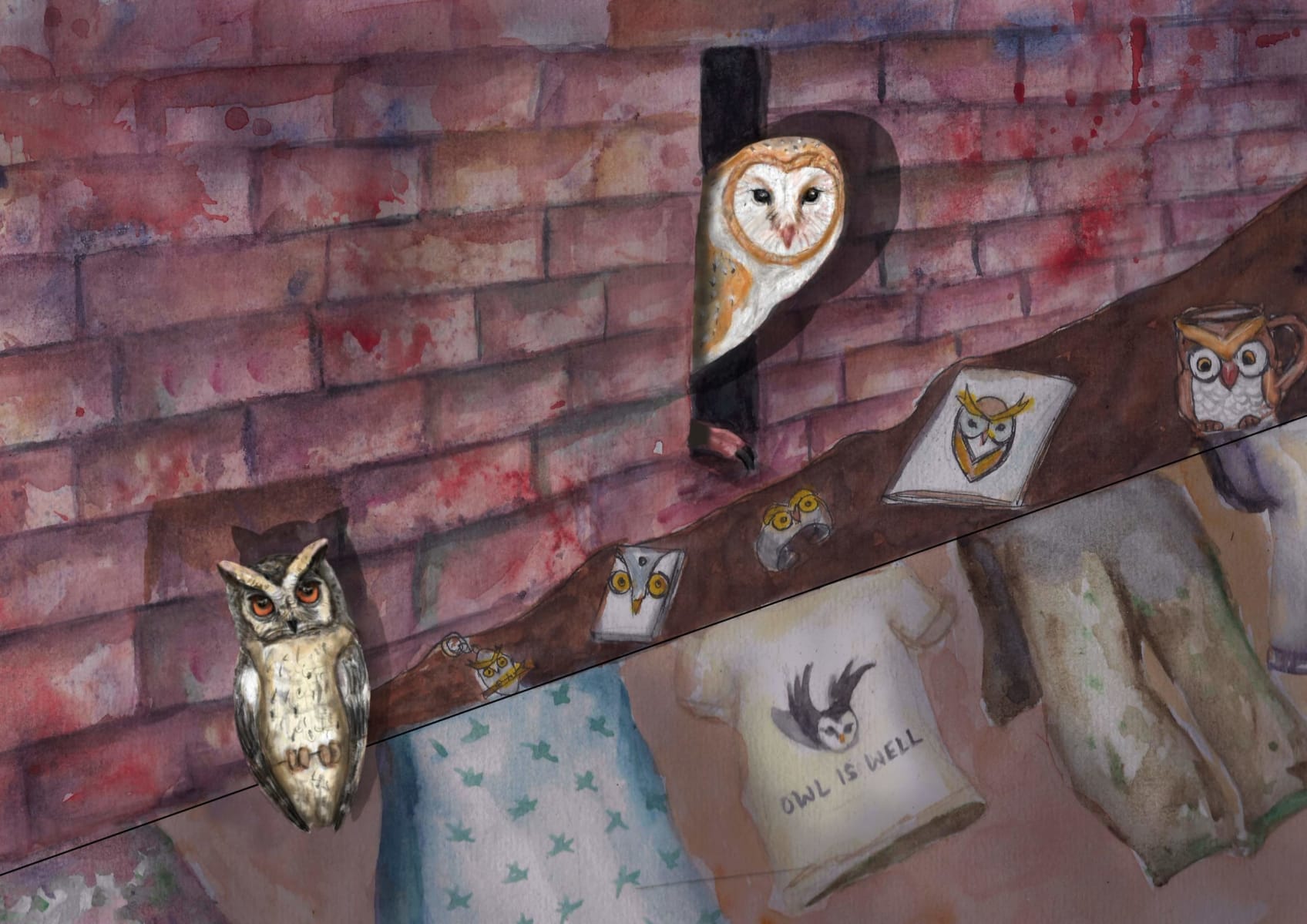
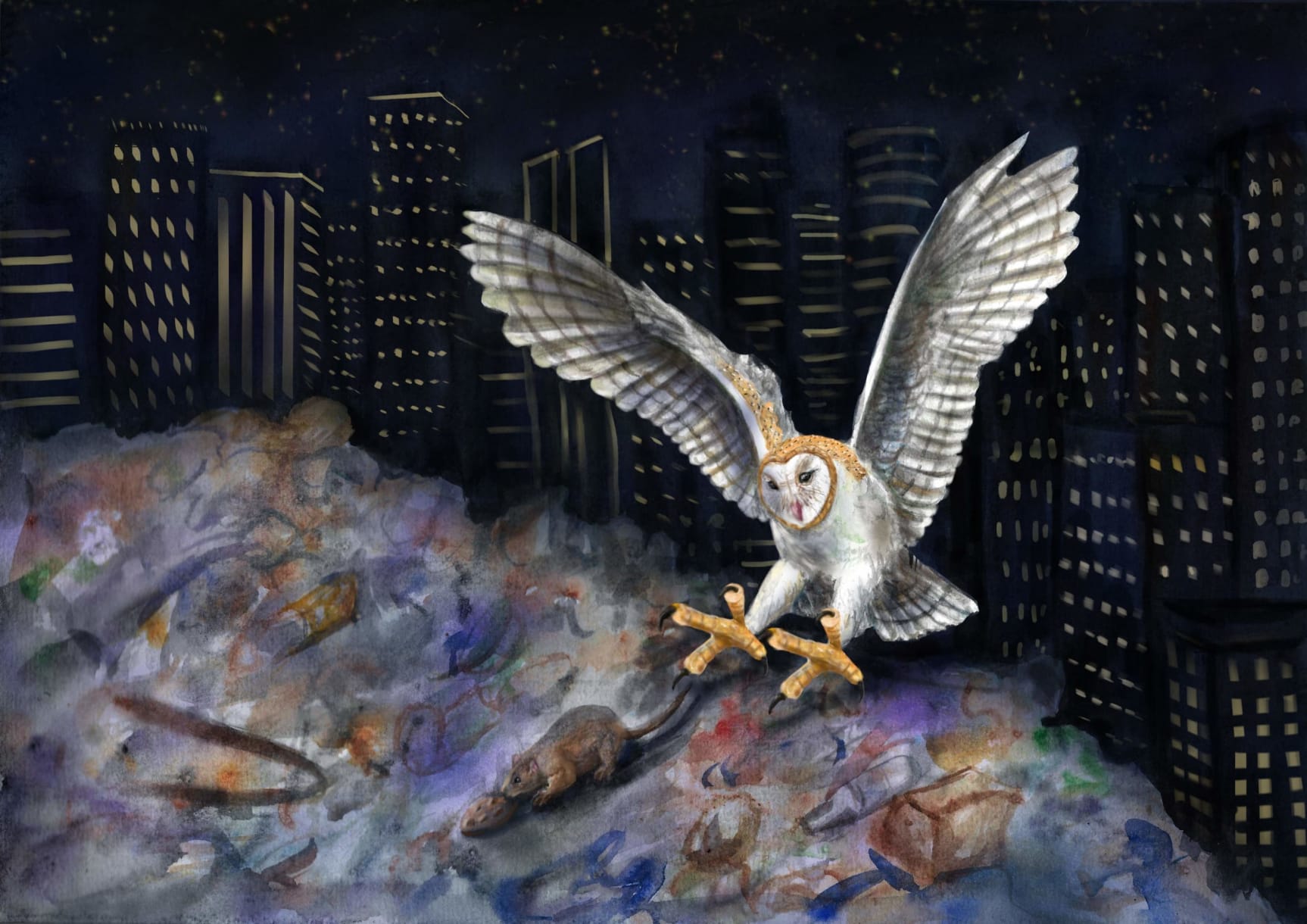
As soon as I hear a sentence that begins with “it is said…”, my mind spins with “whys”. When a cat crosses my path, I do not take a detour. Menstruating women are not to go to the temple or enter the puja room. I do, and reason that menstruation is created by the same Divinity that created all of us. The gorgeous shade of black, considered inauspicious, is one of my favourites, and I wear it often. I am automatically biased toward liking things, places, and people labelled inauspicious or reduced to a lesser place. I counter when people speak badly of owls by explaining that they quietly clean up a lot of messes and never get the credit they deserve. Our urban areas, with inadequate waste disposal facilities, and our habit of throwing food on the streets and dumping garbage everywhere, have led to massive increases in rodent populations. Owls eat these rodents, which helps control their numbers. Owls are doing us a service, and they have a thankless job.
My unusual affection for owls was further encouraged by friends who gifted me anything with an owl: bags, notebooks, clothes, jewellery, planters, coasters, stickers, you name it. They fill the nooks and corners of our house. Such is their prominence that once Ayesha, who helps with housework, came running and said: “Woh jo aap puja kartein hein, woh udhar baitha hai” (The one you worship is sitting there). She thought only objects of veneration were offered that kind of space. She figured, I must not miss seeing them when they appear. I ran with her and found three Indian scops owls (Otus bakkamoena) in a short, dense tree canopy in the neighbour’s backyard. When I mentioned this to the neighbour, she called me later to see them sitting on her balcony clothesline.
Having these owl-things has inspired conversations. A stranger, noticing the image of an owl on my phone cover, once took me to her home to show me a barn owl (Tyto javanica) sleeping in a crevice opposite her window. Her husband commented: “People say owls bring bad luck”. “Goddess Lakshmi visits riding an owl; your house is blessed!” I replied. He seemed convinced. Nobody wants to doubt Goddess Lakshmi.
How disturbing it is to see owls domesticated. These wild nocturnal creatures are imprisoned in owl cafés in some parts of the world. My chance stumbling upon People for Animals (PfA) Bangalore chapter at a Lalbagh exhibition led to incredibly meaningful exchanges. I reach out to them to care for injured creatures: a tangled black kite hanging by manja thread, a wounded mynah, a crow that hit a glass window head-on. PfA offers passive adoption, and when they had owls, I jumped at the idea. In fact, donating to PfA and sponsoring meals for recovering animals has become my way of celebrating birthdays and remembering special people. Once healed, all of them are released back into the wild, unless they are irreversibly incapacitated.
These shy nightly creatures are ever so hard to spot. The best time to see them is at dawn and dusk, when shades of grey camouflage them. Some lucky ones see owls even during the day. I keep my head up, looking closely at branches, trunks, and bark, and have found them most unexpectedly. A fleeting glance, looking down from a branch. Or while lying on a rooftop at night stargazing, when a barn owl may fly by. At a spot in Kasu Brahmananda Reddy National Park (KBR Park), Hyderabad, near the remains of an old building and an abandoned vehicle, a family of owls once lived in a tree. Every day I would walk past with the hope of a glimpse.
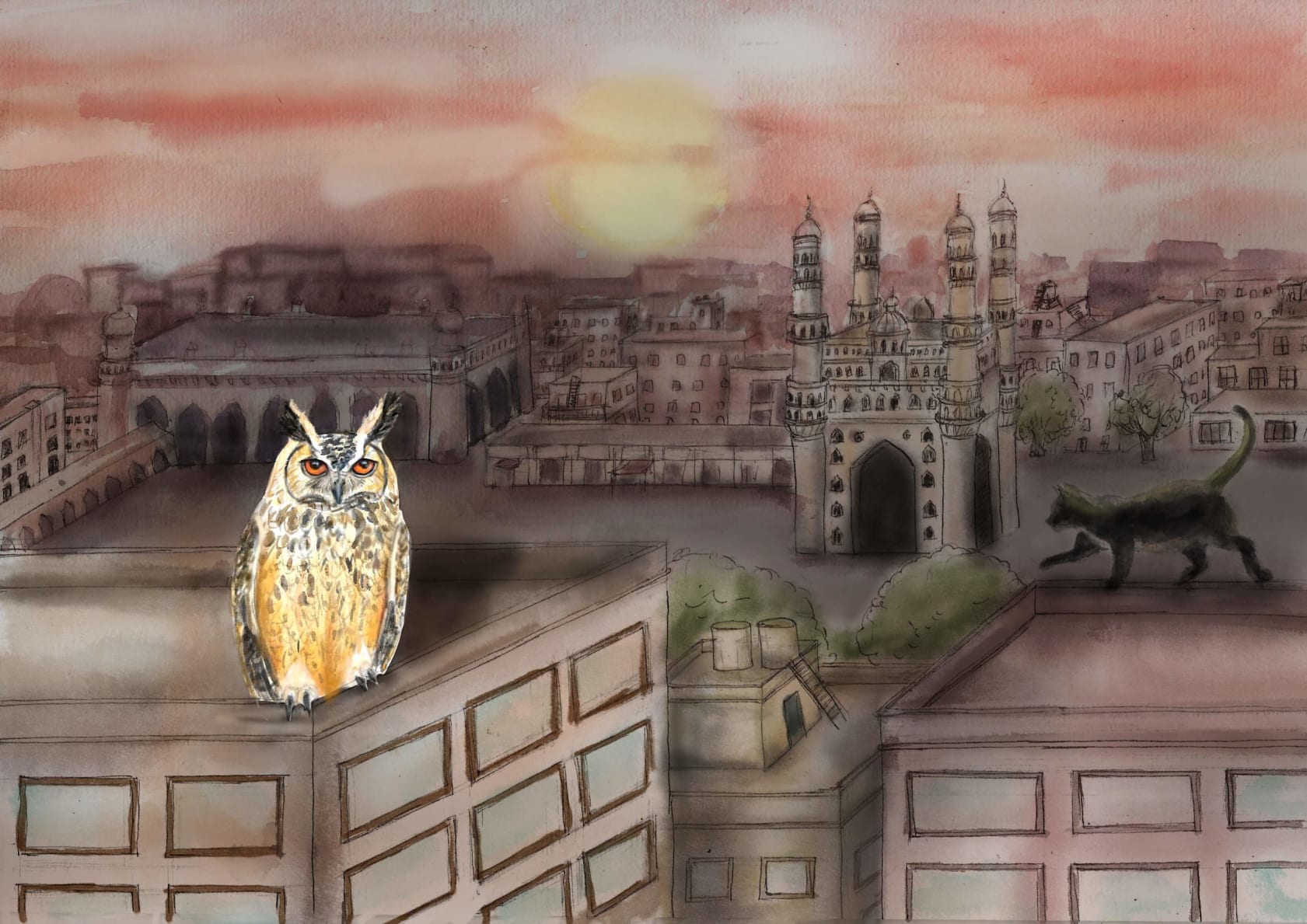
One time in Hyderabad, I heard an unusually loud sound late in the evening and went to the balcony in the busy Begumpet area. A rock eagle owl (Bubo bengalensis), the size of a cat, was perched atop a four-storey building across our residence block. For about 10 minutes, I watched in stunned fascination. Then, spreading her majestic wings, she turned her back and sailed away.
We currently live in Ulsoor, Bengaluru, near a large army campus. I often hear owls and sit by the window late into the night to listen to them call. On a walk, I once saw a spotted owlet spring from inside the trunk of an old mango tree. On another day, a barn owl, perhaps lost, took shelter in a soursop tree across our kitchen window. I watched it quietly. Then the other resident birds created a ruckus, and she left as soon as the sun went down.
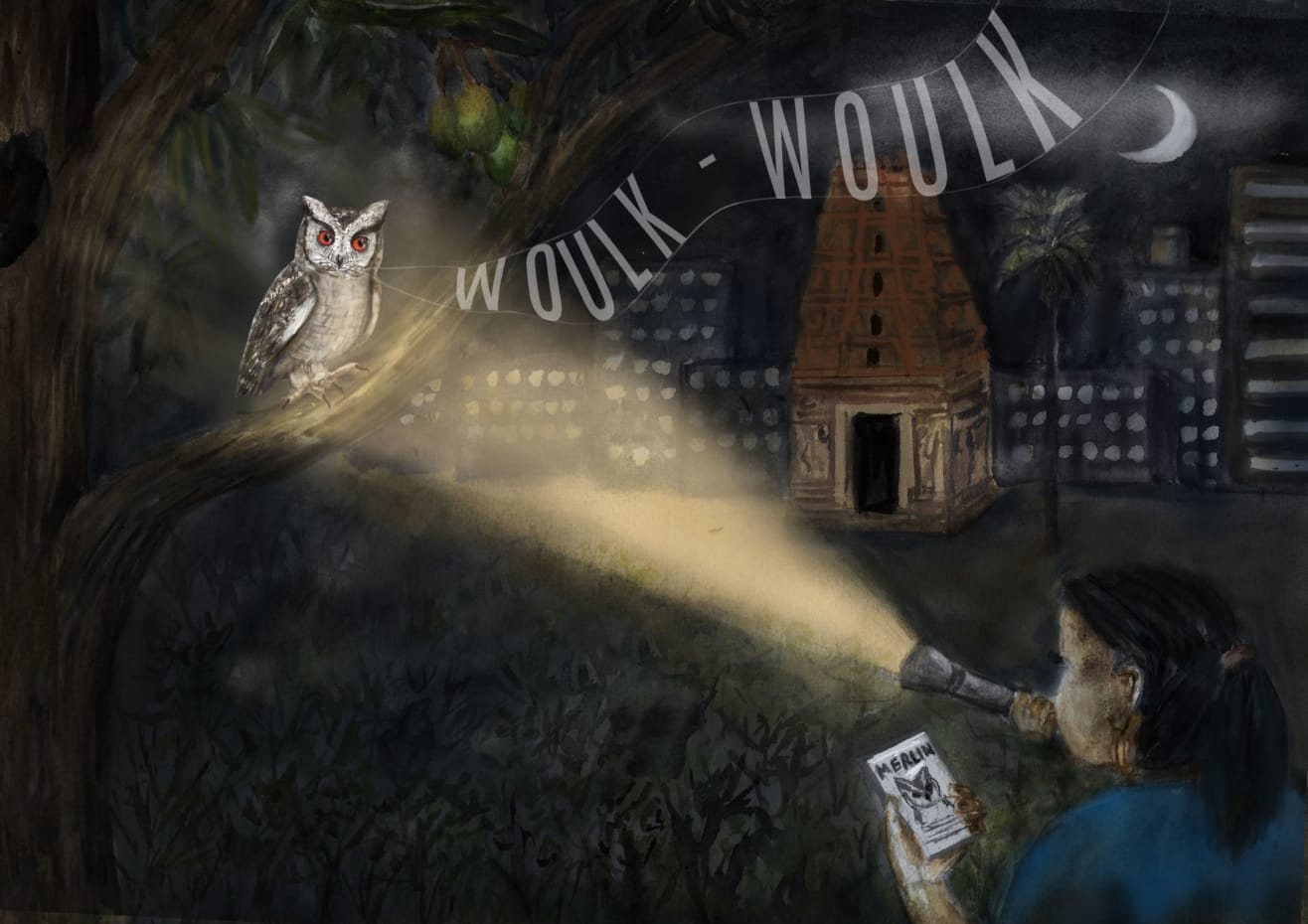
Even serious birders with immense knowledge confess that recognising bird calls is tough. What confused me for the longest time was that the owl’s call is named “hoot”. I could never hear any “hoot-hoot-hoot”. In June 2026, a birder friend told me about the Merlin app. I now know that there are at least 14 bird species around us. One evening, I heard two calls which sounded like owls. I opened the app. It recorded both a scops owl and a spotted owlet. I followed the rhythmic “woulk-woulk-woulk”, which seemed very close. But it was dark, and I could barely see. Excited and hesitant, I got a flashlight. There it was, an Indian scops owl on the mango tree.
Nothing seems to deter the authorities from axing trees in our area, neither soaring temperatures nor the lack of shade. In pursuing owls, I have learnt to identify trees. I know more bird species. My interests have expanded, and I understand our interconnectedness and the need for synergy among all living beings for survival; I appreciate how varied living species support one another.
During a programme where I discussed consumer choices — what we eat, wear, read, and do — a young woman asked me, “What brings meaning to your everyday life?” As I answered hesitantly, I realised that meaning comes from alignment. For me, it means noticing what is pushed to the margins, taking action, and sharing the experience. To care for neglected and injured birds and animals, supporting handmade and handloom crafts, gifting books, donating blood, or connecting people.
Now when I hear owls, I know they are flying by. I nod. I feel reassured.
And my one-sided love story continues.
About the Authors

Anuradha Pati