Listen to this article
•
15:34 min
Listen to this article
•
15:34 min
Past the Athirappilly Falls in Kerala’s Thrissur district, a state highway meanders through the lush forests of Vazhachal, eventually making its way towards Valparai. The road sees considerable daily traffic, and the attitudes of people driving through range from indifference towards wildlife to excitement at the sight of elephants or leopards. But a drive down this road with the windows rolled down also opens your senses to a whole new world of the forest’s avian residents. We drive slowly, keeping our eyes and ears peeled, letting into the car the slightly maniacal cackle of Malabar grey hornbills along with the shrieking of racket-tailed drongos and hill mynas as they swoop through the canopy. The soft clicking of flowerpeckers sounds constantly in the background, as does the unmistakable “khut-roo” of the ubiquitous white-cheeked barbet. A whistle from high above is accompanied by a swift shadow on the ground — the speck of a black eagle climbs into the sky.
The habitats around Athirappilly, from the wet evergreen forests upstream of the Chalakkudy River to the fragmented mix of native trees and plantations downstream, host an incredible range of birdlife, some of which is endemic to the Western Ghats. While some birds, such as parakeets and starlings, thrive even in the plantations, others are more strongly tied to their niches in the forests above. Dark-fronted and puff-throated babblers forage in the forest understorey — a microhabitat typically absent in monoculture plantations — while white-bellied treepies, bulbuls, and flycatchers use the middle and upper reaches of the canopy.
As we head down to the Chalakkudy River hoping for hornbills, we walk through swathes of oil palm and rubber, and I wonder how the endemic Malabar pied hornbill flourishes across this landscape. Observing them, I notice them feeding at fruiting Ficus trees and flying to roost in moist deciduous trees along the riverbank. Such observations in Athirappilly echo the story of fragmentation and survival that plays out across the Western Ghats. As primary and secondary native forests become increasingly sparse, maintaining these fragments is crucial to the survival of several specialist bird species in the region.


(1) The Malabar imperial-pigeon (Ducula cuprea) and (2) grey-fronted green-pigeon (Treron affinis) are large pigeons restricted to the moist lowland and hill forests of the Western Ghats (although grey-fronted green pigeons are seen in other parts of South India). These frugivorous birds forage in the upper canopy and rely heavily on native fruiting trees for their diet. Despite their size, their colour and shape let them camouflage easily in leafy canopies. Grey-fronted green pigeons are often noticed only when they fly out with their distinct, cascading siren calls. Interestingly, they achieve the olive-green colour that lends them their name from carotenoid pigments found in their diet. Besides acting as colour pigments, these carotenoids are also essential for physiological functions connected to their immunity.

Our foray into an oil palm plantation one evening is rewarded with the unmistakable shrieking of (1) plum-headed parakeets (Psittacula cyanocephala) and the distinct “zi-zi-zi” call of (2) vernal hanging parrots (Loriculus vernalis) in flight. Craning my neck to watch them zip overhead, I see them alight on tightly packed clusters of fruit nestled in mature palm trees and attack them with gusto. True to its name, the male plum-headed parakeet, with its pinkish-purple head, stands out against the bright yellow background of palm fruit. Loud squawks from within the palm fronds are followed by the exit of a few starlings. Raucously outcompeted, the flock heads elsewhere in search of food.

In the chaos of activity, lucky birdwatchers occasionally spot the endemic Malabar parakeet (Psittacula columboides). A bird of forests and forest edges, it enjoys the easy rewards of abundant palm fruit as much as its more widespread cousins.
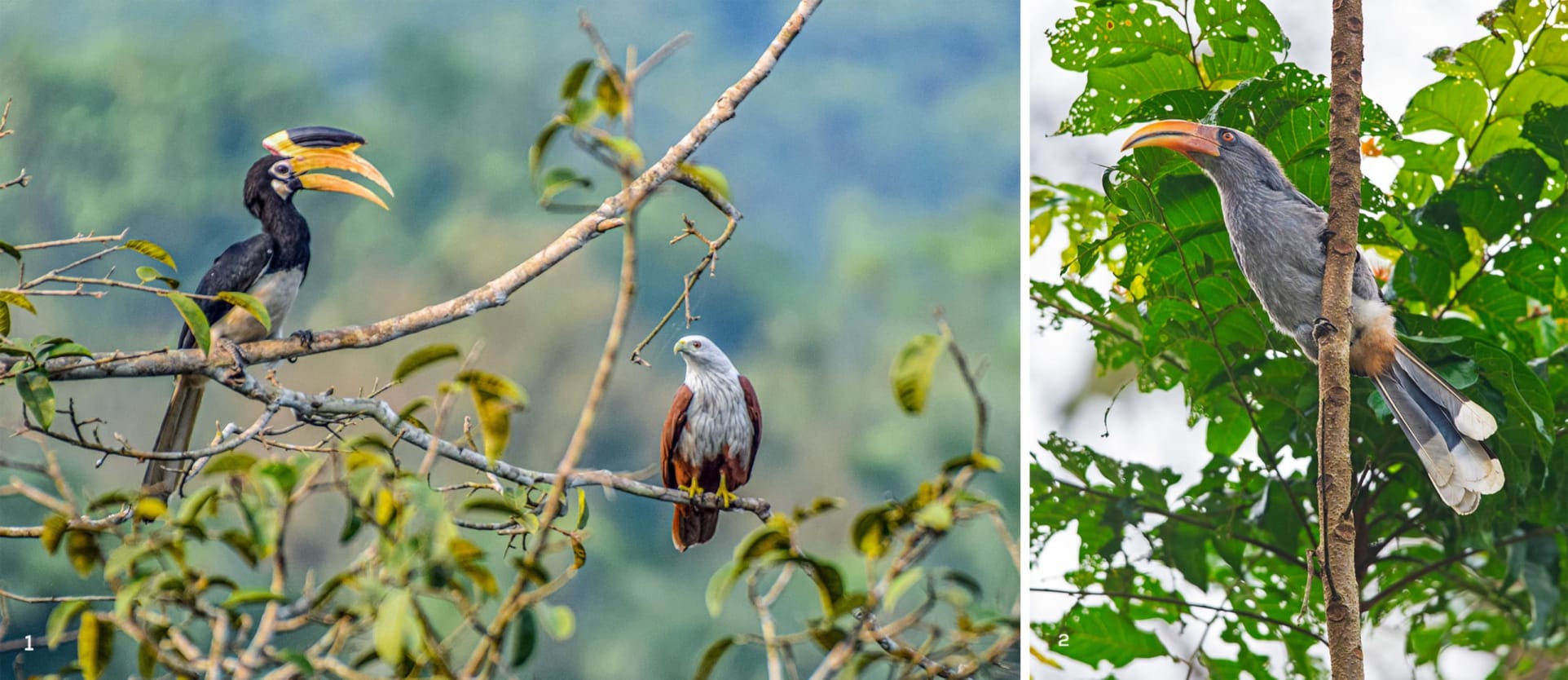

As we wait by the roadside under the canopy sounds of swaying branches and the cascading rat-a-tat of giant squirrels, movement in the foliage nearby resolves into a pair of foraging Malabar grey hornbills (Ocyceros griseus). Despite being primarily frugivorous, these birds, like other hornbills in the region, are opportunistic omnivores (eating whatever is available), a fact supported by the hairy caterpillar I see being thwacked against a branch by a determined female. The habitats around Athirappilly host all four hornbill species of the region, with the Malabar grey hornbill endemic to the Western Ghats. These birds are key seed dispersers for native trees and rely on them for their diet and for nesting. A hornbill nest survey in Vazhachal revealed that the nesting sites of (1) Malabar pied hornbills (Anthracoceros coronatus) and (3) great hornbills (Buceros bicornis) in the region are restricted to riparian edge forests along the Chalakkudy River and the evergreen forests found upstream. During the nesting season, these birds nest in holes in tree trunks, and the female is sealed inside with the eggs while the male forages for the family. Once the chicks hatch and grow, the female breaks out and joins the foraging effort.
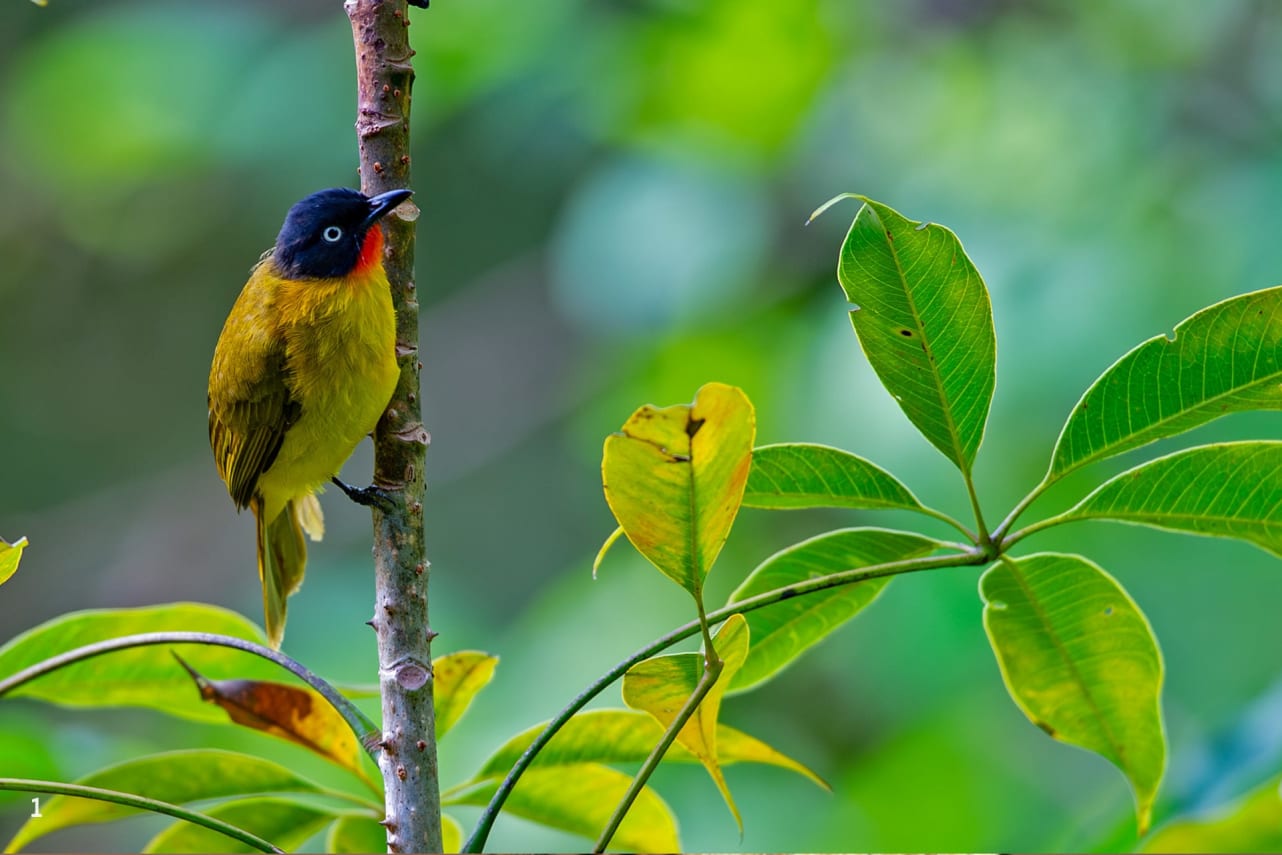

In habitats across the world, birds of different species forage together in roving groups known as mixed-species flocks or mixed hunting parties. These groups mainly host insectivorous birds that benefit from foraging together as they find new feeding sites and prey on insects flushed out by other flock members. The flocks also function partly because of the varying foraging patterns of their participants — different species forage at different levels in the vegetation, from understorey to canopy. (1) The flame-throated bulbul (Rubigula gularis) gleans insects off the foliage while the (2) bar-winged flycatcher-shrike (Hemipus picatus) catches them midair. The mutually exclusive nature of these sub-groups allows the flock to function cohesively without competing for resources.

While these flocks are common, Western Ghats endemics such as the Malabar flameback (Chrysocolaptes socialis) and flame-throated bulbul participate in them, making them fascinating to observe. However, these endemics are often absent in flocks that form in degraded forests and plantations in the region (though individual birds may still be seen). Such clear gaps between the capacities of different bird species to cope with changing habitats highlight the need to preserve the existing swathes of native tree cover found across the Athirappilly landscape.
About the Author

Smriti Mahesh
is a project assistant at BEE Lab in IISER Thiruvananthapuram. Besides deceiving ants for research purposes, she enjoys pottering about in the forest and fiddling aimlessly with her violin.