Listen to this article
•
15:34 min
Listen to this article
•
15:34 min
During my PhD journey, I spent a lot of time watching birds in western Arunachal Pradesh, north of the Brahmaputra. Later, I was keen on birdwatching south of the mighty river. It may seem like an odd geographic desire, but the Brahmaputra acts as an important biogeographical boundary between the Eastern Himalaya and the Indo-Burma biodiversity hotspots. Despite being separated by only about 10 km, numerous bird species exist only on one side of the river. I knew that if I wanted to meet some of the long-lost cousins of the birds I had seen in western Arunachal, I would need to visit the Patkai, Naga, and Mizo hills. These hills extend from southeastern Arunachal Pradesh into Nagaland, Manipur, and Mizoram, forming a natural boundary between India and Myanmar. It was only in March 2026 that I finally got the chance to visit Nagaland, and I had my eyes out for some of these special birds I had never seen before (lifers in birdwatching lingo).
With our wonderful guide, Kevingulie Hiekha, and renowned wildlife photographer, Dhritiman Mukherjee, we set out to watch birds along a road connecting the villages of Khonoma, Dzuleke, and Benreu. Situated around 2,000 metres above sea level, these were among the most scenic villages I have visited. Along this 50 km stretch of road, we were surrounded by beautiful forests, clear streams, steep ravines and idyllic farmlands. Additionally, apart from weekend picnickers, this tranquil road doesn’t see much traffic. By visiting midweek, we had all the right ingredients to maximise our chances of seeing many of the region’s birds. As luck would have it, in five and a half days, we spotted 133 species, over one-fourth of all bird species in Nagaland.


One of the most sought-after birds in (1) the hills around Khonoma is the (2&3) Naga wren-babbler (Spelaeornis chocolatinus). It is endemic to the Naga Hills, but each hill system in the region has isolated populations of closely related species that look and sound very similar. The Khasi Hills have the tawny-breasted wren-babbler (Spelaeornis longicaudatus), the Patkai Hills have the yet undescribed Lisu wren-babbler, and the Mizo Hills have the Chin Hills wren-babbler (Spelaeornis oatesi). We heard the Naga wren-babbler at multiple spots near Khonoma village but didn’t spot it. Our guide, Kevin, then suggested a spot with less dense bushes and slightly bolder birds. A 40-minute uphill trek later, we reached the spot mildly out of breath (six months of city life had taken its toll). There, two birds were singing close together; soon, they hopped into an opening, allowing us to watch them sing to each other. The sighting lasted only about 30 seconds because, as soon as they detected our prying eyes, the birds quickly escaped, not to be seen again.

Laughingthrushes are one of my favourite groups of birds, and the tiny state of Nagaland is home to 17 out of the 30 species found in India. I had seen 22 species and was hoping to add five more on this trip. Despite being large birds, they are notoriously hard to spot because they are extremely shy and reluctant to leave the shrubbery. This can be frustrating, but the thrill is in the chase.

The first one we spotted was the striped laughingthrush (Trochalopteron virgatum) (pictured here), a sleek, attractive bird. At the edge of the forest, we heard a bird rustling through bushes by the side of the road and tracked its movement for about 15 minutes. As it moved from one bush to the next, it hopped onto an open perch for about two seconds. The striking white streaks against the chestnut head caught my eye, but the bird vanished before I could raise the binoculars to my eyes. Somehow, Dhritiman was faster, snapping the photo at superhuman pace.
The second laughingthrush we spotted was the Assam laughingthrush (Trochalopteron chrysopterum), which unexpectedly made a split-second appearance on the way down from the Naga wren-babbler spot. Unfortunately, there wasn’t enough time to photograph it. Its Himalayan cousin, north of the Brahmaputra, the chestnut-crowned laughingthrush (Trochalopteron erythrocephalum), looks remarkably similar and was considered the same species until the early 2000s.
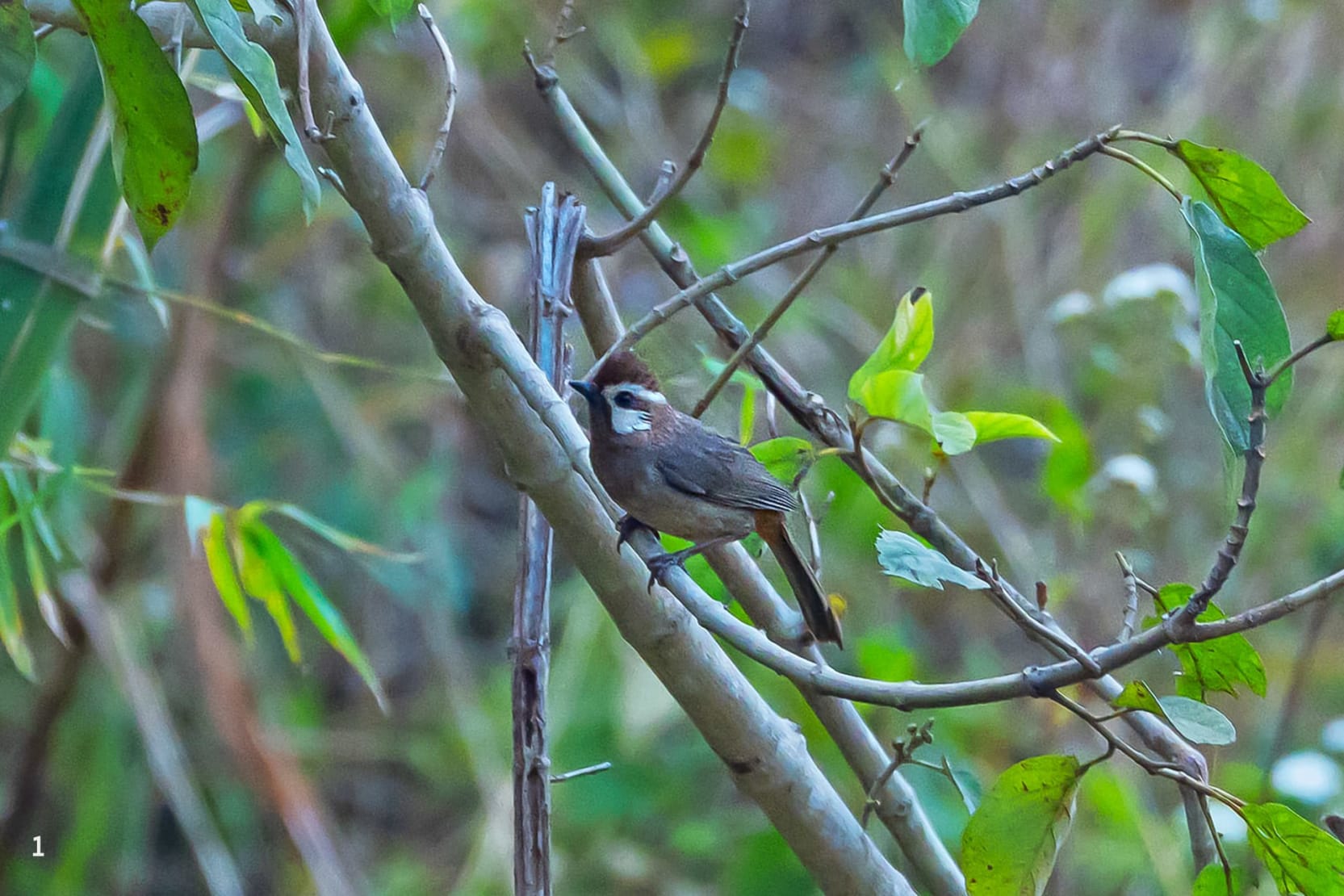

The third and final laughingthrush that we saw on our last morning was the (1) white-browed laughingthrush (Pterorhinus sannio). This bird took us to the (2) picturesque agricultural terraces of Khonoma, where it seemed to occupy the overgrown hedges between crop land. Our first attempt to see this bird was the previous evening, when we spent around 3 hours scouring the area to no avail. Our optimism was gradually diminishing as it was very windy, and very few birds were flying about. At dusk, we started hearing the laughingthrushes move down the mountain and settle into the agricultural fields. Thereafter, it got very dark very fast. We didn’t actually see the birds, but we seemed to have figured out where they roosted. We planned to arrive at dawn the following morning and hopefully catch a glimpse of white-browed laughingthrushes as they awoke and started their daily business. The plan worked, and we saw at least six birds in the beautiful morning light. Like the other laughingthrushes, they too were extremely secretive, giving us a few glimpses as they dispersed up the mountain slope. We tried hard to spot the remaining two species, which included the brown-capped laughingthrush (Trochalopteron austeni) and the spot-throated laughingthrush (Garrulax merulinus), but there was no sign of them. This was probably a sign that I need to visit this place again.

To find the spot-breasted parrotbill (Paradoxornis guttaticollis), we employed the opposite strategy. Near the village of Benreu, an hour after sunrise, we patiently waited at the edge of a steep ravine for the birds to make their way up the slope. Kevin knew the exact spot where they would cross the road, but warned us that the wait could be long, and so we used the time to eat our breakfast. After waiting for a little over an hour with my hands cupped to my ears, I thought I heard the faint call of the parrotbill from the bottom of the valley. When my companions heard nothing, I began to wonder whether my desperation to see the bird was making my mind play tricks on me. About 10 minutes later, my ears were vindicated, and we clearly heard around four birds moving up towards us. The parrotbills finally reached us, and we got wonderful views of them as they crossed the road, while calling continuously (presumably to keep the flock together). What really struck me was how these birds used their large parrot-like bills to violently twist and break branches and bamboo while feeding on insects within. I’ve had enough skin on my fingers torn off by smaller parrotbills during my PhD research to be thankful that the massive spot-breasted parrotbill isn’t found at my field site.

Fortunately, not all the birds we were attempting to see were as hard to spot. The rusty-capped fulvetta (Schoeniparus dubius) is a small, mostly brown bird with white brows and a bright orange forehead which catches one’s eye in the dark forest understory. Moving frenetically in groups of 7–10 birds, they weave through the dense vegetation with such speed that isolating a single bird for a clear photograph is difficult.
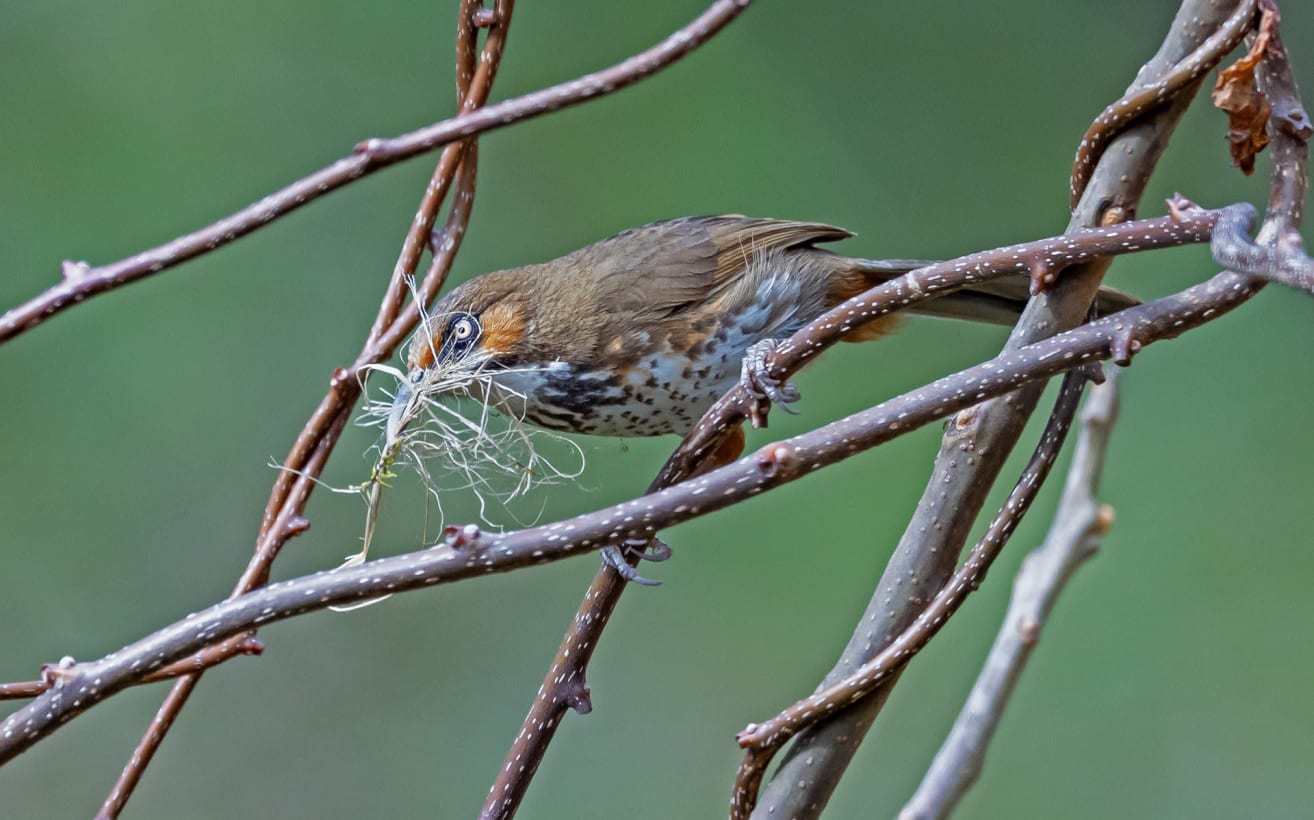
The spot-breasted scimitar-babbler (Erythrogenys mcclellandi) is a noisy bird with a long, curved sword-like bill, found in most overgrown bushes around the village. The one in this image was enthusiastically collecting plant fibres around our Benreu homestay, presumably for a nearby nest.

Many chestnut-vented nuthatches (Sitta nagaensis) were seen scuttling about on tree trunks, using their beaks to prod under the bark for insects. The species gets its scientific name from the Naga Hills, where it was first described by HH Godwin-Austen, the British explorer whose name is on the world’s second-highest mountain (K2/Mt Godwin-Austen).

A curious-looking bulbul with a broad finch-like yellow bill inhabits the forests and scrublands south of the Brahmaputra. It is called the crested finchbill (Spizixos canifrons), and we saw large flocks of about 20-30 birds around many of the fruiting trees of Khonoma and Dzuleke.

About three hours after sunrise, bird activity steadily declined. While the others were taking a short break, I ambled along the edge of the road, lost in thought. The melodic sound of a familiar, yet unfamiliar warbler broke the quiet. It was coming from bushes close to me, but I couldn’t quite see a bird. I tried to identify the song by playing recordings of various warblers on my Merlin bird app until one species seemed to match perfectly. It was the grey-crowned warbler (Phylloscopus tephrocephalus), a species new to me and one I wasn’t expecting at all. After spending the winter across southern Myanmar, Thailand, and Vietnam, these birds were likely just arriving in the hills to begin their breeding season. Although this bird stayed hidden, Kevin helped us spot a pair, two days later, feeding in the open at dawn.
About the Authors

Tarun Menon
is an avid naturalist, birdwatcher and ornithologist. His interests lie in understanding the behaviour and adaptations of mountain birds.