Listen to this article
•
15:34 min
Listen to this article
•
15:34 min
During the COVID lockdown of 2020, when much of life moved online, I returned to my home in Bongaon, West Bengal. It had been a decade since I left home or spent that much time with my family. During the rainy season, I usually observe insects and small creatures. However, one morning, after a spell of rain, something else caught my attention: a huge colony of pale, gilled mushrooms growing from a decaying tree trunk in our backyard. In the first light, the funnel-like caps were white, with a pearly sheen; they looked magical. I brought out my camera, and as I zoomed in, I saw their intricate, fascinating gill structure, which drew me into a whole new world of mushrooms, diverse in colour, texture, and mystery.
After that, there was no looking back. I began looking for mushrooms in backyards, orchards, bamboo groves, roadside log piles, damp bark, and leaf litter. A heavy shower, the smell of wet soil, or a gentle mist hanging low over an orchard became an invitation to look again. The mushrooms were diverse: beaming bright and dramatic or fragile and so tiny they were hard to spot.
My nine-year-old niece became my partner in crime, rushing to announce, “Kaka, ekta notun mushroom dekhechi, cholo cholo!” (Uncle, I saw a new mushroom, come, let’s go). Other neighbourhood children also became interested and enthusiastic about this quest and began pointing them out to me. Neighbours invited me into their backyards or orchards when an unusual fungus appeared.
These photographs are from that season of looking closely. They are not from the wilderness or backcountry but from familiar, inhabited spaces. They reveal a wonderful world of fungi in different shapes, colours, and forms, and as decomposers or shelters — signalling renewal in landscapes we often walk past without noticing.
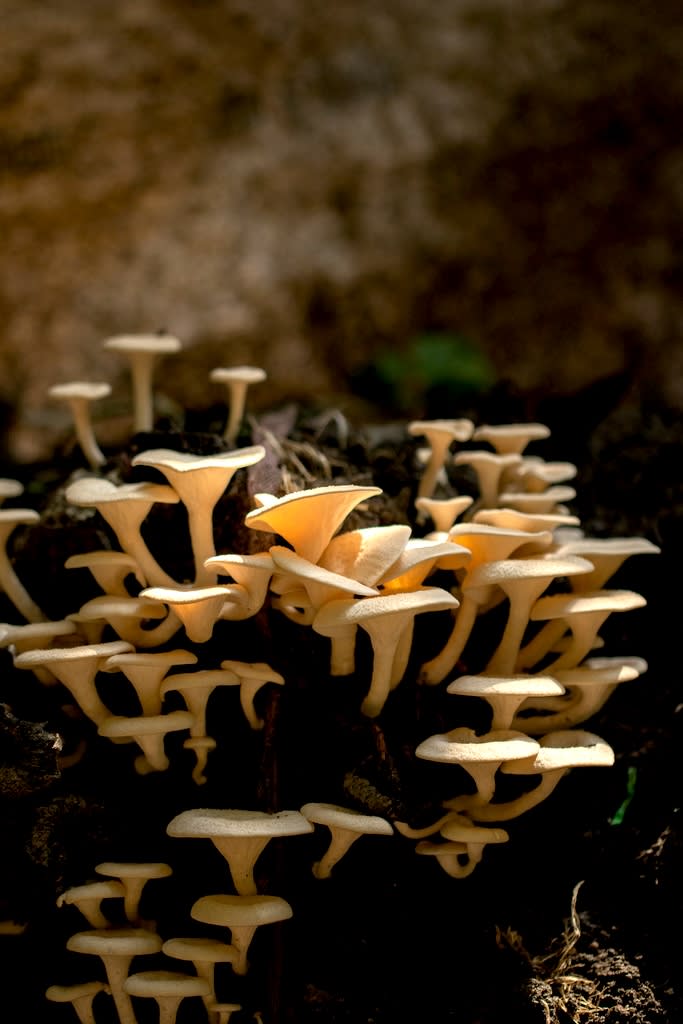
Oyster mushroom on a backyard trunk
This pale, gilled mushroom, identified from field photographs as probably belonging to the genus Lentinus, started it all. It showed up on a decaying tree trunk in my backyard after the rains. I was drawn to its pearl-like colour and clustered form, but the real surprise came when I peered at it through my camera lens. The fine, repeated structures turned a familiar log in the backyard into a miniature landscape.


A colony of crumble caps
These tiny mushrooms, probably of the genus Coprinellus, appeared in large numbers on damp, decaying wood surrounded by leaf litter. Their abundance was mesmerising: one day, the trunk was crowded with off-white caps; the next day, many had collapsed into dark, broken umbrella-like remains. Many mushrooms live briefly above ground, and finding them depends on rain, timing, and luck.
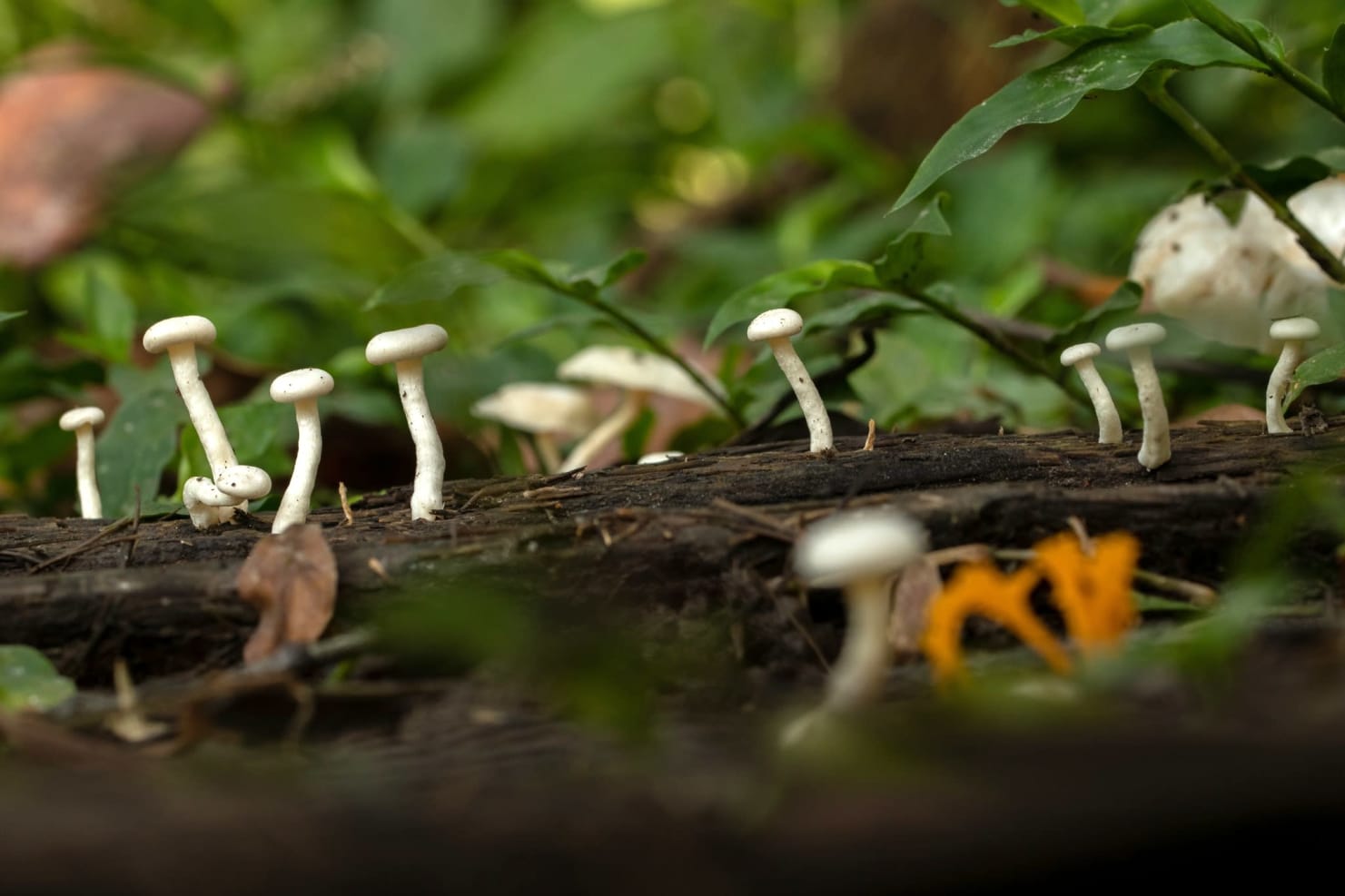
It was a complete microhabitat: old wood, green surroundings, pale mushrooms, and orange jelly fungus nearby (likely Dacryopinax sp.). Fungi are silent workers of such places, decomposing dead wood and helping return nutrients to the soil.


Tiny orange umbrellas in leaf litter
In the bamboo grove, I learnt to slow down. I slip in quietly and scan the leaf litter. One day, I spotted a tiny orange umbrella, then two, and more. Soon, the orchard floor seemed full of these delicate parachute-like mushrooms. Were they Marasmius sp., I wondered. Such tiny fungi are easy to miss, but once noticed, they change the way we look at leaf litter.

Earthstars near a mossy tree base
The first time I saw an earthstar (probably of the genus Geastrum), it felt like finding a star on the ground. I’d spotted a small colony near the mossy base of a chopped coconut tree in an orchard. In its early stages, it looks like a brown ball. But when it opens, the outer layer splits and expands like a star. Fungi often surprise us because they do not always look like the mushrooms we know and recognise.
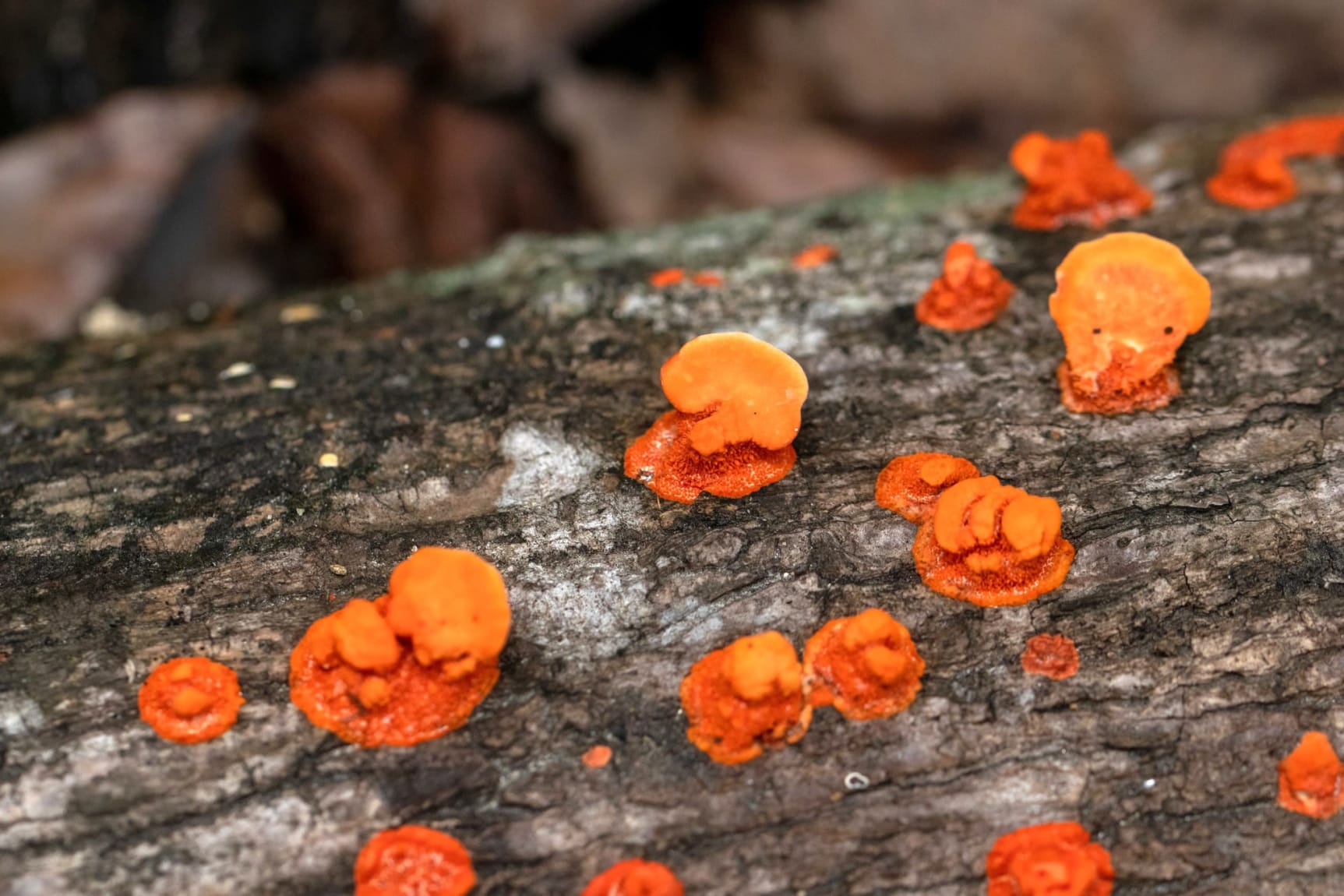

Violet cups on fallen wood
These violet cup fungi (probably Geoscypha sp.) grew in a large colony on a fallen tree trunk. Their shapes reminded me of tiny ears; all gathered closely on the wood. It’s always exciting to see a new kind of fungus, but this one was truly remarkable, with a whole hidden gathering on a piece of dead wood.

Such moments reveal that mushrooms are part of their environment and not isolated entities. Fungi can provide food, moisture, shelter, or simply a surface for tiny creatures moving through the wet monsoon landscape.
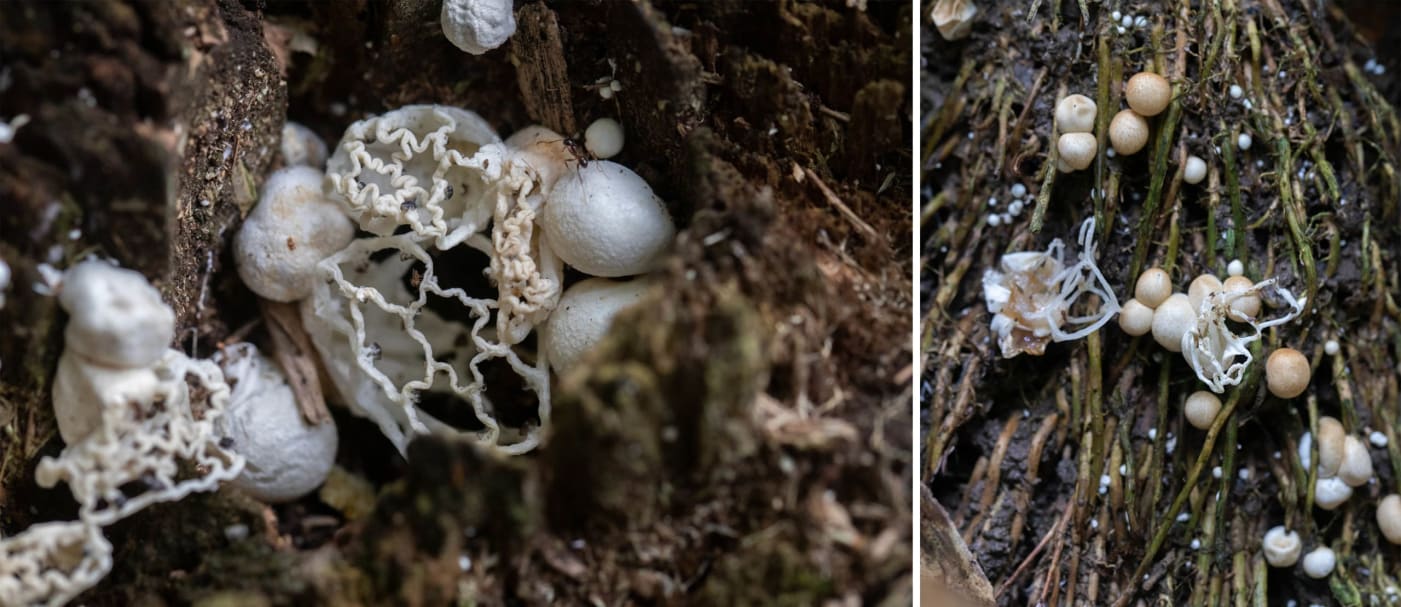
Delicate lace stinkhorn
The delicate lace stinkhorn, Clathrus delicatus, was one of the most peculiar fungi I have seen. It emerged close to the base of the bamboo, encircled by fallen leaves. At first, I thought I saw white egg-like structures. Later, some opened into cage-like forms, attracting fruit flies and other insects. Stinkhorns are strange and environmentally astute because they employ scent and visiting insects to help spread their spores.

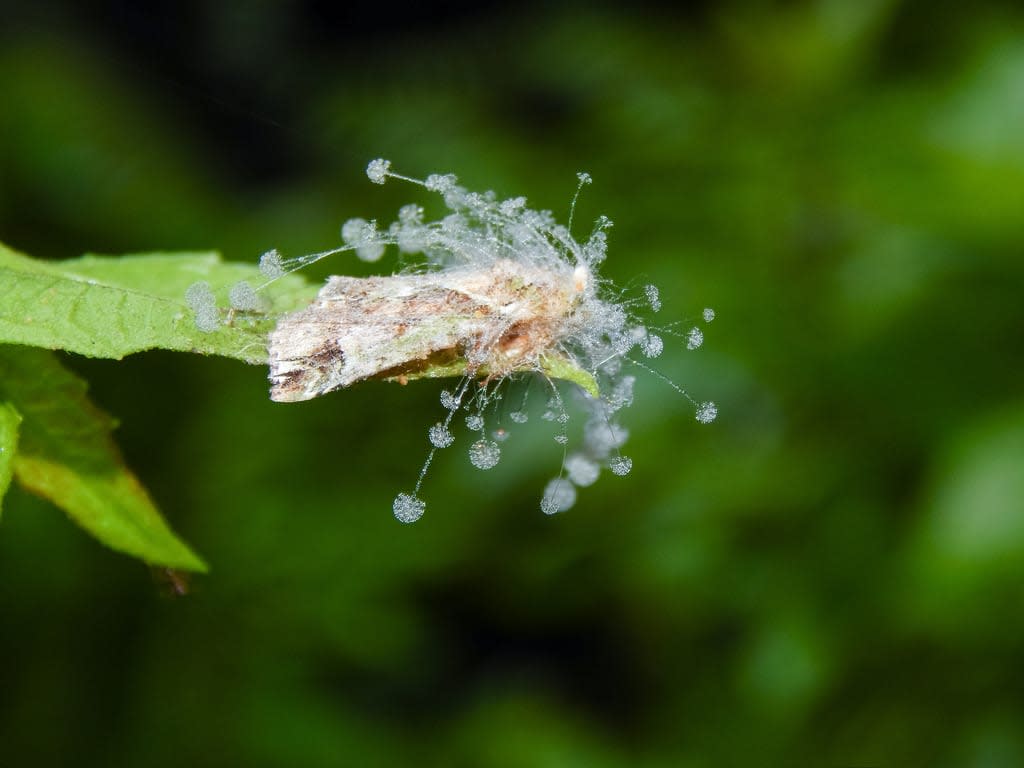
Pin mould on a dead moth
In a patch of woodland, I saw this pin mould (likely Sporodiniella sp.) growing from a dead moth. A delicate, flower-like structure sprouting from a lifeless creature was one of the most amazing things I have captured on camera. It encapsulates a central truth about fungi. After it rains, they are more than just decorations. They are part of the unseen processes that keep ecosystems alive as they decay, change, and rejuvenate.
About the Author