 Listen to this article
•
15:34 min
Listen to this article
•
15:34 min
As February comes to an end and spring marches in, the hills of Northeast India come alive with the sounds of nature. Visiting Khonoma, Nagaland, in the spring of 2026 reminded me of an old quote by Charles Dickens in Great Expectations, where he describes March as a time when “the sun shines hot, and the wind blows cold: when it is summer in the light, and winter in the shade”. I would like to add to this description by highlighting the weather’s unpredictability— sunny one minute and hailing the next. And the wind doesn’t simply blow; it uproots trees on occasion. Yet, springtime in Khonoma is incredibly romantic. Hues of red, green, yellow, orange and white adorn the forest canopy; insects are feverishly feeding on the sudden glut of food after the cold, and birdsong fills the air as male birds try their best to impress females.
Most of the wildlife that I spotted was invariably around fruiting or flowering plants. The sugar-rich nectar and fruit are important resources after the lean winter, allowing birds to replenish their energy stores for the breeding and nesting that follow. Unfortunately, research in temperate regions has shown that climate change is causing spring to arrive earlier. So, while the plants have started flowering and fruiting sooner in the year, the birds haven’t been able to bring forward their breeding cycles. This creates a timing mismatch: by the time the birds start breeding, there isn’t much fruit or nectar left, which can affect their ability to reproduce and raise young.
The fruiting and flowering plants act like magnets, attracting insects, birds, and mammals from the vicinity. Engrossed in their meal, these otherwise shy birds seem very bold, allowing us to creep up and observe them at close quarters.

A few moments later, my theory was disproved when we saw about 70 birds from 20 species in a feeding frenzy. The shrub they were all feeding on is called Debregeasia longifolia or orange wild rhea. There were about 15 shrubs, all seven to eight feet high, with clusters of small, sweet, berry-like fruits. The sheer amount of fruit in such a small area probably meant that birds from within a radius of a few kilometres were here for the all-you-can-eat feast.


Several migratory birds use the abundant resources of spring to fuel up for their long, arduous journey back to their breeding grounds. The most exciting amongst these species was the eyebrowed thrush (Turdus obscurus), which breeds around Siberia and Mongolia and winters in Southeast Asia, including parts of Northeast India. Throughout the winter, it is a relatively uncommon sight around Khonoma, but from March on, one suddenly starts to see groups of 10-15 birds at fruiting trees.

Another closely related thrush that migrates relatively shorter distances is the grey-winged blackbird (Turdus boulboul). They breed in the middle elevations of the Himalayas and migrate down the mountain, with some moving farther south into the Naga Hills.

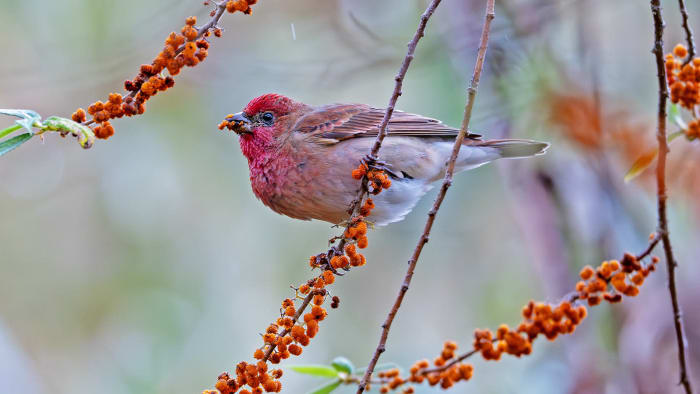
The photograph of the common rosefinch here accurately captures its scientific name (the Latin Carpodacus means “fruit-eating” and erythrinus refers to the beautiful red colour on its face and breast). This small, stout bird has a widespread distribution across Europe and Asia; however, the subspecies we see in Nagaland migrates here from the higher elevations of the Eastern Himalayas and the Tibetan Plateau.

The wild Himalayan cherry tree (Prunus cerasoides) is one of the most eye-catching trees in the forests around Khonoma. Its bright pink flowers bloom twice a year, in spring and autumn, adding a bright pop of colour when viewing the forest canopy from a distance.


Apart from birds, we also saw three species of squirrels feeding on various species of fruits and flowers. The smallest, and according to me the cutest, was the Himalayan striped squirrel (Tamiops mcclellandii). Here, it is extracting every last sip of nectar from the cherry blossoms.

We saw the orange-bellied squirrel (Dremomys lokriah) feeding on a flower. It seemed to be a flower from the family Lamiaceae, foraged from somewhere further away by the squirrel, but we couldn’t identify it.

There were a few wild walnut trees (Juglans regia) flowering, and among their visitors was the hoary-bellied squirrel (Callosciurus pygerythrus) nibbling on male flowers. Also known as the Irrawaddy squirrel, it is called “hoary” because of the greyish-white colour of its belly.


Among the more overlooked floral visitors, despite being the most numerous, are insects. One of the more charismatic ones is (1) the rock honey bee or the giant honey bee (Apis dorsata), seen here collecting nectar from bramble flowers (Rubus sp.).We were standing next to a rock face whose upper edge jutted out in a natural overhang, and tucked underneath were several beehives — some active, some abandoned. Rock honey bees are known to be aggressive when defending their colonies, so there were multiple signs warning visitors not to make loud sounds or disturb the hives in any way. We unsuccessfully kept an eye out for the yellow-rumped honeyguide (Indicator xanthonotus), a curious bird that includes beeswax as a staple part of its diet. They usually perch on shrubs nearby and eat wax and larvae from unguarded or abandoned beehives.
About the Author

Tarun Menon
is an avid naturalist, birdwatcher and ornithologist. His interests lie in understanding the behaviour and adaptations of mountain birds.