Listen to this article
•
15:34 min
Listen to this article
•
15:34 min
The first time I saw an Asiatic black bear (Ursus thibetanus) was in Dachigam National Park, close to my home. I was visiting the park in the company of a wildlife guard, with a camera in my hand and excitement in my heart. At 5.20 pm, we reached the spot where the bears are usually seen. The forest was settling into the evening shadows, and I waited eagerly for the bear to make its appearance. In hushed tones, I spoke to my experienced companion about the possible sighting. He guided me to a hide and informed me that the bear would appear at 6 pm. I smiled politely but interpreted his 6 pm to mean “around” 6 pm, as animals, of course, do not wear wristwatches. However, he was quite confident. So, I kept glancing at my watch, and to my great surprise, at precisely 6 pm, a majestic Asiatic black bear appeared in the clearing in front of us. I totally forgot to use my camera as I stood in complete awe of this rare sight and the bear’s flawless internal clock. I learned that their behaviour also aligned with the seasons, and that they would retreat to their shelters for hibernation with the arrival of winter and accompanying snowfall. Sadly, however, this is no longer a given.
Today, some black bears in Dachigam remain active throughout the winter, a drastic change from their normal behaviour. The reasons could be many, but one thing is certain — these changes symbolise adverse alterations to their habitat and climate. And the consequences of such changes are highly concerning.

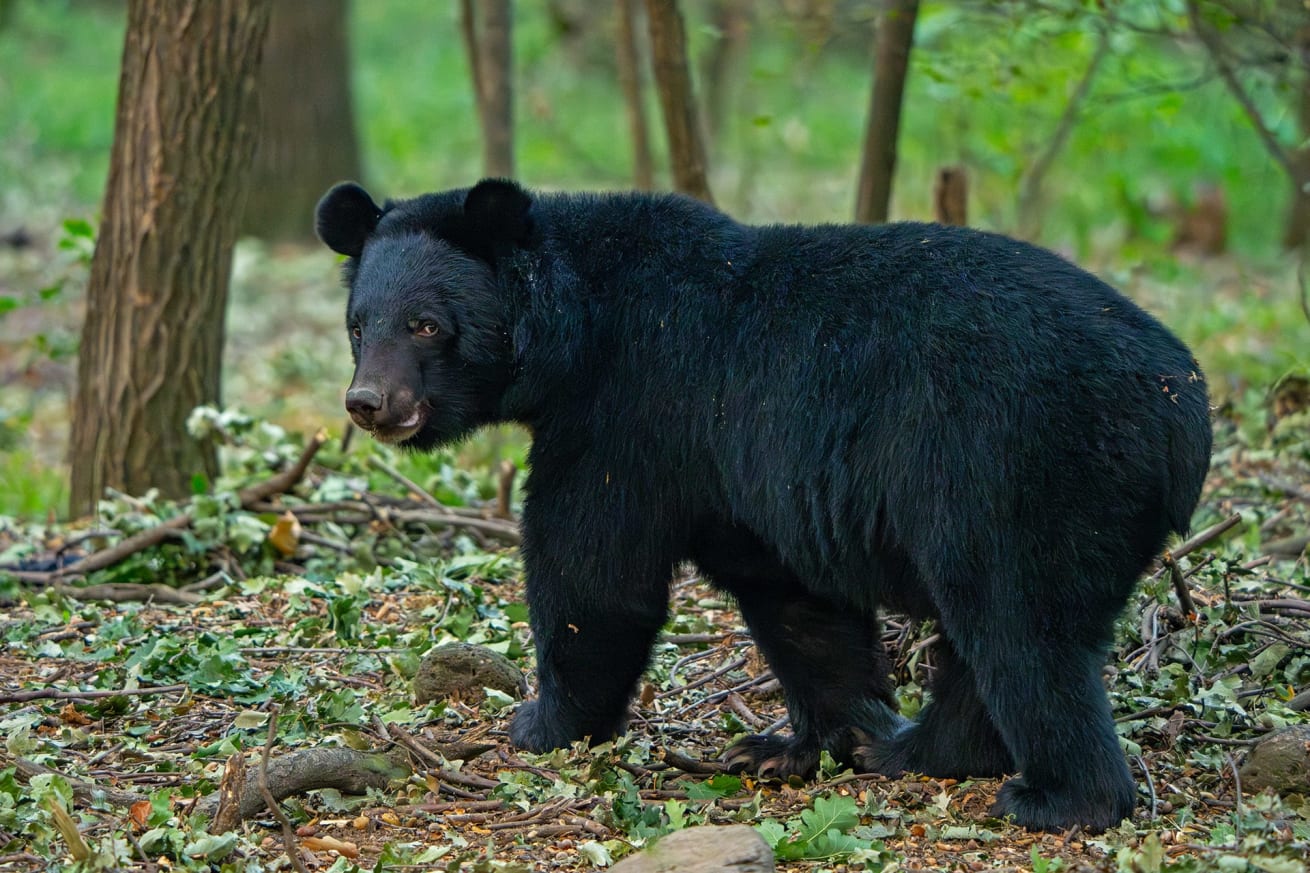
Cover Photo: The Asiatic black bear is also called the moon bear after the crescent moon-shaped white patch on its chest.
Winter Without Sleep
Dachigam National Park has one of the best (densest) populations of Asiatic black bears, often referred to as jungle ka maali (gardener of the forests) for their role in regenerating forests by dispersing seeds through defecation. They are an ecologically significant species and help maintain a healthy natural world. The usual behaviour of the Asiatic black bear is to hibernate with the onset of winter and sleep until the arrival of spring to escape the harsh cold. But now, things are different. Some Asiatic black bears do not hibernate at all. I confirmed this in the winter of 2025, when some Asiatic black bears were wandering around even after the snowfall. Their presence was confirmed both directly through sightings and indirectly through pugmarks and scat in the snow. This was an unusual observation for the winter. Interestingly, the scat contained only rosehip seeds, indicating food scarcity at the time and that rosehip was the only available food.
A similar incident was reported in November 2025, when a subadult Asiatic black bear roamed the Hazratbal area of Srinagar for about two weeks. Wildlife officials I spoke to told me they had to track the Asiatic black bear for 11 days to trap it to ensure its safety and that of local residents. Fortunately, during this time, no attacks on humans were reported, indicating that the Asiatic black bear did not want contact with humans. But the question is: Why did it land in the city instead of going to sleep in the winter? What did it feed on while spending so much of the time in the city? Garbage is the answer! Unmanaged waste thrown along roadsides serves as food for the Asiatic black bear when its normal food sources become scarce in winter. The way we dispose of our waste can trigger bear-human conflict.
Many other reasons can trigger a shift in bear behaviour, including the changing climate. Research has shown that over the past four decades, Kashmir has experienced a two-degree rise in temperature. Snowfall has become very uncertain. During my childhood, I recall that snowfall would arrive by December, and it was heavier than the snowfall of December 2025-January 2026. In 2026, we experienced less than a foot of snow in Srinagar and near Dachigam. Snowfall plays an important role in bear hibernation. Climate change is clearly severely affecting Asiatic black bear behaviour.

From Acorns to Insomnia
There are many possible reasons the Asiatic black bear is now staying awake in winter, but one factor that stood out clearly to me was the competition for food in its habitat. Before going into hibernation, Asiatic black bears must accumulate body fat to survive the long winter months. To satisfy this need, they rely on acorns from oak trees and feed heavily on them, as they are one of the richest sources of true fats available to them. Autumn (September and October) is therefore crucial in determining whether a bear can successfully hibernate.
During October 2025, while observing an Asiatic black bear, I noticed something unusual. I was surprised to see the wild boars aggressively feeding on the acorns, and at one point, I counted at least three competing for the same acorns. The bears appeared disturbed, unable to feed freely. This level of competition likely leads to a lower fat accumulation than required before winter.
In India, we often relate an adage to children: bacha khayega nahi to soyega kaise (how can a child who has not eaten sleep?). The same logic applies to bears: when food is insufficient and competition is high, some bears will likely fail to meet their fat reserve requirements. The fruiting of acorns occurs every other year, so if, in a particular year, the supply is low and a native species (bear) has to compete with an exotic species (boar), this increases competition.
It is important to note that wild boars were introduced to Kashmir by the maharaja Gulab Singh in the 1840s for hunting. The population declined in the mid-80s and became rare. In 2015, it was again sighted, and its population subsequently increased. Their growing population may be contributing to the ecological shifts. Today, wild boars aggressively compete with native species for key resources such as acorns in Dachigam. Their growing population may force other species, such as the Asiatic black bear, to adjust their normal behaviour to survive.

Community Perceptions and the Shifting Human-Bear Relationships
Ultimately, this change in the Asiatic black bear’s winter behaviour will shape how local communities perceive wildlife. For generations, communities living around Dachigam National Park coexisted peacefully with black bears, as these animals remained in dense forests, where there was abundant natural food, during the summer, and hibernated during winter. However, in the past few decades, much has changed. The chances of humans and bears coming into direct contact have increased manifold. Such interactions have changed people’s perceptions of these bears and sparked fear, confusion, and concern. Many residents now interpret these encounters as signs of an increase in bear numbers. However, ecological observations point to a different story. Bears are now responding to food scarcity in the forest, competition for traditional fat sources, and climate change rather than seeking conflict.
About the Authors