Listen to this article
•
15:34 min
Listen to this article
•
15:34 min
Sitting in a local cafe in Lahaul, I noticed a black bird gliding through the Himalayan poplar trees with the Drilbu-Ri mountains in the backdrop. Also known as “Bell Mountain”, Drilbu-Ri is considered Lahaul’s holiest site. According to locals, it is as sacred to Lahaulis as Kailash Mansarovar is to pilgrims from around South Asia. It was June 2025, and the snow had not yet disappeared. My colleagues and I had been visiting Lahaul in Himachal Pradesh since 2024, when we started Conservation indica, a non-profit working towards community-centred nature conservation. Seeing and understanding the landscape, ecology, and wildlife is part of the job. Having worked in the mid-Himalayas in the past, I was aware of the Himalayan blackbird, so I knew this was not that bird. I looked at the yellow beak and remembered that my advisor, Asad Rahmani, had once reminisced about it, describing it as a fascinating member of the Corvidae family. I recalled its name and mispronounced it as “choo-gh”; the correct pronunciation is “chuff”.
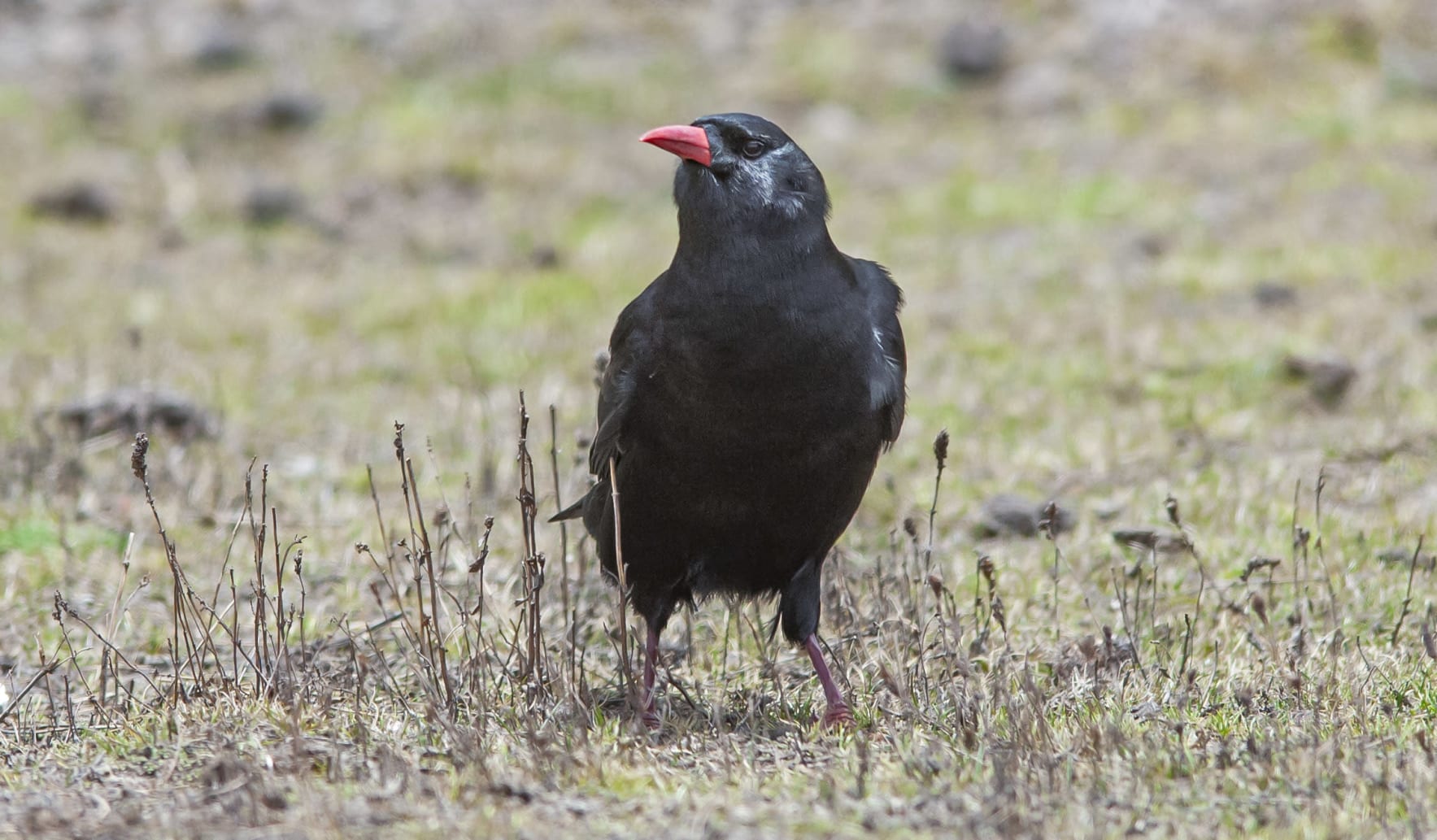
Alpine Chough and Red-billed Chough in Keylong
We lingered long hours in this cafe for the free Wi-Fi. Aditi sipped a lemon-ginger-honey infusion, and I, an awful-tasting tea. Laraib, a friend from the corporate world, tried to keep up with work.
Together, we are a group of curious individuals who quickly became captivated by this bird. While staring out of the window, I saw a similar but larger bird with a longer red beak and immediately reported it to Aditi, who then wanted to see it for herself. Later, on one of our evening walks from Keylong town to Billing village, crossing the Gangstang peak, I noticed a pair of red-billed choughs on a windowsill.
Two choughs share these valleys: the red-billed chough (Pyrrhocorax pyrrhocorax) and the yellow-billed, or alpine, chough (Pyrrhocorax graculus). Both are cliff-nesters of the crow family, usually moving in flocks outside the breeding season. They feed mainly on ground-dwelling insects and other invertebrates and often forage on pastures kept short by grazing livestock.
We talked to Premji, a friend with a large, generous and kind heart. He is also someone who, when he sees new people struggling even for a bit, he makes sure to adopt them and ease things for them. Tell him what’s bothering you, and he will help. He is a Buddhist man from Billing village who talks very fast, and it takes special hearing to decipher what he is saying. We asked about this bird we kept seeing glide, seemingly unfazed by the workings of the world. He said it is very common in the area, and Lahaulis call it kiang.

Are both the red-billed and yellow-billed birds called kiang? We queried.
He said, “The yellow beaked is kiang, and the red is khwa”, he said.
And while he told us the local names of these birds, he immediately assassinated their characters.
“The red one is a messenger of death”, he said.
“The yellow one is a ‘bechara’”. For Premji, bechara is the pinnacle of innocence. On many occasions, even we were referred to as becharas by him. And according to him, the yellow-billed chough is a symbol of good fortune, auspiciousness, and positivity.
In monasteries and on special occasions, sighting yellow-billed choughs is considered a good omen and interpreted through a spiritual lens. Locals say that both species are social. Yellow-billed choughs can gather in flocks of 1,000, while red-billed choughs are found in small groups and can form a flock of up to 200.
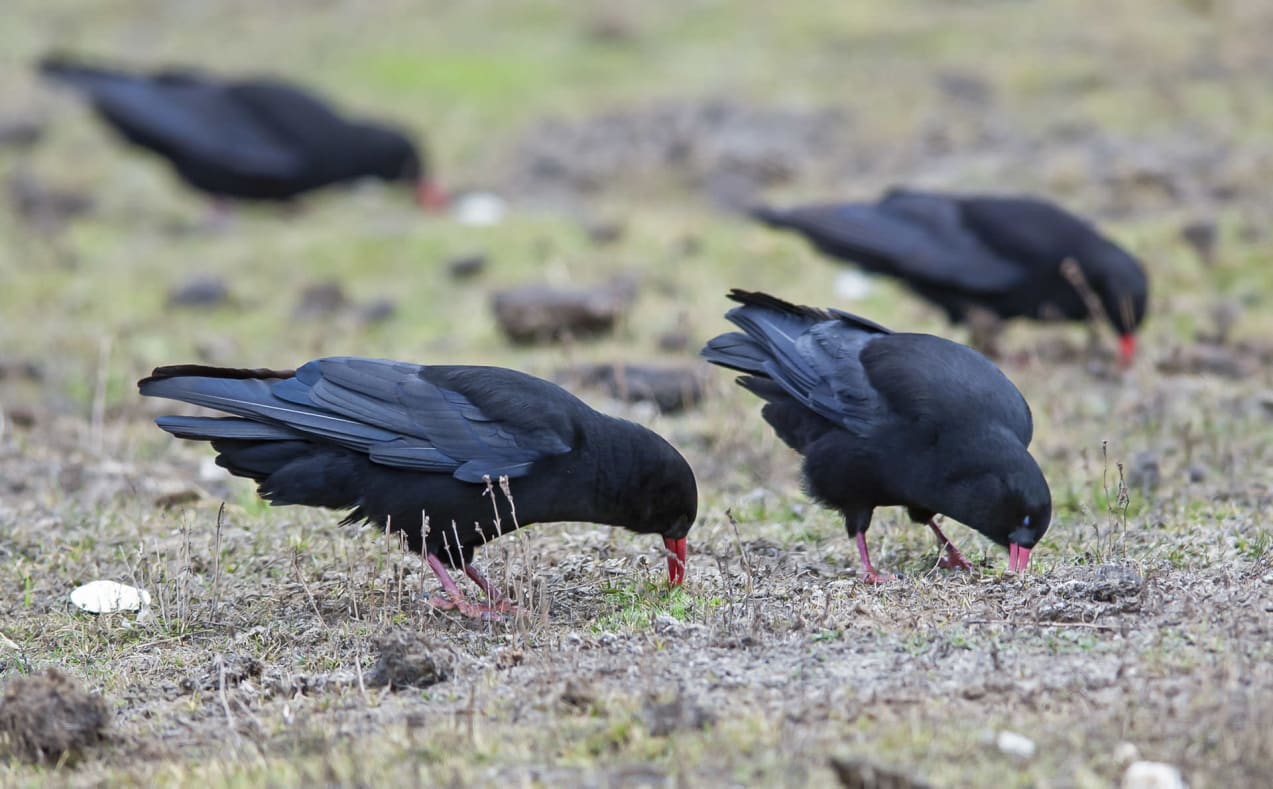
Alpine Chough in Shinku-la Pass
Our work took us to Shinku La, a high-altitude mountain pass at 5,091 metres above sea level, marking the boundary between Lahaul, Himachal Pradesh, and Zanskar, Ladakh. At Zanskar Sumdo, along a rugged path to Shinku La Top, the Shinku La tunnel rose into view — an audacious construction, soon to be the world’s highest tunnel, slashing 60 km off the Manali-Leh route. I couldn’t help wondering: were the Himalayas, the people along the Leh-Manali Highway, or even the choughs ever part of these decisions?
We arrived at Shinku La, a path trodden by pilgrims and monks on their spiritual journeys. Kiangs rose and dipped on thermals, making thin air look easy. They soared effortlessly above the jagged heights — wild, untamed, utterly free at 5,091 metres. In that moment, the arrogance of human ambition seemed almost trivial against the grandeur of the mountains and the defiance of the wild.
Watching them, I understood why flocking is such a reliable strategy up here: more eyes to spot large avian predators, quicker discovery of food patches, and safer communal roosts when the wind sharpens.


What choughs ate changes across villages and passes. On quiet pastures, they probe the soil for insects; near cafes, camps, and roadworks, they switch to scraps. Corvids are natural opportunists, and studies from mountain tourist sites show that both alpine and red-billed choughs alter their behaviour around people and food. By the time we left, the scenes were familiar: chapati snatched from Keylong rooftop diners, and at Shinku La, birds hopping close to our feet for biscuit crumbs and other packaged goods.
Alpine Choughs in Batal near Chandertal
When our fieldwork concluded, we set off from Keylong. There was quite a crowd at Chacha Chachi Dhaba, a legendary roadside eatery in remote Batal village (~4,000 m altitude). Batal had a feast prepared not just for humans. On a bridge, there was a pile of leftovers which eleven alpine choughs were devouring with gusto. I filmed them, I imagined them savouring biryani, though it was actually rajma-chawal. It was not rare behaviour for a scavenging corvid with an opportunistic diet, but it was a sharp reminder that even remote places now come with a human menu.

Making of a “Least Concern” Species
Red-billed choughs and alpine choughs are listed as “Least Concern” on the IUCN’s Red List. This is due to their widespread global distribution and abundance. Although humans did not intentionally decide that we would care less about species in abundance, the label of “Least Concern” has been an emotionally and linguistically damaging term. It was never meant to imply “least important” or “okay to ignore” unless there is an emergency. But unfortunately, nature and wildlife conservation in India thrives on crisis management, urgency and extinction are more compelling than creatures of “Least Concern”. Interestingly, research papers on red-billed choughs from the UK reveal that a successful reintroduction plan was initiated in Kent after their disappearance, driven by various factors. In 2017, an IUCN assessment focused on their local extinction and listed them as “Vulnerable” in the UK.
I hope choughs always remain on the “Least Concern” list. Yet we must never distance ourselves from noticing, caring for, and feeling deeply for the species, even when their presence seems quite ordinary.
About the Author