
 Listen to this article
•
15:34 min
Listen to this article
•
15:34 min
Around the monsoon months, the forest floor of Pakke Tiger Reserve turns soft, fragrant, and alive. Fallen leaves melt into the soil. Fruits drop silently in the night. And if you walk carefully, you begin to notice something else — small, neat holes puncturing the earth around fruiting trees. They are easy to miss. But once you see one, you begin to see them in lots of places.
“What could be making these?” I asked aloud one morning.
Khem Daju, who knows these forests of East Kameng district of Arunachal Pradesh the way others know city streets, glanced down and replied, “Ek keeda hota hai, jo aise ched karta hai mitti mein.” (An insect makes these holes in the soil.)
An insect? The holes looked deliberate.
Weeks later, I noticed the same mysterious openings in our nursery soil. Daju smiled again: perhaps the same insect had moved in there, too.

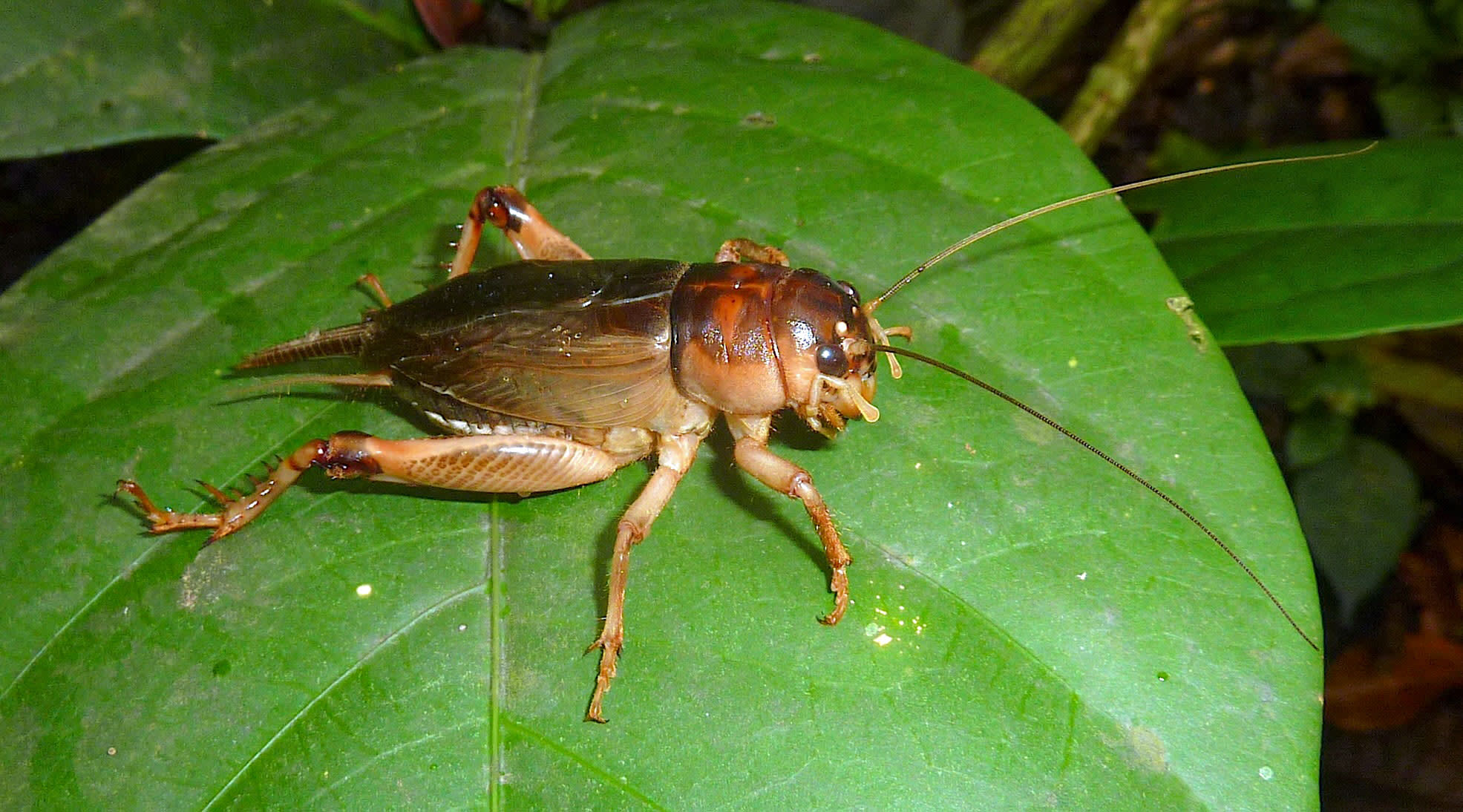
Cover photo: Giant crickets, Brachytrupes sp. are generally seen in the monsoon. They are nocturnal insects with modified legs and strong mandibles that help them dig burrows. Photo: Swati Sidhu
At the time, I was deep into studying fruit-animal interactions. I would place fruits and seeds in front of camera traps, waiting to see who came to feed — civets, squirrels, rodents, maybe even a barking deer. The monsoon made the forest generous; fruit was everywhere from September onwards. But something puzzling kept happening. Fruits would vanish overnight. Seeds would disappear. And yet the camera traps showed nothing. No warm-bodied mammals. No birds. Just empty ground where fruit once lay. Sometimes, smaller rodents might have taken the fruits or seeds, or perhaps there were technical glitches in the camera traps. But for certain plant species, I would find only the outer peel of the fruit; the inner contents had vanished.
The forest was playing tricks on me. Only later did I realise the obvious: camera traps are designed to detect larger, warm-blooded animals. Small, cold-bodied insects can move in and out undetected. The thief did not trigger the camera because the thief was too small.
One evening, Daju and I began digging one of the tiny holes (approximately 0.5-0.8 cm) in our nursery soil. That was when we found the thief. The holes and the vanishing fruits and seeds began to connect in my mind.
A few years earlier, my colleagues Aparajita Datta and Swati Sidhu had set out to study rodent-seed interactions. In the process, they encountered an unexpected player: burrowing crickets belonging to the genus Brachytrupes, commonly known as giant crickets.
These crickets are not delicate grasshoppers hopping in the open. They are about 4.5 cm long and are powerful diggers. With heavily modified legs and sturdy heads, they excavate burrows deep into the soil. Beneath those small, innocent-looking holes lies an underground chamber system. And inside those chambers: seeds, along with other stored material.


The crickets were caching them; dragging seeds into their burrows, and likely storing them for later consumption, 10-25 centimetres below the surface. Many recovered seeds bore unmistakable bite marks from cricket mandibles.
But here, the story shifts. Some buried seeds germinated. Not just a few. In some cases, the percentage of germinated seeds exceeded that of seeds cached by mammals such as hoary-bellied squirrels or murid rodents. What began as a story about seed eaters was turning into something far more intriguing: a story about the forest’s accidental gardeners.
During my fieldwork, the plot thickened. In addition to previously recorded plant species, I documented four additional species whose fruits and seeds these crickets handled. I observed them feed on the pulp of Stixis suaveolens, scraping away the fleshy exterior before carrying the seeds underground. Often, after consuming the pulp, they removed the seeds entirely from the forest floor; I would find the fruit peel, hollow and empty.
Elsewhere in the world — from the neotropics to Japan and New Zealand — studies have reported crickets dispersing seeds. In most of those cases, the plants involved were shrubs or orchids. Here, in Northeast India, the possibility is more dramatic. These crickets may be dispersing the seeds of trees.
Towering tropical trees, whose canopies hold hornbills and whose roots hold the soil in place, may owe part of their next generation to a burrowing insect working quietly underground. The little helper of giants.

Crickets already play multiple roles in tropical ecosystems. They can pollinate, consume seeds, break down organic matter, and serve as food for predators (and in some cultures, even for humans). Now we may need to add another role, that of seed disperser.
There has been relatively little research on cricket-mediated seed dispersal, perhaps because they do not fit our mental image of a disperser. We think of hornbills, primates, and elephants. Large bodies. Wide movements. Obvious impact. But forests are maintained as much or perhaps even more so by the small and unseen as by the large and celebrated. Crickets are found across habitats, from grasslands to dense rainforests. It is possible they have been performing this quiet ecological service for millennia — burying seeds, unintentionally planting future forests — without drawing our attention.
We study their songs. We marvel at their sound-producing mechanisms. Yet beneath the music, another story unfolds in the soil.
A story of holes in the ground.
Of fruits that vanish without a trace.
Of tiny engineers shaping the fate of giant trees.
Sometimes, to understand a forest, you simply have to kneel and look closer. Tropical forests are often defined by their giants — towering trees, wide canopies, and charismatic animals such as hornbills, tigers, and elephants. When we think of seed dispersal in such forests, we usually imagine large-bodied frugivores carrying fruits across long distances. Yet beneath the leaf litter and below our line of sight, much smaller actors may be performing an equally important role. Among them are burrowing crickets, which might quietly reshape the future of forests.
About the Author