Listen to this article
•
15:34 min
Listen to this article
•
15:34 min
“Shiyal is not here anymore; we never hear its bark or howl. About 20 years ago, it used to cry and howl on the Aloobari side. But now it has disappeared. It even used to howl back to the train whistles.” For Bipinda, this haunting call represented a connection to a simpler time before cell phones and television dominated daily life.
Aloobari Road runs parallel to Hill Cart Road, both of which lead to Darjeeling. Today, you can still hear the toy train’s whistle from Aloobari and nearby villages, but why are the golden jackals silent?
In the Darjeeling district, the vast landscape encompasses tea gardens, forests, and transitional zones between wilderness and farmland. Wildlife has always been woven into the fabric of life here. Locals wake up to black bears feeding in their fields, while villagers and tea garden workers often spot leopards on their way home from work. Darjeeling got its name from the Tibetan word dorje, meaning thunder and clouds. And, as the name justifies, even on sunny days as evening falls, Darjeeling is submerged in mist, the haunting howls of golden jackals (Canis aureus) echoing through the hills, while the toy train cuts through the fog.
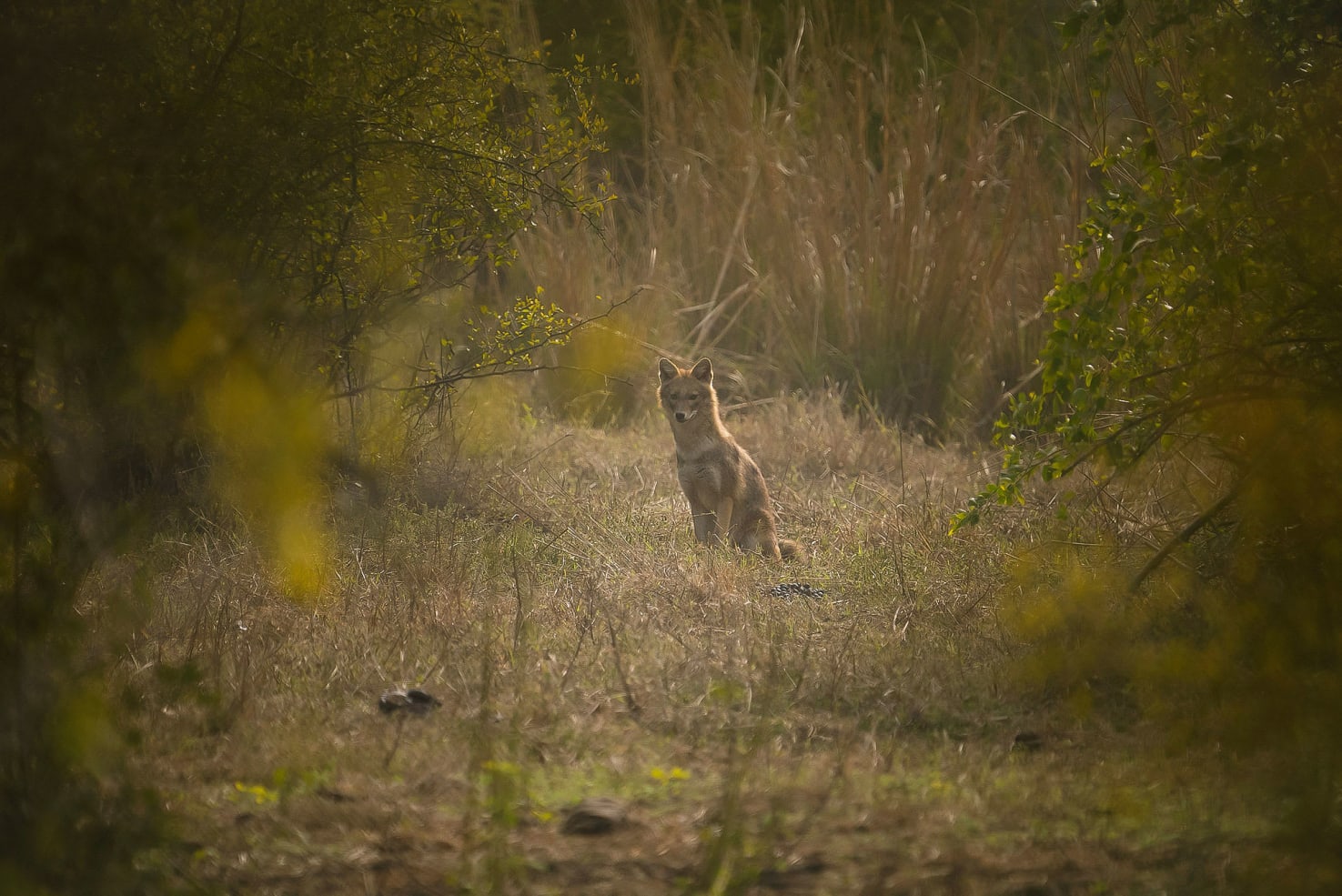
The golden jackal is a mid-sized carnivore of the dog family, living in packs of 2-6 individuals. This flexible and adaptable species has historically lived alongside people in the open meadows and farmlands of Darjeeling. Yet, in recent years, those howls have grown quieter, and pack sightings have become rare.
In 2024, I started my fieldwork in Darjeeling to examine interactions between mammals and people. The shared spaces of Darjeeling are home to mammals such as leopards, black bears, Himalayan serows, yellow-throated martens, yellow-bellied weasels, and golden jackals. Locals shared their encounters and experiences with various mammals. Unsurprisingly, these were a mix of positive, negative, and neutral experiences. Surprisingly, 70 per cent of the people I interviewed narrated their experiences with golden jackals in their lifetimes, but most of them hadn’t spotted one in recent years. Intrigued by this, I further examined their sightings and interactions.
Some locals believe jackals bring luck; that seeing one before a journey brings good fortune. Others speak of the traditional medicinal value of jackal meat, believed to cure certain ailments, such as asthma, and of its use in brewing local alcoholic beverages called raksi. Yet, like elsewhere in South Asia, jackals also have a bad reputation for preying on poultry and livestock. Only 40 per cent of interviewees expressed positive perceptions of the species despite not having seen or heard one in years. Most people reported not having seen jackals in the past decade, yet their prevailing attitudes remain negative. “They used to eat chickens, day and night, causing a lot of damage,” said Anand, and continued, “They had a den, but after villagers worked together to eliminate it, their numbers declined.” Prava, his wife, added bluntly, “It’s good they’re gone; they were nothing but trouble for our chickens.” This raises the question: Do old fears and past threats still put jackals at risk through beliefs passed down over generations?

Local theories about the jackal disappearances varied. Some attributed the jackals’ decline to increasing leopard pressure, with Madandaju, a farmer, explaining, “Their numbers have dropped because of leopards. Leopards hunt them.” His friend reminisced, “They’re fascinating animals. I’ve always liked them. In the past, their meat was consumed, and they were hunted through trapping. Villagers would buy and consume it.”
Others recalled organised hunting parties brought in to eradicate jackals near villages. There is also speculation that herbicides from nearby tea plantations contributed to their decline through biomagnification.
Our camera traps recorded only two golden jackal sightings across the entire Darjeeling hills, both solitary individuals, unlike the packs typically observed. However, my team and I occasionally spotted a few individuals near forested patches around Darjeeling town.
I discovered one particularly surprising habitat: a small urban wild patch nestled in the middle of the concrete jungle, where an elderly woman had been feeding a family of jackals every evening for years. “I’ve always loved animals,” she told me. Her jackal family once numbered seven or eight individuals, but has now dwindled to just three or four. She suspects that the growing population of neighbourhood dogs may be driving the jackals away. Looking at such relationships, I often find myself raising questions about rights and wrongs in conservation. What do we think about feeding wild species that have undergone a decline?
Golden jackals have long been embedded in the socio-ecological fabric of this landscape, with a mix of positive and negative perceptions. While their role as opportunistic scavengers and predators may cause some tension with local communities, there is a shared understanding that these creatures are disappearing from the hills. Gitadidi from a village near Sukhiapokhri highlighted their ecological role: “It’s good. When an animal dies, jackals clean it up, and there’s no rotting flesh to spread disease. My mother saw it herself. Even after death, they prevent contamination. But now they’re gone. The carcasses decay and mix with our drinking water, leaving it polluted.”


Others noted an unexpected consequence of the jackals’ decline: wild pig populations have surged, damaging crops and disrupting the ecosystem. Some speculate that jackals once helped control wild boar numbers through pack-hunting. Their smaller size facilitated access to wild pig resting sites and to piglets. Golden jackals are one of the most adaptable species in human-altered landscapes. Their ability to persist in such spaces largely stems from their elusiveness, which enables them to thrive in environments that might seem inhospitable at first glance. Research from Mumbai, for instance, shows a thriving population of jackals in the city’s mangroves, close to the encroaching concrete jungle. In Ladakh, golden jackals have even been spotted at an elevation of 3,120 metres, according to a 2020 study. Meanwhile, in Delhi, researchers have documented jackals adapting to urban environments, feeding on human waste, including banana and bread scraps.
Given the larger discourse surrounding their adaptability and thriving, it is startling to observe a contrast in Darjeeling. Regardless of their attitude toward jackals, everyone agrees that sightings have reduced. Is it a result of declining numbers, are the jackals simply shifting their habitats, or is there a deeper issue brewing?
Delving into the literature, I found that the silent poaching of jackals across India is driven by trade in their body parts. This is compounded by conservation priorities that disproportionately focus on charismatic species such as tigers and neglect less charismatic species. Long-term inadequacies in research and protection have even led to local extinctions of once-common species. My team is working to bridge this gap by focusing on such overlooked species, in both practice and advocacy.
I often share the story of jackals with those who ask about my research. Recently, my friend Nisha, after hearing this story, sent me a hopeful clip from near Darjeeling that sounded like a chorus of jackal howls, giving us much-needed optimism to keep going. Perhaps, by clearly documenting the reasons for their loss and learning more about how people feel toward this fascinating creature, we can find a way to bring their whistles and howls back to the slopes of Darjeeling.
About the Author