Listen to this article
•
15:34 min
Listen to this article
•
15:34 min
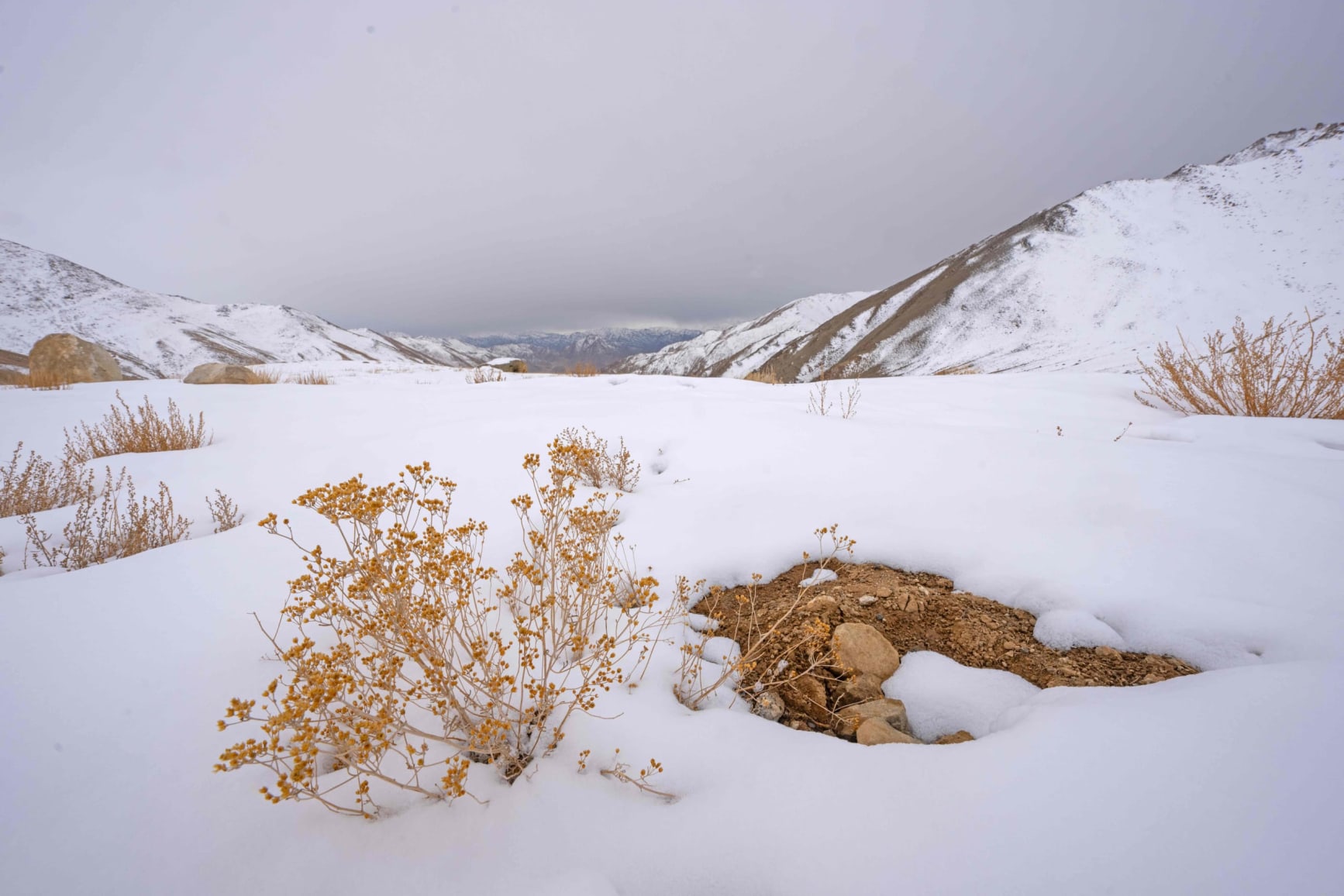
When Usha Lachungpa, my former colleague at BNHS and research officer with the Sikkim Forest Department, told me she could show me the Tibetan snowcock (Tetraogallus tibetanus), provided I was willing to walk many kilometres across high mountain terrain. I agreed without hesitation. The year was 1994. I was 44 years old with chronic asthma, yet the promise of encountering this elusive bird outweighed every physical constraint. She had arranged for us to meet her friend, Chingya, a shepherd of Tibetan origin living high in the mountains of North Sikkim, dwelling in a rebo, a circular nomadic tent (also spelt rba, ba nak, or reba), akin to the Mongolian yurt or ger.
The Tibetan snowcock has a wide distribution across Nepal, Sikkim, Bhutan, and China. It has five subspecies, mainly distinguished by plumage colour. The western subspecies found in the Pamir Mountains is paler than the eastern races.
After a long journey of nearly 130 km from Gangtok through Mangan, Chungthang, and Lachen, we halted at a modest hotel in Thangu (4,000 m). Once an important resting place for Tibetan traders and pastoralists travelling to the erstwhile kingdom of Sikkim, Thangu has today transformed into a gateway for tourists bound for Yumesamdong (4,663 m), popularly known as Zero Point, where there is perennial snow. Tourists also travel through Tangu to see the sacred Gurudongmar Lake and monastery (5,340 m), named after Guru Padmasambhava (aka Guru Rinpoche), the revered founder of Tibetan Buddhism.
The next day, from Thangu, we walked for about five hours and reached Chingya’s hut around 3 p.m. Chingya lived in isolation for nearly six months each year, tending his horses, yaks, dzos (a hardy hybrid of yak and cattle), and sheep. From his hut, that evening, we could see that the east-facing slope of the mountains had already fallen into shadow, as the sun slipped behind towering peaks. He welcomed us with warmth and ushered us indoors, where a vigorous fire blazed in the hearth, its glow and heat transforming the austere mountain evening into one of unexpected comfort.
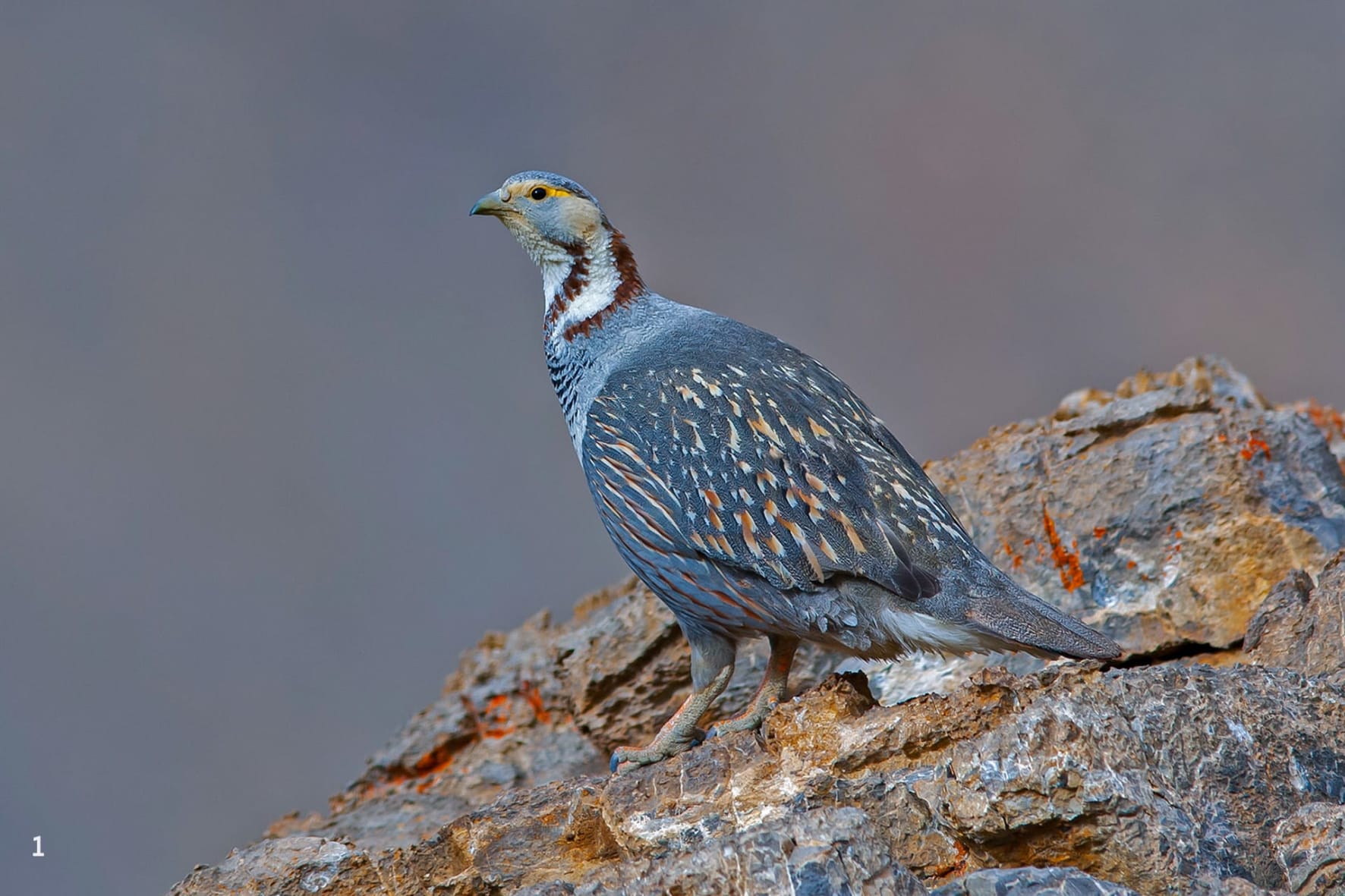
Cover photo: Tibetan snowcocks are built to thrive in harsh high-altitude habitats where they remain for most of the year. In the coldest weather, they descend to lower slopes. They are often spotted foraging in coveys or small flock.
An unforgettable encounter
At dawn, the mountains awakened to the voices of Tibetan snowcocks. Their calls rang across the slope. We saw birds calling, chasing, and sparring in restless animation. It felt as though a curtain had risen upon a spirited alpine performance, a wild choreography played out in the stark, stony mountain slope, with low bushes. For nearly an hour, the avian drama unfolded. Then, as sunlight spread across the ridges, the commotion ceased. The birds descended to forage silently, dissolving into low shrubs and boulder-strewn ground with ease. Moments earlier, they had leapt and battled in full view; now they vanished so completely into their surroundings that the hillside seemed suddenly empty, as though the actors had withdrawn from the stage.


That unforgettable encounter awakened in me a renewed desire to closely observe the Himalayan snowcock (Tetraogallus himalayensis), a slightly larger species of snowcock. It is found from central Nepal westward through the alpine and subalpine areas of Uttarakhand, Himachal Pradesh, Jammu and Kashmir, Pakistan, parts of Afghanistan, and then into Central Asia and eastern China. There are many areas in Nepal, Jammu and Kashmir and the Pamirs where both Tibetan and Himalayan snowcocks are found. Their ecological segregation of time and space is still not fully understood and therefore a good topic of research. During earlier visits to Ladakh, I had glimpsed the Himalayan snowcock from a distance. Though I had technically added a “lifer” (a first-time sighting) to my list, I am not a twitcher (a birdwatcher obsessed with seeing rare birds and not satisfied with fleeting sightings).
In search of Himalayan snowcocks
The opportunity arrived on 28 August 2021. After watching a brown bear in the Mushkoh Valley in Ladakh, we travelled from Drass to Kargil via the lesser-used Laser La route. As our vehicle edged along a steep mountain road, we unexpectedly encountered a convoy of seven Himalayan snowcocks. Unperturbed, they walked uphill with measured dignity, pausing to forage before gradually blending into the landscape. The mountainside was carpeted with crimson Himalayan bistort (Bistorta affinis) shrubs, their reddish leaves and flowers echoing the birds’ own hues. This time the sighting was intimate, barely ten metres away, unlike earlier encounters when I had seen only distant silhouettes.
Known locally as barfeela murga or ramchakor in Kashmir and Himachal Pradesh, or juggar in Ladakh, the Himalayan snowcock inhabits high alpine meadows between 2,743 and 3,353 m. It is twice the size of a partridge or francolin.

Defence mechanisms
Both the Himalayan snowcock and the Tibetan snowcock have aerial predators such as golden eagles and ground predators such as foxes, wolves, and weasels. Their plumage blends into the rocky, open scrub-covered mountain terrain, making it harder for predators to spot them. The Himalayan snowcock’s grey, chestnut-barred body and dark underparts camouflage it well, especially when the bird freezes flat against the ground to avoid detection. The white tail coverts cover the bases of a snowcock’s main tail feathers (rectrices), so they are not visible when the bird is hiding, but conspicuous in flight. Facial markings in black, white, and grey also help break up the bird’s silhouette and confuse predators.
The Tibetan snowcock is similarly attired, with a dark grey head and white cheeks, forehead and throat. The back is mostly sandy grey, finely streaked with buff. The abdomen is white with thick black streaks that reach up to the neck collar. The rump, upper tail coverts and central tail feathers are rufous. Unlike the Himalayan snowcocks, there is no white in the tail feathers. But surprisingly, both species have white in the wings, visible in flight. In the Himalayan snowcock, the primaries are white, tipped with black, while in the Tibetan, the secondaries are white, and the primaries are dark. The main reason for having conspicuous white in the wing feathers is to alert other members of the covey during sudden flight, much like the white underside of the erect tail of a spotted deer (Axis axis) serves as a warning sign to the herd. It also helps with herd cohesion and re-gathering.


Diet and breeding
The snowcock is omnivorous, eating plant matter, animals, and insects (though they are scarce in the cold, they become abundant during the late spring and summer). This is the period when the chicks hatch. The clutch size of the Himalayan snowcock is 7-6, up to 16 eggs have been reported for Tibetan snowcocks by the late ornithologist Salim Ali. Or, it could be that 2-3 females are laying eggs in a single nest (not uncommon in pheasants, ducks and other birds). Incubation lasts almost a month, which is quite long for a bird of this size. For the chicks to hatch simultaneously, incubation begins when the clutch is complete. Within 24 hours of hatching, the chicks leave the nest with the mother and begin foraging for small insects, flowers, seeds, tubers, green shoots, and fruits, especially Ephedra berries. The chicks grow quickly and can fly within six weeks.
Many predators such as ravens, crows, harriers, eagles, foxes, stoats and weasels, hunt chicks, so not all survive the first year. Spring and summer are also the breeding season for predators, who must provide food for their own young.
Although the snowcock is rarely seen, its loud, hoarse calls often echo across the high mountain slopes and steep valleys. Both birds are the loudest during the breeding season, when males call out to attract females.
Threats and challenges
Fortunately, both species are quite widespread and not in danger of extinction. IUCN and BirdLife International list them as “Least Concern”. However, overgrazing by livestock, habitat degradation from development, and increased crow numbers due to human settlements negatively impact the snowcock (and other wildlife). The locals, especially from the Buddhist community, do not harm wildlife, including snowcocks, so it is not unusual to see these robust, smartly-plumaged birds foraging near Buddhist settlements.
Snowcocks are attractive birds that are a pleasure to spot, and in the last few decades, I have been lucky to see them multiple times. However, there is one additional interesting fact about these birds. In the ten-volume Handbook of the Birds of India and Pakistan, by Drs Salim Ali and Dillon Ripley, the authors write: “One of the less attractive peculiarities of the snowcock as a game bird is the strong and disgusting stench it often emits within only a couple of hours of being killed, possibly due to some food it has eaten.” Fortunately, I have never encountered a dead snowcock, nor this unpleasant smell.
About the Authors