 Listen to this article
•
15:34 min
Listen to this article
•
15:34 min
A frequent lament among turtle experts and enthusiasts is the lack of scientific attention freshwater turtles receive — unlike their marine counterparts. While sea turtles such as the olive ridley, hawksbill, green, loggerhead, and leatherback often steal the spotlight, around 330 species of freshwater turtles and tortoises (collectively called non-marine chelonians) remain largely overlooked. Freshwater turtles residing in lakes, rivers, and ponds are often hidden from view and lack the dramatic mass and synchronised nesting phenomenon (arribada) that captures the interest of the media, photographers, and conservationists. Though I’m no turtle specialist, I understand that the role of freshwater species is as vital to aquatic ecosystems as that of marine turtles to oceans.
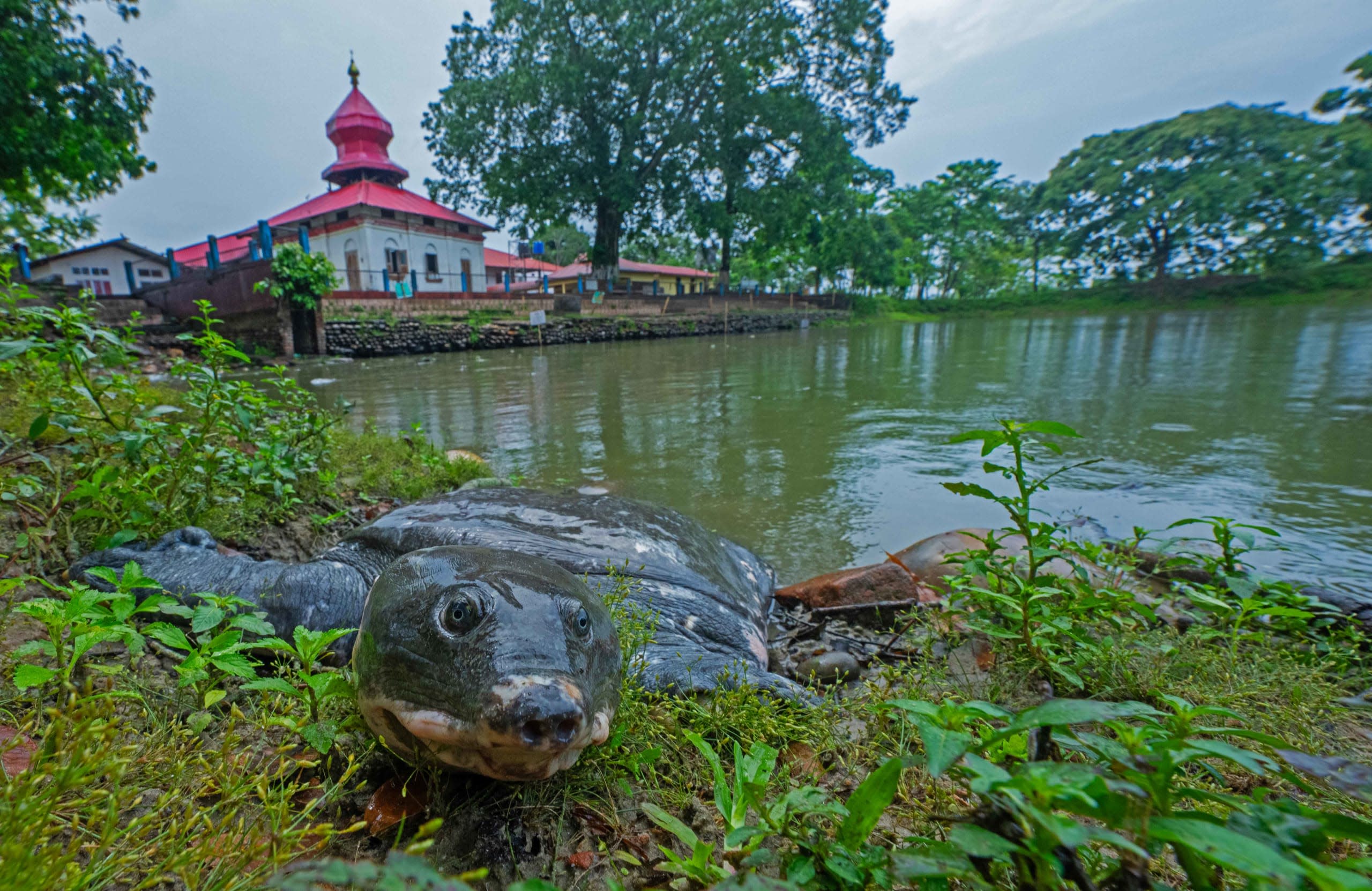
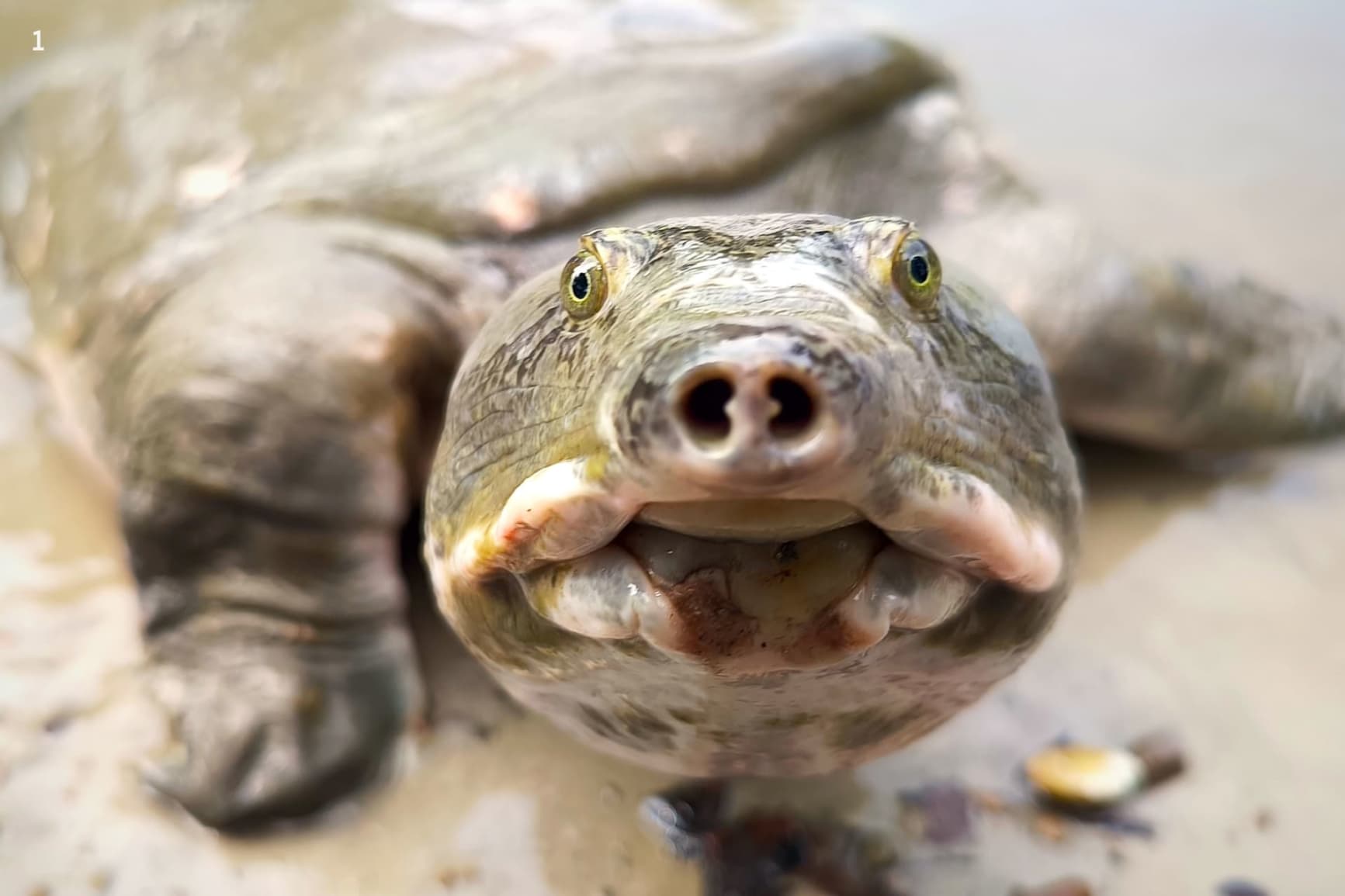
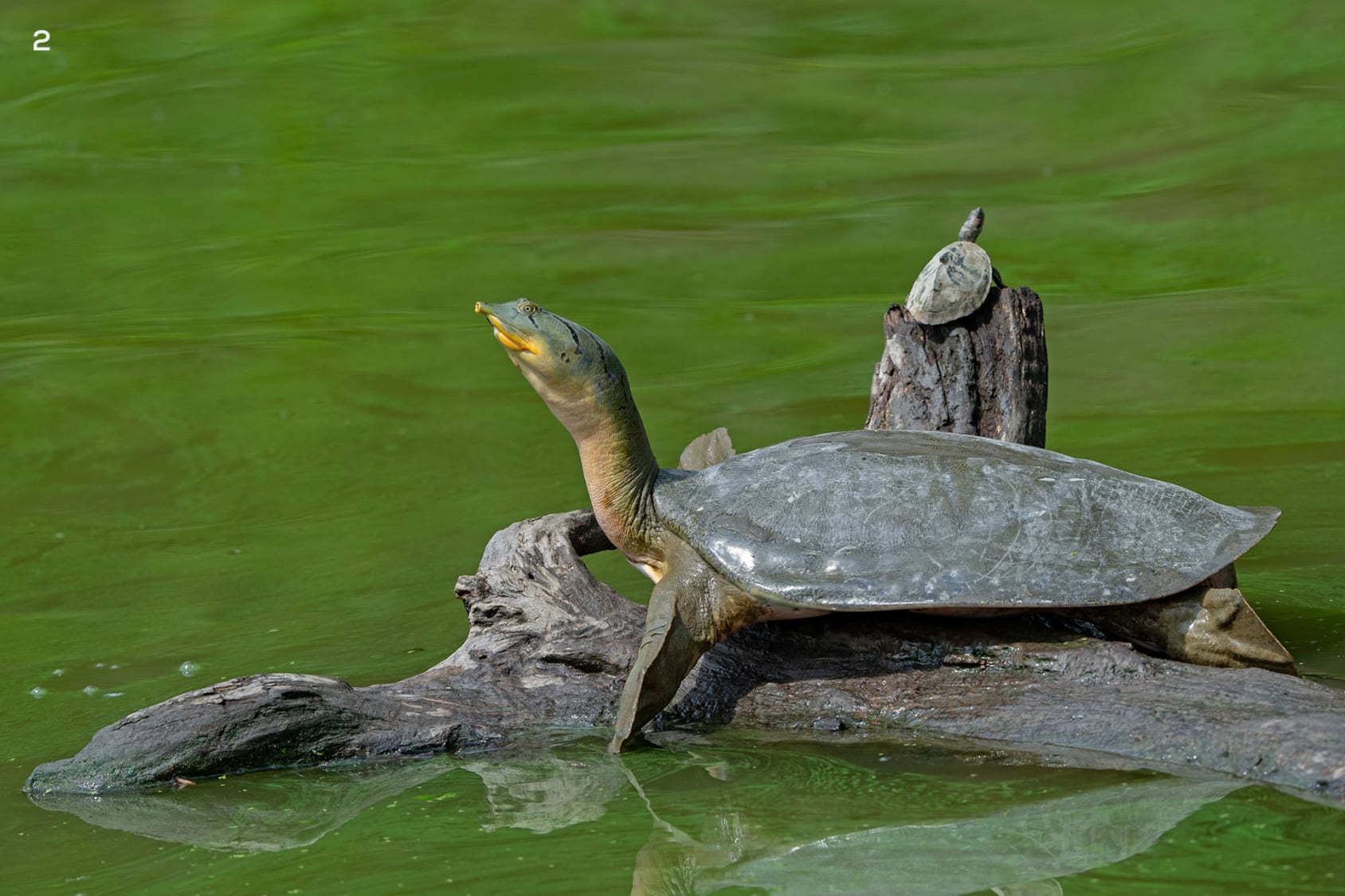
I had the opportunity to visit Nagshankar Temple in Assam’s Biswanath district in May 2025, along with renowned wildlife photographer Dhritiman Mukherjee, Dr Sachin Ranade of BNHS, and two students. Departing from the Bagori Rest House in Kaziranga National Park at 5.40 a.m., we arrived at Nagshankar Temple on the northern bank of the Brahmaputra by 8.15 a.m. Here, Ms Sushmita Kar, a scientist, and Mr Aditya Prasad, an intern from the India Turtle Conservation Programme, met us. Sushmita briefed us about the 13 turtle species nurtured in the one-hectare pond within the temple premises. The main attractions were the critically endangered black softshell turtle (Nilssonia nigricans) and the Assam roofed turtle (Pangshura sylhetensis). Other species included the Indian softshell (Nilssonia gangetica), peacock softshell (Nilssonia hurum), Indian flapshell (Lisemys punctata), spotted pond (Geoclemys hamiltonii), Indian tent (Pangshura tentoria), Indian narrow-headed softshell (Chitra indica), Indian roofed (Pangshura tecta), brown roofed (Pangshura smithii), Indian black turtle (Melanochelys trijuga), Assam leaf turtle (Cyclemys gemeli), and the tricarinate hill turtle (Melanochelys tricarinata).
In Assam, many temple ponds have traditionally safeguarded turtles and considered them incarnations of Lord Vishnu. The Nagshankar Temple turtles, jointly cared for by the temple committee and the India Turtle Conservation Programme team, are among the best-protected turtles in the region. Sushmita explained that the Nagshankar Temple dates back to the 4th century AD and was built by King Narasankar of Nagakha. In 1480, Ahom king Susenpha restored it and commissioned a square tank beside it. Most temples, especially Shiva temples, have a tank to drain the water/milk offerings made to the Shivling, and to dump other organic waste generated during ceremonies.
As part of better management of the captive turtles, the temple committee added a new pond in 2020. Sushmita’s affection for the turtles was palpable; she showed them off with the pride of a child displaying her treasured dolls. She has even formed a group of kaso sakhis or “turtle friends”— local community guardians for turtle conservation at this temple and along the northern bank of the Brahmaputra, on the fringes of Kaziranga National Park.
Sushmita Kar tells us that turtles are revered at the Nagshankar Temple for religious reasons, and their biological needs are also addressed — an example of culture and conservation. She describes how the turtles are familiar with visitors and approach anyone holding food. Beyond the temple premises, the entire village of Nagshankar protects turtles and discourages disturbance and poaching. Owing to its serious commitment towards turtle conservation, the Assam government has recognised Nagshankar as a “model temple” and an example for others to follow. Temple ponds like this are considered conservation repositories for highly threatened turtle species. However, interbreeding among congeneric species (especially among three species of Nilssonia) is problematic, and further studies are required to ensure that non-hybrid individuals are released into the wild.
In 2004-05, the black softshell turtle was thought to exist only in a few ponds, such as the Bostami Pond in Bangladesh and Nagshankar; it was feared to be extinct in the wild. However, thanks to the traditional practice of priests and royalty gifting turtles, the species was later found in other temple ponds too. Currently, about 100 adult black softshell turtles live at Nagshankar, and over 450 hatchlings have been successfully released into the wild utilising this cohort.
In Tripura, the Sundari (Tripureswari or Matabari) Temple is considered sacred, a kurma peeth, deriving its name from a small hillock that resembles the hump of a turtle (kurma), upon which the shrine is placed. In 1501 CE, the Maharaja of Tripura, Dhanya Manikya, established the temple of the Goddess Tripura Sundari and released turtles in the adjacent Kalyan Sagar pond. In 2025, Sushmita conducted the first-ever study of turtles in the Kalyan Sagar pond, documenting seven species of freshwater turtles and tortoises, with black softshell turtles as the dominant species.
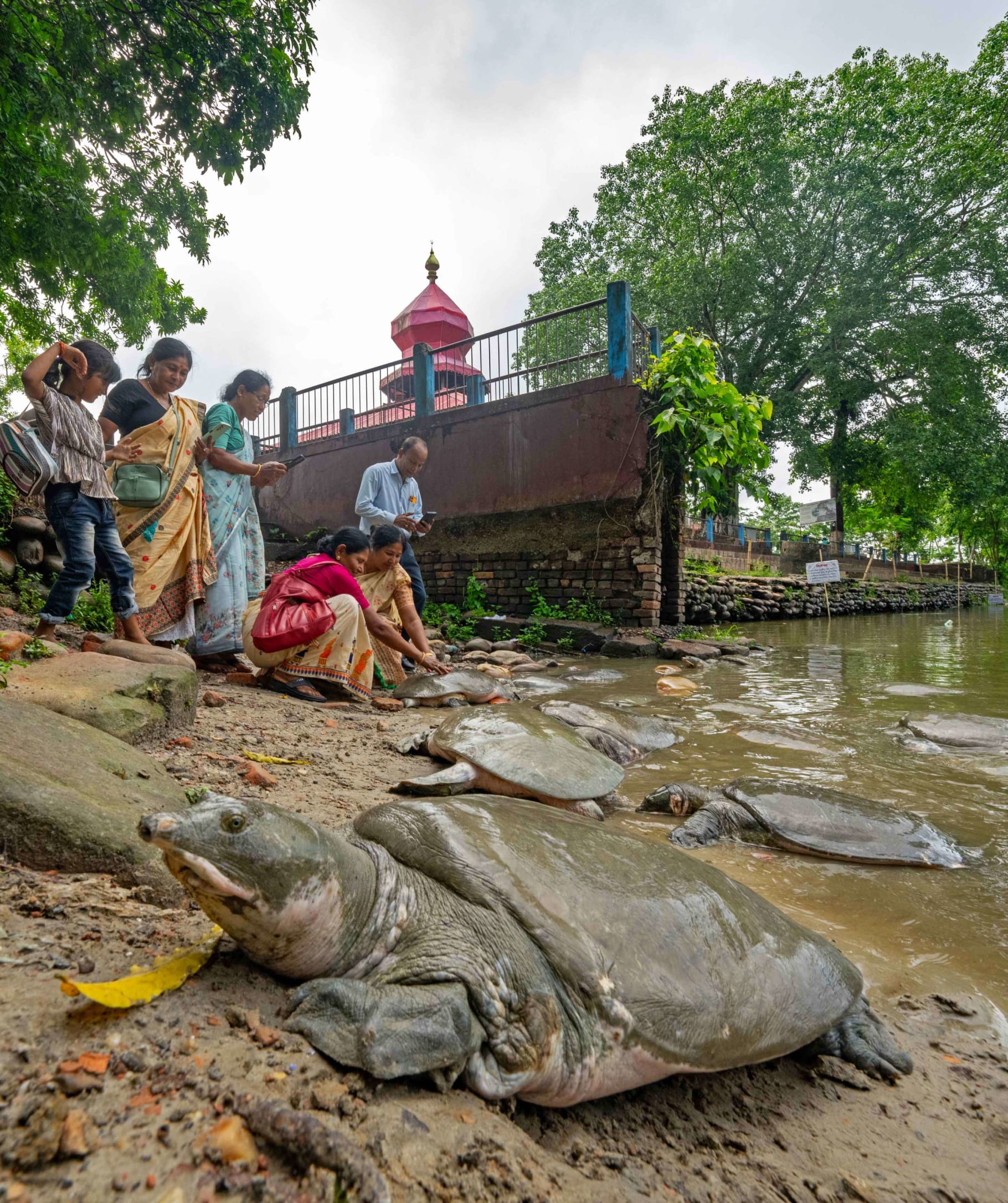

It was quite possible that our ancestors and temple sages intuitively understood the ecological importance of turtles—especially their role in scavenging decaying matter and maintaining water hygiene. However, in Nagshankar, the turtles are mostly fed biscuits, bananas, dry fish, and prasad by devotees. Initially, the temple committee was hesitant to feed them live food, but they relented after turtle researchers explained that turtles naturally consume fish, frogs, and crustaceans. With persistent persuasion, the temple permitted the sale of dry fish near the premises so visitors could feed the turtles a more natural diet. We fed them bananas, which they eagerly devoured, and our supply quickly ran out amidst the hungry crowd. The conservation team encouraged local vendors to sell terracotta turtles to discourage the practice of offering wild-caught turtles to the temple pond.
Despite such care, challenges remain. Plastic pollution is a major threat. Devotees often discard plastic wrappers from food offerings, despite temple guidelines. I saw several plastic bags scattered around. In their frenzy, turtles may accidentally ingest plastic, mistaking it for food. Sushmita’s project team, often involving students, runs cleanliness drives around the temple premises.
Another concern is the concretisation of pond edges to prevent seepage. This reduces soft, muddy areas essential for nesting. Sushmita has witnessed turtles venturing into adjacent farmland to lay eggs, where many nests are inadvertently destroyed during cultivation and predation by free-ranging stray dogs.
Temples like Nagshankar are not alone. Across India, several temples maintain turtle populations. For critically endangered species like the black softshell, such sacred ponds may serve as reservoirs for rewilding efforts. For example, at Kanpur’s Panki Nageshwar Temple, about 150 softshell turtles inhabit a small pond, where devotees feed them paneer every Wednesday — a unique example of how these omnivorous reptiles adapt to human offerings.
Turtle researchers remain concerned that many such turtle ponds are being cemented over in the name of beautification and cleanliness, destroying crucial nesting habitats. Overcrowding and inappropriate feeding practices are additional challenges.
Across religions, turtles are often symbolic of longevity, wisdom, and stability. In Hinduism, the tortoise (kurma) is sacred because it is one of the ten avatars of Lord Vishnu. According to the Samudra Manthan myth, this divine tortoise supported Mount Mandara during the cosmic churning of the ocean for amrita, the nectar of immortality. Turtles thus represent cosmic balance, endurance, and the foundation of the Earth. No wonder turtles are frequently carved into temple gateways and courtyards, as they are believed to bring prosperity and good fortune. Let us preserve this good fortune — for the faithful and for the turtles.
About the Author