Listen to this article
•
15:34 min
Listen to this article
•
15:34 min
Travelling through Sikkim’s Pangolakha Wildlife Sanctuary feels like riding an elevator through the clouds.
The sanctuary sits on a steep elevation that climbs from about 1,500 m above sea level to nearly 4,900 m. Winter has just set in. There’s a nip in the air. Our journey begins near Lingtham (~1,524 m), at the sanctuary’s lowest edge, where we slip through deep green tunnels of tall, fern-draped trees studded with fruit and purple and pink orchids. Birdsong rings through the valley, and clouds sit on mountaintops like freshly plucked cotton. As we turn a corner, the tip of Kanchenjunga (8,586 m), the highest mountain in India, peeks from behind the Pangola range.
Two hours later, near Kupup (~3,940 m), the scene flips. Trees vanish to make way for sparse, frost-dusted scrub in shades of henna and mustard. The air thins; my breath grows heavy. At these heights, clouds settle below us like a quilt tucking in the mountains. Kangchenjunga no longer hides. It stands tall, hulking over us like a mountain god. Few places morph so quickly. Pangolakha is an enchanting shapeshifter.

A Sanctuary that Rises
Spread across 124 sq km in eastern Sikkim’s Pakyong district, Pangolakha Wildlife Sanctuary lies along the Pangola range that separates Sikkim from Bhutan, with China just beyond its ridgelines. This is a landscape of many connections.
Historically, it sat on the Old Silk Route linking Tibet to India, where merchants traded silk and cheese for spices and fruits. At Dzuluk village, the old sarais where traders rested still stand.


Geopolitically, Pangolakha’s habitats form a corridor for animals moving between India, Bhutan, and China. Closer to the border, the region is under army control. While we look for pheasants along the road, a rusty board reminds us we are under “enemy observation”.
Ecologically, the sanctuary stacks three biomes or ecological zones above each other: the Sino-Himalayan Subtropical Forest, the Sino-Himalayan Temperate Forest, and the Eurasian High Montane. In this steep landscape, temperature, moisture, and vegetation change rapidly with altitude. Each level hosts its own vegetation and wildlife. Some, especially birds, move freely between the biomes, while others remain tightly bound to their niche, enduring everything it throws their way.


Brothers, guides, storytellers
“Pangolakha still surprises me,” says Dhritiman Mukherjee, now on his fifteenth trip in 16 years. “When you’re driving the Old Silk Route, you never know what will pop out of the thickets.”
Unfortunately, despite the diversity, Pangolakha remains largely undocumented in popular media. Fortunately, we have two brothers who grew up here to guide us.
Dilip and Ranjeet Subba learned to spot different species before they learnt their tables. Growing up on the edge of what would later become Pangolakha Wildlife Sanctuary, the siblings served as “part-time chowkidars,” guarding the family’s farms from wild animals and collecting firewood in the forest next door. In the fields, they often crossed paths with wild boars, Himalayan porcupines, barking deer, and flying squirrels. In the forest, they hunted birds with catapults.
When the area was declared a sanctuary in 2002, and birdwatchers and wildlife photographers arrived, Dilip already knew the species they were looking for — “just not their English names,” he says. Mukherjee and wildlife filmmaker Siddarth Goswami were among the first to explore the area. Goswami handed the brothers their first bird guide. Mukherjee sent more birders their way. Their hunting days far behind them, Dilip — lively, animated, always ready with a tale — runs a homestay for nature lovers. Ranjeet — eagle-eyed, calm, with a disarming smile — works as a certified bird guide. I find myself in the middle of a hearty reunion.


A thick, dark forest
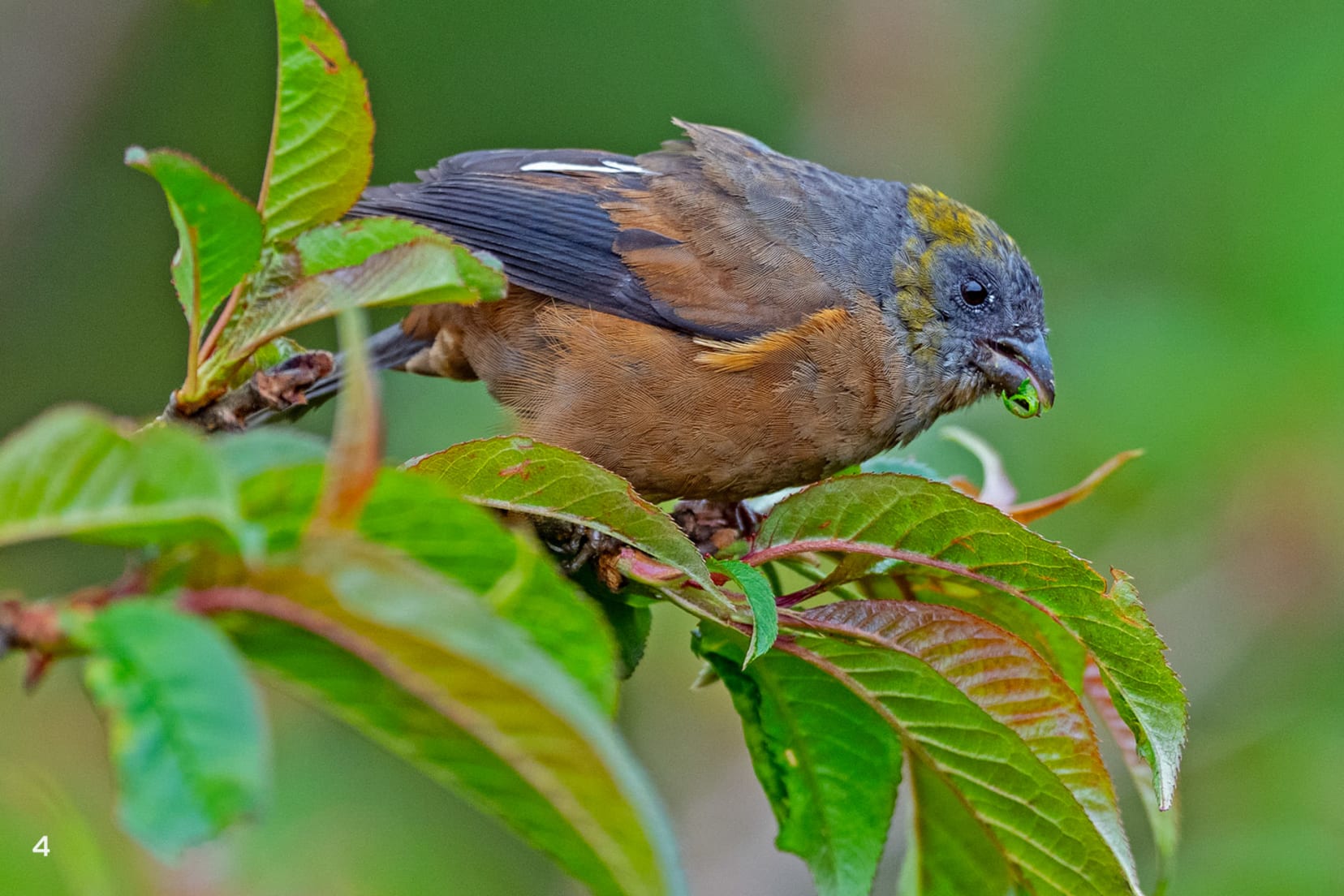
Our first stop is Phadamchin (~2,500 m), where the Subba brothers grew up, on the edge of the sanctuary. Our homestay hides inside a subtropical forest thick with towering trees studded with violet orchids and ferns. Beneath the trees, thick bamboo stands and dense undergrowth dominate. The forest is abuzz. As winter sets in and the higher reaches freeze, many species travel to lower altitudes. Rosefinches (Carpodacus sp.) that breed high in the summer move into lower forests looking for berries and bamboo seeds. They often join riotous flocks of tits, yuhinas, warblers, sibias, and laughingthrushes to hunt, feed, and sing together.
As the sun sets, the sky turns pink and an unmistakable “kruu-kkkk” cuts through the mist. “Raj pankhi,” Ranjeet says, “Raj comes from raat, night; pankhi, winged one”, referring to the Bhutan flying squirrel (Biswamoyopterus bhutanensis).
A subtropical forest’s architecture — closely spaced trees, ferns, and lianas linking one level to another, and overlapping canopies — forms a connected space that lets arboreal or tree-dwelling species move with ease. Fat and agile, at least eight individuals sprint along trunks near us, picking at fruits and raining down scraps on us. And just as I wonder how they “fly”, one stretches its limbs wide, exposing the patagium — a thin membrane of skin stretched between its limbs — and sails from one treetop to the next.

A sweep of bamboo and rhododendrons
The next day, we climb higher along the Old Silk Route. The vegetation dwarfs and rhododendrons take over. In spring and summer, these hillsides burst with colour. Sikkim’s Himalayas host more than 36 rhododendron species in shades of white, yellow, pink, orange, and red. For now, they are dusty green.
In Dzuluk (or Zuluk), a small village dotted with tin-green roofs, we stop for momos and chai. It was once a crucial transit point on the Old Silk Route from Tibet to India, but now functions as a strategic base for the Indian Army, manned by the Cloud Warriors division. The windows of our café offer sweeping views of bamboo forests, home to the red panda (Ailurus fulgens). Just beneath its window is a garbage dump, which the café owner says is visited by Asiatic black bears (Ursus thibetanus) and yellow-throated martens (Martes flavigula).
Four hill villages that lie within Pangolakha Wildlife Sanctuary — Dzuluk, Lungthung, Kupup, and Jhepla — are pockets of conflict and coexistence. For generations, people here have shared space with wildlife, but a rise in tourism and military presence has brought waste dumps, drawing large mammals closer to the villages than ever before.


As we drive away from Dzuluk, green bamboo colonises the slopes. Instead of looking up, we peer into the bushes. A goral, a goat-like mammal built to scale sharp cliffs, sits on a ledge, soaking in the sun. A few metres ahead, a skittish rainbow pops out of the thicket: a male Himalayan monal (Lophophorus impejanus) in a palette of blue, green, copper, and crimson iridescence.
Beyond Dzuluk, the road narrows into a single-lane, steel-grey ribbon that rises through sharp U-pin bends. On one cliff wall stands a curious piece of artwork. In the 1990s, Ranjeet tells us, construction workers were shocked to see a tiger (Panthera tigris) at these heights and sculpted the cat with leftover cement on a rock. But anecdotal sightings hold little heft. Decades later, in December 2023, the conservation organisation Bombay Natural History Society’s (BNHS) camera traps in Pangolakha captured a tiger at 3,640 m, which they declared was the highest documented tiger sighting anywhere in India. The same camera traps also captured the snow leopard in this sanctuary, making it a rare place where both these predators share space.


The many names for snow
Our final destination is Lungthung, where Dilip runs a homestay — a small cluster of tin-roofed rooms that sit above the clouds, facing mighty Kangchenjunga. At first light, the mountain glows like gold. Before sunrise, we set off in search of one of the most elusive creatures of the landscape — the Himalayan musk deer (Moschus leucogaster). Solitary and only active at dusk, night, and dawn, when visibility is low, the deer is an enigma.
It is subzero. The vegetation shrinks even further. Moss hugs the ground, and dwarf rhododendrons barely reach my hips. Only the silver fir stands tall. By now, we are huddled in layers and layers of clothes. And just when it feels too harsh to continue, we catch a quick glimpse of a musk deer so well camouflaged that we see only its silhouette when it moves, and then it disappears. Hours later, when we return, an unexpected resident sprints across the road, forcing us to brake and gasp — the red panda, or “firefox”.


The next day, we are raring to go again, but the season’s first snow arrives. Instead of stepping out, we huddle around the bukhari (traditional indoor heater) in the kitchen, while Ranjeet and Dilip teach us local names for snow in Nepali. The first fall, soft and round like confetti that flies with the wind, is charke. The harsher hail that follows is ashine, “hard enough to dent the car’s hood,” says Dilip. Hue is the steady snowfall that turns the land sparkling white, and khekpa are icicles that hang where water freezes. In the highest reaches of the Himalayas, where snow is integral to survival and daily life, different forms of snow have a variety of local names.
While we are chatting, Dilip’s cousin Kaden announces the arrival of a frequent little visitor who visits the kitchen to feed on scraps. The “neori musa” or Himalayan weasel (Mustela sibirica). Long-bodied, short-legged, with brownish-golden fur, the high-altitude carnivore, rattles through large empty vessels, and finally sticks its neck out from behind a rice cooker.
Mukherjee was right. Pangolakha has a way of surprising you.

About the Authors