Listen to this article
•
15:34 min
Listen to this article
•
15:34 min
Cruising on the Thenmala Dam reservoir (Parappara reservoir), I felt like I had entered the visually stunning world of Flow, a 2024 Oscar-winning film. The animated film follows a cat’s journey on a sailboat after its home is devastated by a great flood. The partially submerged islands I saw from my motorboat resembled what the cat saw from its boat. A great hornbill (Buceros bicornis) flying from one island to another reminded me of a secretary bird that joins the sailboat crew. My friendly guide Ramesh and reticent boat driver Shibu’s demeanour were like the cat’s fellow voyagers — a Labrador retriever and a capybara. Adventure beckoned, like it often does when one sets sail.
Forest bathing in Idimuzhanganpara
Ramesh, Shibu and I, with the spray from the blue reservoir in our faces, were headed to Idimuzhanganpara, a tourism camp in the western part of Kerala’s Shendurney Wildlife Sanctuary. The 173-sq-km sanctuary in Kollam district is about an hour’s drive from the capital Thiruvananthapuram. Named after a rockface believed to attract lightning on stormy nights, Idimuzhanganpara falls in the 48.35-sq-km tourism zone on the western side of the sanctuary. The core zone (75.5 sq km) lies on the eastern side, while the buffer zone (47.13 sq km) is sandwiched between the tourism and core zones.


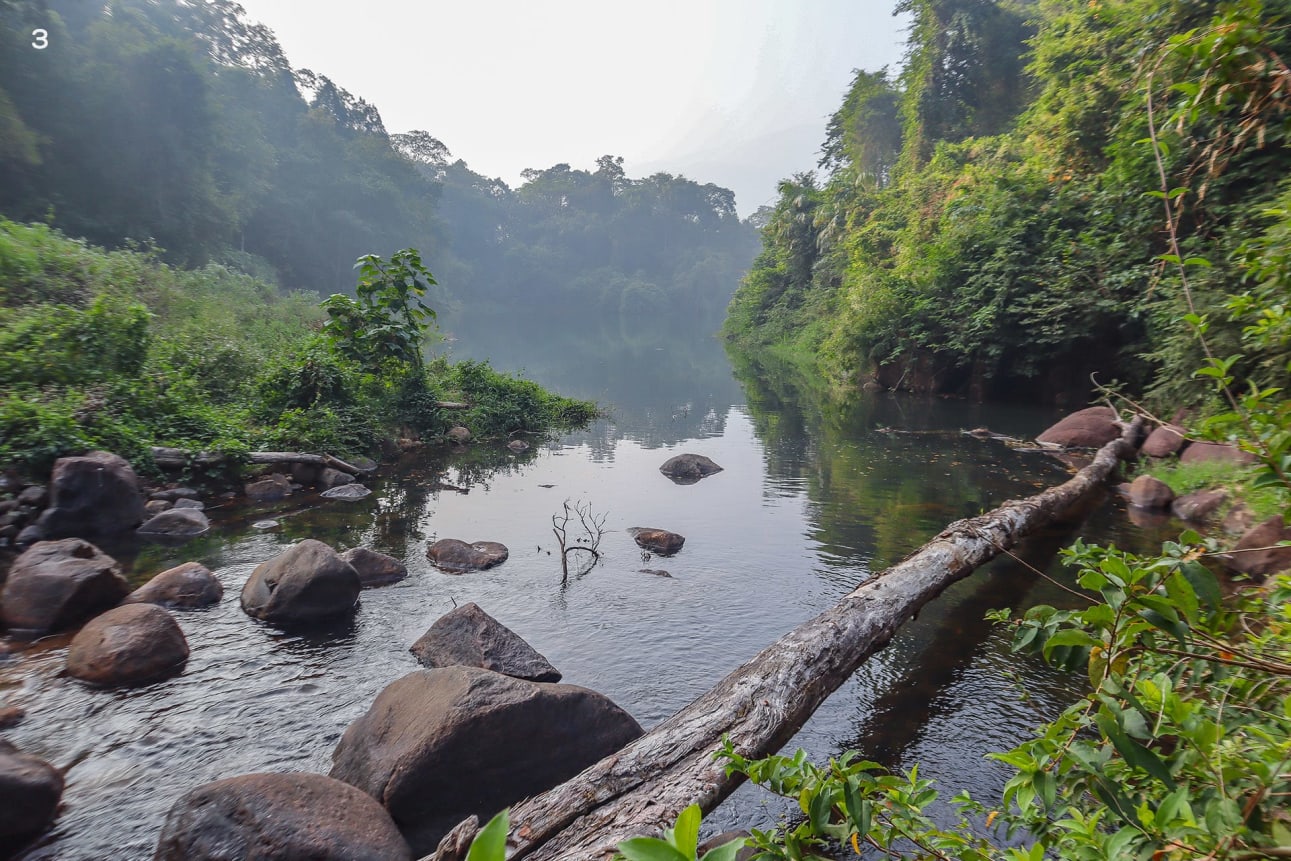
I didn’t need a second invitation when Shibu asked me if I’d like a dip in a stream near our camp. A five-minute walk along a narrow forest path led to a large bedrock carved open by water. I settled in one of the many alluring pools in the rock, my own jacuzzi in the jungle. Small snails clung firmly to rocks, the fast-flowing stream unable to dislodge them. Water striders in an adjacent pool strode back and forth with clockwork precision. On occasion, when a six-legged insect infringed upon another’s territory, a minor tussle ensued before the infringer returned to their corner. Known as velathil aashan (masters of the water) in Malayalam, these half-inch-long insects are adapted to life on the water’s surface. Their legs have microscopic hair that traps air, helping them stay afloat and “walk on water”.
Indian peafowl (Pavo cristatus) foraged at the edge of the reservoir where our boat was moored. I was initially oblivious to the pointed ciliate blue butterflies (Anthene lycaenina) flitting around, as I was focused on where the peafowl had disappeared. It was only later that I noticed the little flecks of greyish brown flying close to the ground. Camouflaging perfectly against the soil, the butterflies — one of 263 species found in the sanctuary — became invisible as soon as they perched on land. A little egret (Egretta garzetta) waited patiently by the stream, and a crested serpent eagle (Spilornis cheela) circled in the blue sky above.


The following morning Shibu led me on a hike. The sanctuary lies in the western part of the Agasthyamala–Ashambu hill range. Much of its terrain is undulating, with valleys and high hills. Shibu, equipped with a machete, cleared the forest path wherever it had grown wild. The devil tree (Tetrameles nudiflora), locally known as cheeni, soon made its towering presence felt. The massive tree with a pale white bark was omnipresent across my three days in the sanctuary. I was disappointed to learn that the tree’s wood is used to make tiny matchsticks — it seemed an incongruous fate for a gigantic softwood with buttress roots more than three metres tall. Shibu also pointed out medicinal plants growing on the forest floor, including arogyapacha (Trichopus zeylanicus), a rare herb endemic to the Western Ghats. Shendurney Wildlife Sanctuary has around 1,257 plant species, comprising west-coast tropical evergreen, southern hilltop tropical evergreen, west-coast tropical semi-evergreen, southern subtropical hill forests, southern moist mixed deciduous forests, Ochlandra reed brakes, Myristica swamps, and grasslands.


Canopy gazing at Pallivasal
The following day, I encountered the chenkurinji tree (Gluta travancorica) on my way to Pallivasal, a tourism camp in the sanctuary’s buffer zone. The sanctuary is named after this evergreen tree, which is found only here and in nearby tracts. Approximately 3,500-4,500 trees (locally known as thodappa) are found in this sanctuary at altitudes ranging from 300 m to 1,200 m.
Shendurney was declared a sanctuary in 1984 and is part of the Agasthyamala Biosphere Reserve, which includes the Peppara and Neyyar Wildlife Sanctuaries and the Kalakad Mundanthurai Tiger Reserve. It is surrounded by the reserve forests of Thenmala in the north, Tirunelveli in the east, Thiruvananthapuram in the south, Punalur and a portion of Thenmala in the west.
The Rosemala viewpoint, built atop a hill, offered panoramic views of the Thenmala reservoir. The climb to the watchtower was steep. I stopped often to catch my breath and peer into the homes of funnel web spiders.

I woke up to birdsong the following day and headed to the veranda of our forest bungalow, but the dense foliage made it extremely difficult to sight birds. A pity, considering around 267 bird species are found in the sanctuary. A sudden commotion in the canopy revealed a troop of Nilgiri langurs on the move. Shendurney harbours four primate species: lion-tailed macaque (Macaca silenus), Nilgiri langur (Semnopithecus johnii), bonnet macaque (Macaca radiata), and slender loris (Loris lydekkerianus). Thirty-five species of mammals, including the tiger (Panthera tigris), leopard (Panthera pardus), barking deer (Muntiacus muntjak), wild boar (Sus scrofa), gaur (Bos gaurus), elephant (Elephas maximus), sambar (Rusa unicolor), Malabar giant squirrel (Ratufa indica) and Nilgiri marten (Martes gwatkinsii) are found here.


On a hike led by Forest Beat Assistant Akhil and guide Radhakrishnan, I continued marvelling at the diversity of trees. Fungi grew on rotting wood and lichen on tree bark — quiet indicators of a thriving ecosystem. Fresh scat on the forest path indicated a tiger had been on the prowl the previous night. Akhil explained that the sanctuary lies on either side of the Shendurney River. A blur of shimmering green and red near a stream turned out to be stream glories (Neurobasis chinensis) and stream rubies (Heliocypha bisignata) — two of 41 species of damselflies recorded in the sanctuary.
Trekking at Rockwood
That same evening, I headed to Rockwood Camp in the buffer zone, along with Jose, a forest department driver for more than 20 years. He stopped his jeep to show me a patch of Myristica swamps along the way. A female Malabar trogon (Harpactes fasciatus) on a wild nutmeg tree exposed its tawny-yellow back. Our wait to see if the male would join its mate went in vain.


As we climbed higher, I wondered if Rockwood was named after the huge, rugged rocks along the hill’s edges and slopes. A Malabar parakeet’s (Psittacula columboide) blue wings contrasted with the green leaves of a tree beside the road. Rubber, oil palm, and coffee grew on a private estate, where tea was once cultivated. An abandoned school and church near the estate stood as remnants of a bygone era. A rat snake (Ptyas mucosa), trying to catch the last rays of the sun, quickly slithered into the valley when we stepped down from the jeep. The mist-laden hilltop with its ruins and strangler figs seemed like the perfect location to shoot a horror film.
I headed into the jungle the following morning with Jose and Beat Forest Officer Harikrishnan, who enthralled me with tales of sandalwood smuggling from the surrounding forests. Sharp-eyed Jose noticed movement in the leaf litter. He peered down and pointed out an Indian kangaroo lizard (Agasthyagama beddomii). The lizard, named for its habit of running on its hind legs with its body upright, is endemic to the Western Ghats of South India. It is commonly encountered in leaf litter and is one of approximately 35 reptile species in the sanctuary.

The climb grew steeper. Fresh, round, fibrous dung on our path suggested an elephant was nearby. Jose casually pointed to a snake draped around a tree trunk barely a metre away and exclaimed, “Look, there’s a Malabar pit viper (Craspedocephalus malabaricus).” My day was made seeing a viper at such close quarters.
Over three days, I explored three trails in Shendurney, but the sanctuary offers many more inviting forest trails for intrepid nature explorers. Chirruping Malabar giant squirrels, a pit viper lying in wait, or spotting a malamuzhakki vezhambal (great hornbill), whose calls reverberate through these mountains, are added treats along the way.


About the Authors