Listen to this article
•
15:34 min
Listen to this article
•
15:34 min
At first light, the forest does not wake all at once. Mist hangs low between sal trunks, drifting over roots darkened by dew. Damp sal leaves release the smell of the earth. Somewhere downhill, water moves over stone. In Similipal, Asia’s second-largest biosphere reserve, even silence can feel alert.
A warning call may mean a tiger crossing unseen through bamboo shade. It may mean elephants moving toward a stream. Or it may mean hunters entering the forest just before sunset, country-made guns wrapped in cloth, moving carefully enough to leave almost no trace.


“Earlier, if dogs barked at night, we thought elephants had entered the fields, or that a leopard had come near the village looking for livestock,” says Madan Murmu, a Santal farmer from Saruda, a forest-fringe village in Jashipur block in Odisha’s Mayurbhanj district. “Now people first think of poachers.” Mohanty Birua, Sarpanch of Astakuanr panchayat, said, “Around 20 years ago, poachers used traditional bows and arrows. Now they use country-made single-barrelled muzzle-loading guns, long-barrelled air guns, and pistols.” During 2023 and 2024, wildlife authorities seized over 1,000 country-made guns from poachers in Similipal Tiger Reserve within the biosphere reserve.
Spread across nearly 5,569 square kilometres, Similipal Biosphere Reserve in Mayurbhanj district is among India’s largest and most ecologically important forest landscapes. Its sal forests, grasslands, rocky plateaus, waterfalls, streams and river valleys support more than 1,000 plant species, 55 mammals, over 300 bird species, and around 60 reptile species.
Tigers, elephants, leopards, gaurs, sambar, spotted deer, barking deer, wild boar, pangolins, giant squirrels, among others, move through these forests. It is also the only landscape in the world where a substantial population of melanistic tigers with thick, wide black stripes survive in the wild. They are often among the primary targets of poachers.
Odisha’s 2024 tiger estimation counted 27 adult tigers and eight cubs in Similipal, including 13 melanistic individuals, making it the state’s strongest tiger habitat.


Surge in poaching
Wildlife crime records from Similipal’s south division show 34 reported cases in 2019–20, 74 in 2020–21, and 119 cases across 2021–23. In 2023, a major anti-poaching operation led to 21 arrests and the seizure of 165 illegal firearms, most of them country-made muzzle-loaders used for hunting. During 2025, forest officials said more than 100 suspected poachers had been detained during intensified drives.
The statistics reveal only the tip of the iceberg. “Many cases never become formal records because evidence disappears quickly,” says Sailendra Kumar Das, Assistant Conservator of Forest, Talabandha Wildlife Range, Bangiriposi. “When patrol teams find signs of a snare, blood marks, or spent cartridges, often the people involved are already far away.”
Hunting patterns have changed, officials say. Earlier, hunting was local and seasonal: a wild boar after crop damage, a hare trapped occasionally for meat. Now some parts of that older pattern overlap with organised trade. Elephant tusks, pangolin scales, deer horns, tiger skin and claws, and leopard and bear parts seized by forest officials suggest that Similipal is increasingly vulnerable to networks operating from outside Odisha.
Similipal is a conservation landscape and home to several Adivasi communities such as the Santal, Ho, Lodha, Mankidia and Hill Kharia, whose livelihoods remain intertwined with forest resources.

Livelihoods and law collide
By noon, in Kukurbhuka village in Jashipur block, women sit in courtyards sorting mahua flowers. Sal leaves dry in bundles against mud walls. A man returns carrying fuelwood. Here, the forest is a source of food, fuel, medicine, and seasonal income. “We collect mahua, tubers, mushrooms, kendu leaves, sal seeds,” says Sukri Hembram, a 42-year-old resident. “But some years, there is less. If crops fail too, survival becomes a challenge.”
Farmers depend on rain for farming. However, amid the changing climate, paddy yields often fluctuate. Wage labour is uncertain. Forest produce often carries households through the lean months. Wild boar, barking deer, hare, and jungle fowl are the most hunted species around Similipal’s edges, feeding a demand for bushmeat from out-of-state poachers and for local consumption in periods of scarcity. “A wild boar gives both meat and money,” says a young farmer from Astakuanr panchayat in Jashipur, asking not to be named. “People know there is a risk, but hunger makes people do it.”
Lack of livelihood opportunities, uncertain agricultural harvest due to changing climate, and rising demand for bushmeat create a tense situation. “Wildlife protection cannot be separated from livelihood vulnerability,” said Jayanta Kumar Dhalo, Forester, Pithabata Wildlife Range, Samakhunta. “Where agriculture remains uncertain and alternative livelihood opportunities are limited, enforcement alone rarely solves the problem.”


The fragile work of trust
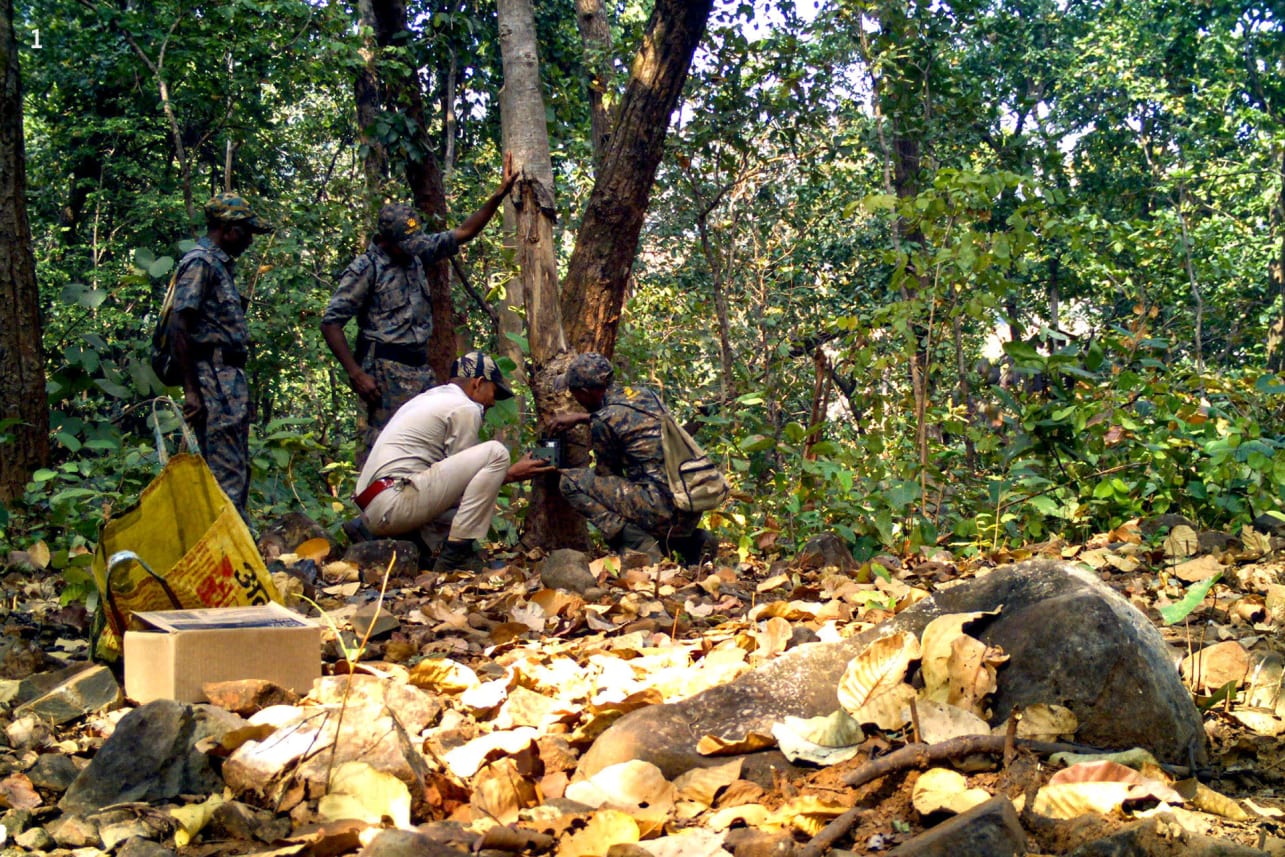
Similipal is not only a story of conflict. In several villages, young people now quietly alert forest guards about suspicious movement near forest trails. Women’s groups linked to sal-leaf stitching, sabai grass craft, and forest-produce cooperatives discourage locals from setting snares and hunting for bushmeat. In March 2026, forest officials in Similipal Tiger Reserve arrested four suspected poachers after AI-enabled cameras flagged their movement inside the core area.
Forest staff say intelligence in March 2026 came not from surveillance cameras, but from village conversations. “People know who moves through the forest for hunting,” says one frontline ranger from Pithabata South Wildlife Range, on condition of anonymity. “The question is whether they trust the system enough to speak up.”
That trust remains fragile. Sarita Hansda, sitting beneath a sal beam outside her house in Gopinathpur village in Jashipur, speaks with visible frustration. “We are stuck on both sides,” she says. “If we tell forest officials about wildlife crimes, poachers coming from neighbouring Jharkhand threaten us. If we keep quiet, the forest suffers.”
By around 4 pm, Similipal begins to cool. The smell of bark deepens, cicadas emerge from the ground in waves, and light slips quickly through the sal canopy, leaving the forest floor in shadow long before sunset. While the threats to wildlife are multi-layered, there is also a sustained and significant multi-pronged effort to protect it.
About the Author