 Listen to this article
•
15:34 min
Listen to this article
•
15:34 min
The tide turns at a shore in Vizag city, Andhra Pradesh. It changes its tune, from the roar of the high tide and swollen waves crashing on the coast to a softer pulling back and away. Retreating rather than advancing, it leaves tidepools behind on the rocky patches and a stretch of wet sand on the beach. The tide turns like clockwork, unstoppable, as it does in Mumbai, or on any other shore in the world. It is the same. And yet, it is not.
The act of seawater receding might be universal, but what it reveals is different across the world. The intertidal zone, revealed at low tide at Rushikonda Beach, Vizag, is so different from the one I am familiar with while tidepooling on Mumbai’s busy shores. Tidepooling is the exploration of small pools of accumulated water for life forms.
In 2017, a citizens’ collective called Marine Life of Mumbai (MLOM) began documenting coastal life in Mumbai, inspiring similar actions across the country. They worked with existing organisations such as the East Coast Conservation Team (ECCT) in Vizag to document shore life along their cities.
Srichakra Pranav, founder of ECCT, has worked on different projects along India’s east coast, from documenting sharks, fishing cats, and otters to various conservation initiatives. While tide pooling and in conversations with MLOM, he started documenting life on his shores and nudged others towards the pleasures of tidepooling.


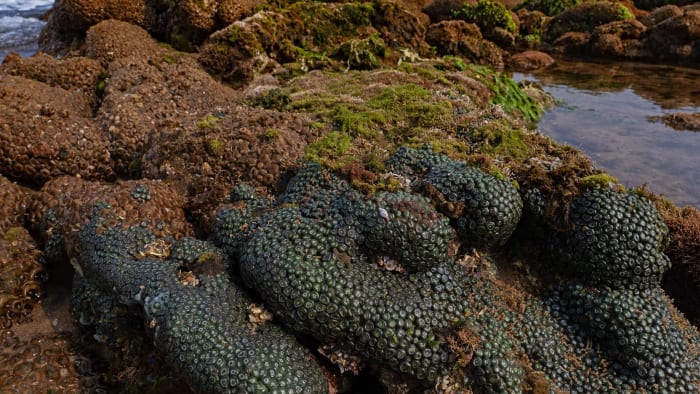
Cover photo: Zoanthids spread like living carpets across rocky reefs along Visakhapatnam’s coast. Each tiny polyp is an individual animal, but together they form vibrant colonies that cover the stone beneath them. Photo: Dhritiman Mukherjee
With him, I climb onto the rocky patch at Rushikonda Beach. Despite being one of the most visited beaches in the city, it is the only Blue Flag-certified beach in Andhra Pradesh. Blue Flag is an award given by the Foundation for Environmental Education (FEE) to beaches that uphold certain global parameters of excellence in water quality, environmental management, safety and services, and environmental education.
We leave the tourist pandemonium of the main beach with castles, food stalls, boat rides, and games behind to head to the quieter, but slippery, rocky patch, with undeniably beautiful views. We look out towards the deep, taking in its vastness. An unending, relentless, seamless fluid that is so solid in character.
“As a marine biologist, the intertidal zone to me, and to others who walk the shores with me, is a bit of a starter pack,” says Pranav. “It is an introduction to the marine world and the deep without having to go in. You just need to come to the beach.”
The shallows appear dark blue and green in sections due to lush algal growth. We are there in winter, and the water is full of padina algae (mermaid seafan) and sea lettuce, giving the shallows the appearance of an underwater forest, with flashes of green swaying under the flowing water. Rocky patches rise out of the deep, almost covered by water. And around us lie deep, large tidepools, where you can slide in and snorkel — very different from the shallow tide pools of Mumbai. Different landscapes provide different intertidal experiences. And yet, we often erroneously think beaches are the same everywhere.
Behind me, a large hill, covered in rock faces and green foliage, towers over the ocean, sloping down towards the beach, literally extending into the sea.
“Vizag is unique on the eastern coast in the way that there are rocky patches in the intertidal zone,” says Pranav. “Nowhere else apart from Srikakulam and Vishakapatnam districts on the Andhra coast does this occur. The reason is that some parts of Vizag come under the Eastern Ghats Mobile Belt.” This belt consists of densely forested hilly tracts along the eastern coast of the Indian peninsula, composed of metamorphic rocks (Khondalite rocks) dating from the Neoarchean to the Mesoproterozoic ages.
In these glorious shallows, the team at ECCT has seen spinner dolphins, electric rays, turtles, which are usually creatures of the deep. Some of the team snorkel in the wide tidepools (4-5 feet deep) at low tide, documenting wrasses and sergeant major fish.
The continental shelf off Vizag is not a gradual slope into the deep. Pranav describes it as steep and slanted. “At a mere 100 metres, you will be at a depth of 15 feet,” he says, “whereas in Goa, I snorkelled at 200 metres with my feet still touching the sea floor.” That is clearly not the case here, which makes the intertidal area small. Apart from spring tides, around the new moon, when the water recedes a little more, not much of the area opens up. “Here, if the tide is above 0.3 (varies; approximately about a foot in depth), there’s no point in going tidepooling unless you snorkel,” says Pranav.
Treasure-trove of sea creatures
On our visit, there is a treasure trove of things to see. Sea stars in numbers I have not seen in Mumbai. During low tide, sea stars hold water inside them to tide them over until the water comes back. They tend to stay close to the tide line, so they do not have to wait too long for the water to wash over them. I spend some time with these colourful protagonists of our childhood books and poems, delighted by their sheer numbers.
A master of disguise, it makes itself nearly invisible by attaching pieces of its surroundings to its body. Using tiny hook-like hairs on its back—almost like Velcro—it collects fragments from the intertidal world: sea snails, algae, tentacles from anemones, even parts of other animals, dead or alive. It builds a cloak that helps it blend seamlessly into its environment, away from prying eyes. Very seamless, very Hannibal Lector.


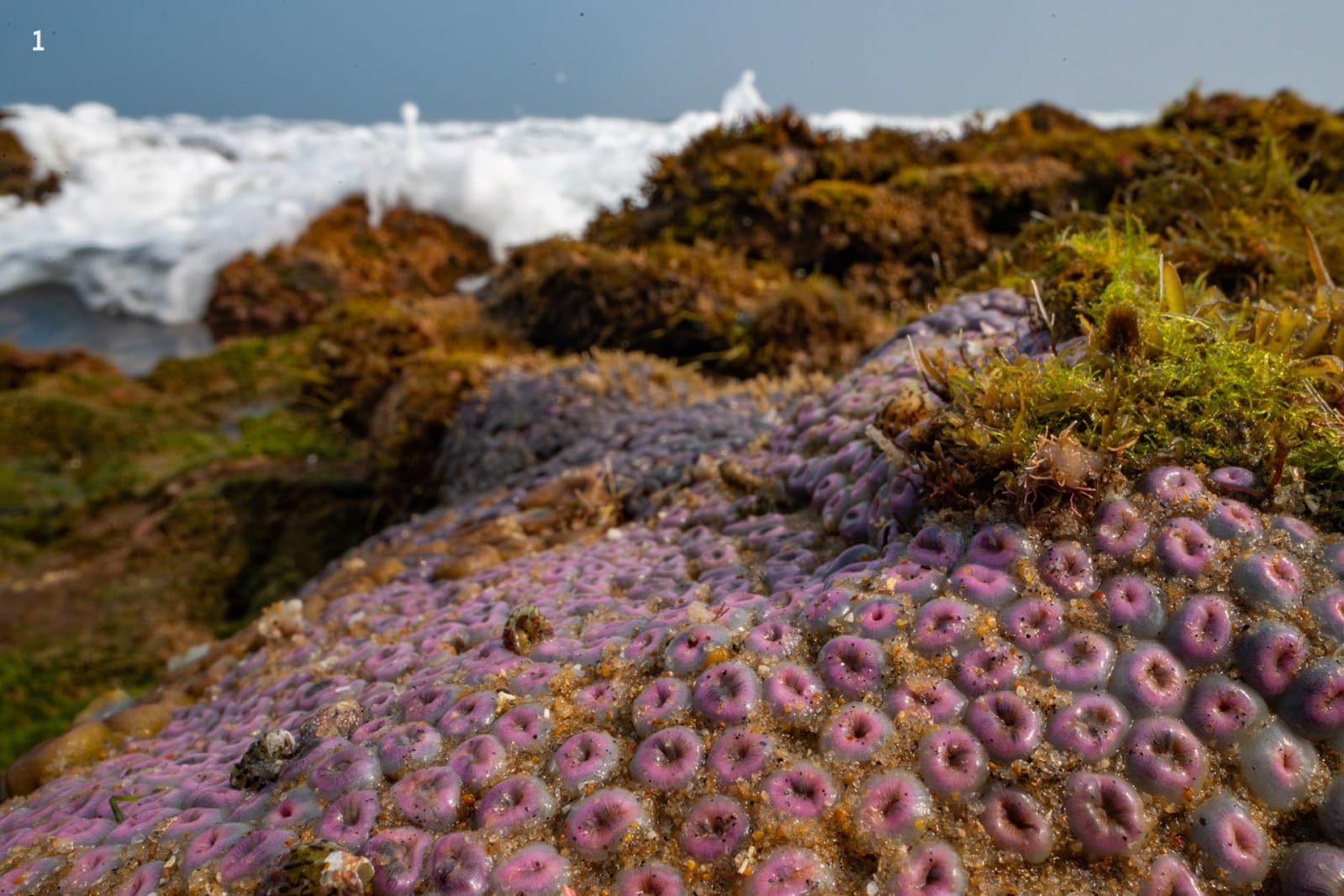
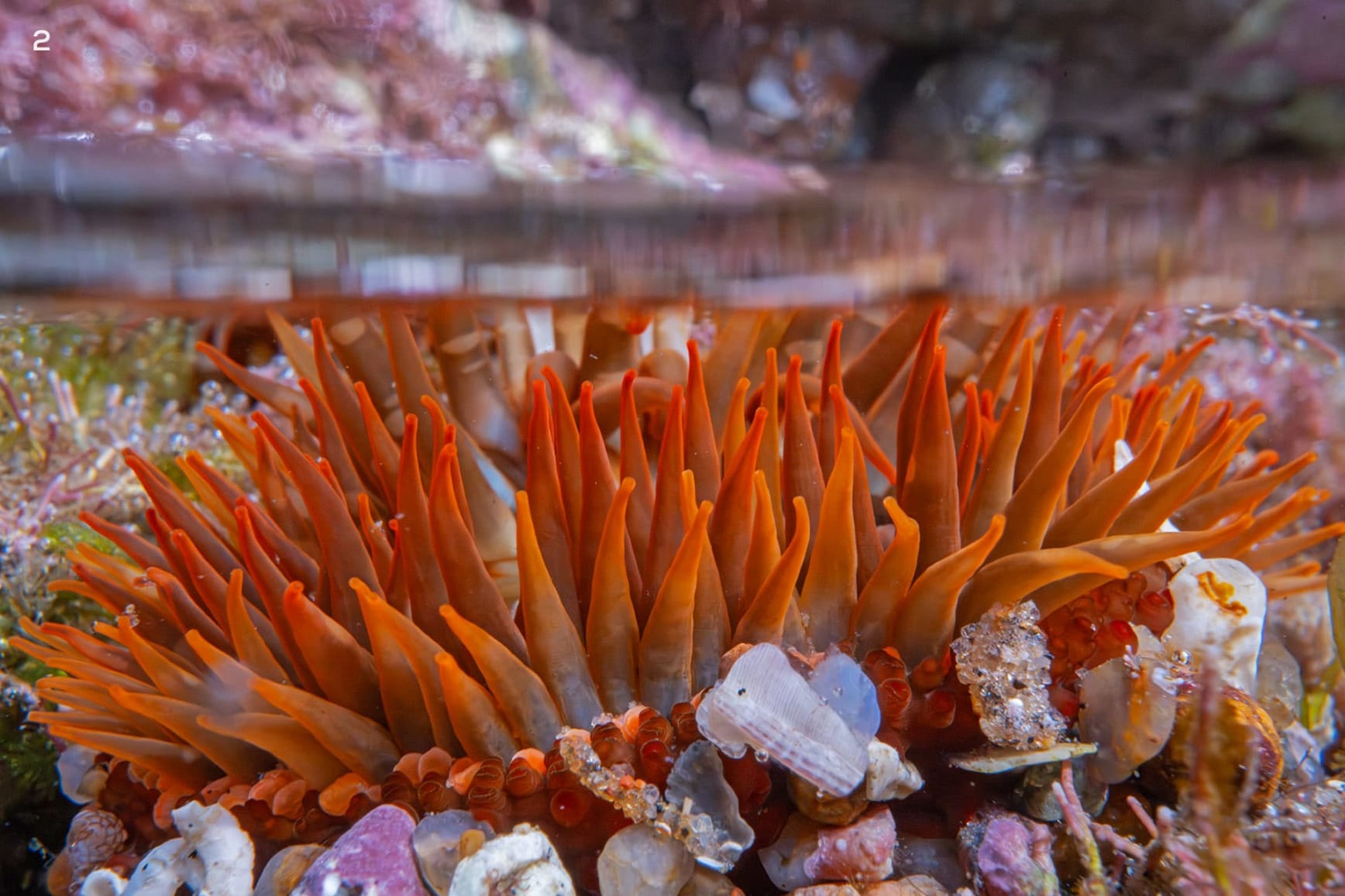
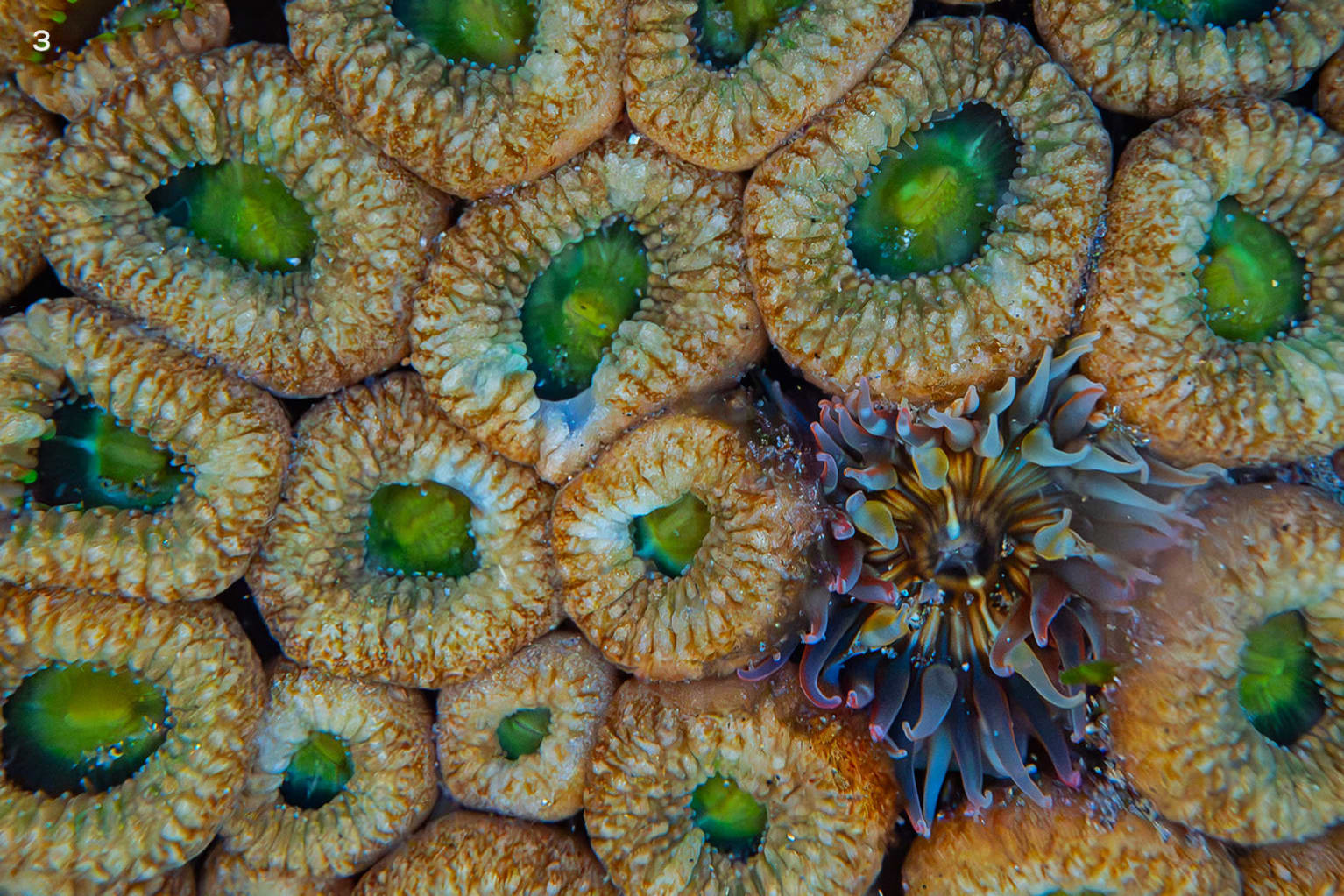
The holes along the rock faces host sea urchins, while colourful sea slugs like Phidiana and Antennoidiella feed like miniature dragons underwater. There are cnidarians here, a group of creatures towards which I have been accused (entirely accurately) of playing favourites. This group comprises jellyfish, anemones, hydroids, zoanthids, and corals, to name a few. They are gorgeous to look at and possess stinging cells, called cnidocytes, which can make you regret your interaction with them fairly quickly. Rushikonda has patches of zoanthids attached to the rock face. Their tentacles tightly close during low tide and open as the tide rushes in, revealing a blue-green, almost peacock-like colour inside.
We also see cushion stars and blennies that zip through the water as soon as they sense us. Once the sun starts to go down, brittle stars come out, their daddy-long-legs tentacles swaying in the water.
On the sandy shore, the water recedes only around 50 metres, so while a whole bunch of shells have washed up, we hardly see the snails that inhabit them. The tide hasn’t retreated enough to reveal the rest. “The water is very rough during high tide, even on the intertidal. So we do not see squid egg masses on sandy shores like you do in Mumbai.”
Around the year, this beach has a creature that visits Mumbai only during the monsoon — the gorgeous cnidarian, Porpita porpita, aka the blue button. A white dial with aqua-blue and green tentacles; these resemble tiny suns scattered on the shore. In Vizag, this creature is found on YMCA Beach. One walk on this different intertidal, largely sandy shore, reveals 30-40 of these. In Mumbai, the porpita is usually a sign for fishers that the season is to change, and rain is on its way. In Vizag, these creatures are seen year-round (especially in August). Each shore has its own patterns that locals keep an eye on. For example, Pranav says, “I have yet to find a correlation to this, but on these shores, the fishers go hunting for tuna whenever they see spinner dolphins close to the shore in January.” Spinner dolphins don’t usually eat tuna, but some studies imply that they are usually found in the same vicinity, and traditional knowledge ensures that fishers know when to head out to sea. Local legends also fuel stories. Pranav shares one in which fishers in Vizag believe that pilot whales are their ancestors who have come to punish them for their sins by tearing their nets and damaging their fishing haul. “They even pray to the whales and apologise,” says Pranav, “and they believe it works, too.”


Knowledge-sharing
In 2020, Pranav got in touch with the team at Marine Life in Mumbai, and a cross-shore knowledge-sharing relationship began. Shaunak Modi, Founder of Coastal Conservation Foundation, has been managing the Marine Life of Mumbai project under his organisation’s umbrella. A regular on iNaturalist, a global database that shares documentation of species, he started noticing regular observations from the eastern coast. “I’m always checking for new marine life observations from India, so when I saw people uploading from a new shore, I started identifying them, and that’s how Pranav and I got to know each other,” he says. Unlike Mumbai, the allure of snorkelling offers opportunities for documentation not dependent on favourable tides. “Seeing the species diversity there, reefs seem to be a lot closer than on the west coast. There are many reefs and reef-associated species in the intertidal, and overall diversity is much higher. The smaller shelf also means that deeper water cetaceans are much closer to land on the east coast. But more than anything else, what I’m envious of most is the presence of Blue sea dragons (Glaucus) on those shores.”
Intertidal bioblitz
Collaborations are just this — conversations, understanding what is new, different and a dose of healthy envy at distant species not found on your own shore. In January 2025, this led to a special event. The first intertidal bioblitz was held from January 26 to February 4, 2025. A sort of coming together, where people from across the country went tide pooling at their own shores, but on the same days. The walks started across coastal cities and towns, and sharing was rapid, excited, and slightly competitive. A sort of relay across shorelines. Updates like a sea hare from Goa, a new nudibranch from Vizag, a sea cucumber from Andamans, and so on made their way across phone chats, iNaturalist pages, and video calls. It was a first for tide poolers on a scale like this, all allies for a largely invisible ecosystem, literally and otherwise.
It also opened up avenues for collaboration across borders, and for Shaunak, a sort of dream come true: tidepooling became a pleasurable activity, not just a means to conservation. “The idea for the India Intertidal Bioblitz came from City Nature Challenge (CNC), but with one difference. While CNC focuses on the number of observations a person can upload to iNaturalist, I wanted to conduct an event which focused on diversity. Naturally, the first person I reached out to was Pranav, who was immediately on board. We then reached out to more organisations and wildlife enthusiasts who regularly contributed to our iNat projects and spread the word. We had a total of 116 observers from 8 states and union territories who documented 3,674 observations of 529 species. In Mumbai, 26 observers participated, and we documented a total of 116 species.” (More information on the bioblitz: This is the link to the project on iNat, which has all the figures and details of species: https://www.inaturalist.org/projects/india-intertidal-bioblitz-2025)


For the east coast, the bioblitz was nothing short of a revelation. The coast threw up new records like the Doridina flatworm, nudibranchs that started conversations and identification discussions on iNaturalist. A nudibranch, Phidiana unilineata, was recorded here after 160 years, after being described by Alder and Hancock on this coast in 1864. There was also a discovery of a flatworm from the family Pseudocerotidae, sightings of the delightful Pikachu nudibranch, which fully lives up to its name, and a sea slug called Pseudoceros bifascia, which was documented in Lakshadweep for the first time in 2023 but recorded on the mainland for the first time in Vizag.
As we walk back to the coast, the lights come on at the shacks around the beach, and the crowds empty and fill into the street food lane close by. These shores are brimming with stories and species waiting to be documented and identified. But there isn’t enough baseline research data to properly understand the coasts. “That’s true for all marine life in these parts, not just intertidal,” says Pranav. “There aren’t any supporting institutions, institutes, or enough funding to carry out longer-term, serious documentation.”
In the meantime, they do what they can. When I left in January 2025, 136 people had contributed 350 species, and now it’s 510 species, 5,769 observations, and still counting. “It took us eight years to document ~600 species in Mumbai, The ECCT documented 500 in 3-4 years,” says Shaunak. “I’d like to see more projects like MLOM. If more people start similar projects, we can all support each other, with the more experienced organisations like CCF helping as knowledge partners. There’s a lot we’ve learnt along the way, and it’s time we work together.”
Pranav and his team take shore walks with students, enthusiasts, and nature educators and want to get locals interested in their coasts beyond the surf. He can see that people are beginning to know more about their coasts. Forty per cent of the people on walks are children, and they come to see sea stars. Once they see that, they go home happy. There is more news space given to these stories in local papers, including that of the bioblitz. And in a wonderful plot twist, government officials took part in the documentation week.
Citizens of a coastal city need to have access to a place like this, which provides livelihood, pleasure, and pause. A meditative space for Vizag, where the forest and mountains meet the sea.
About the Author