
 Listen to this article
•
15:34 min
Listen to this article
•
15:34 min
It was July 2017. I was in Rumbak village in Hemis National Park, Ladakh, in the company of Dr George Schaller, the legendary wildlife ecologist and conservationist, Dr Bivash Pandav, scientist with the Wildlife Institute of India, Mr Karma Sonam, my colleague from Nature Conservation Foundation (NCF), Khenrab le and Smanla le, award-winning guards with the Wildlife Protection Department (le is equivalent to ji in Hindi). Early in the morning, we stepped out of our homestay and scanned the neighbouring mountain slopes with binoculars and spotting scopes set up by Smanla le and Khenrab le to try sighting a snow leopard (locally shan), wild herbivores like bharal or blue sheep (locally nao or nabo), and Ladakh urial (shapo). During peak summer, it is difficult time to spot the snow leopard near villages as they tend to move to higher altitudes. But Hemis is one of those very few places that has the Eurasian lynx (Lynx lynx).
We started trekking towards Yurutse, a hamlet with a single house, near Ganda La. Karma le with his deep regional natural history knowledge said, “We might get to see the lynx at Yurutse. We call it ee.” While trekking and breathing heavily, I asked Dr Schaller what he thought about the lynx. He paused for a moment, looked around, absorbing the mountain vista, and continued walking, then remarked, “They are hardly seen, very rare indeed.” It reminded me of Peter Matthiessen’s book ‘The Snow Leopard’ and his sublime thought on elusiveness and rarity - “Have you seen the snow leopard? No! Isn’t that wonderful?”


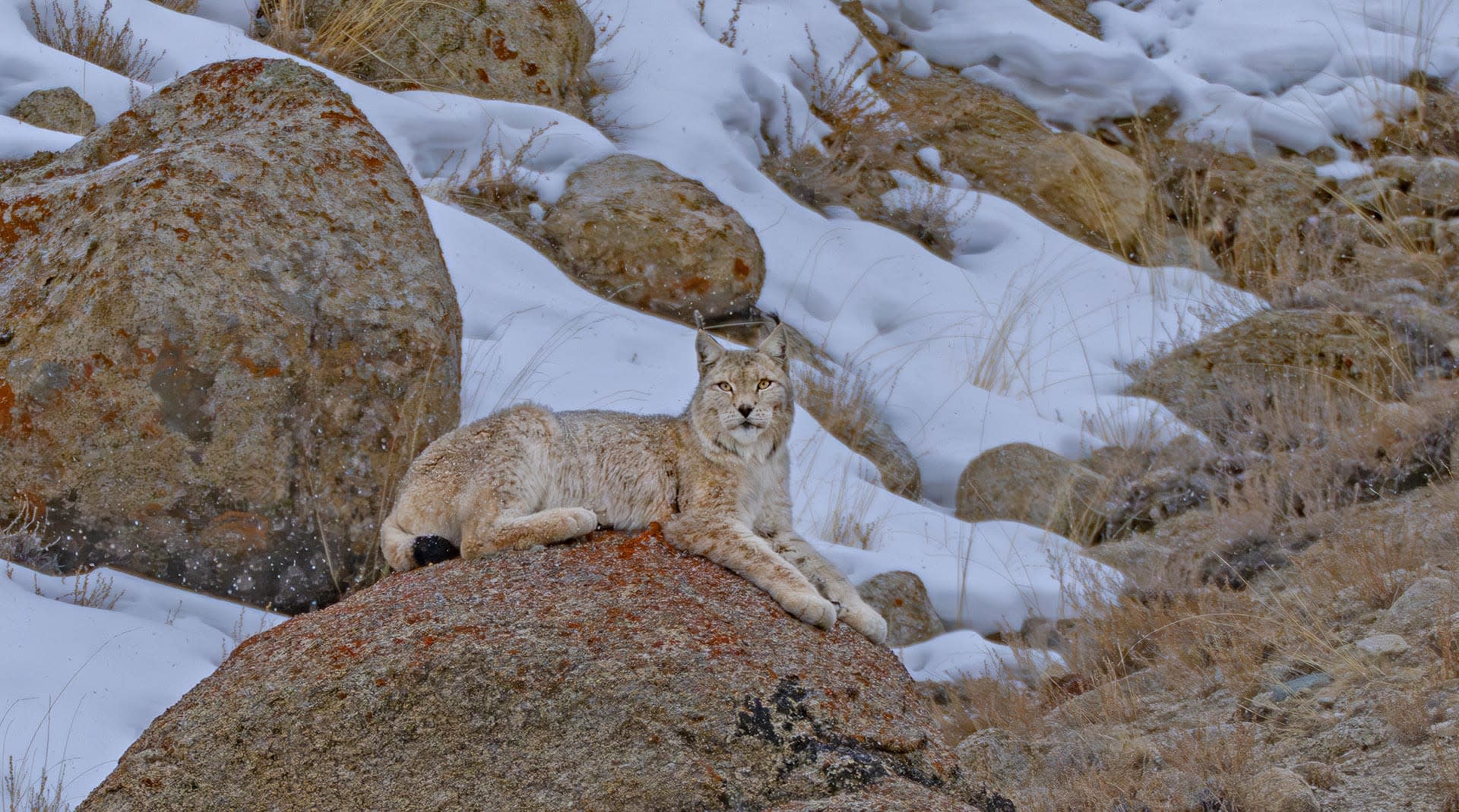
The Eurasian lynx is a medium-sized wild cat with a body length of 73-110 cm, shoulder height of 55-75 cm, and weight of 18-30 kg. Ear tufts and a short bobbed black-tipped tail are perhaps their most prominent distinguishing features. They are found across large tracts of Europe, Central Asia, Russia, the Tibetan Plateau and the Trans-Himalayas. The subspecies Lynx lynx isabellinus is found in India and most of Central Asia. They are adapted to a variety of habitats, from temperate and boreal forests to high-altitude steppes up to 5,500 m. The Trans-Himalayas and the Himalaya Range along northern India, Nepal, Bhutan and Northeastern India form the southern edge of the lynx’s global distribution range.


Perhaps the rarity of lynx is attributable to a combination of their characteristics. Lynx are nocturnal and crepuscular, resting during the daytime. A paper on lynx activity patterns published by Marco Heurich and co-authors in the journal PlosOne (2014) indicates that their activity peaks at twilight, coinciding with the activity peak of their main prey, the roe deer. The research also found that adult male lynx were more active than adult females, and subadult lynx were more active than adults, showing different age-related activity patterns. The lynx’s coat is a mix of golden, red, and brown, varying subtly with the seasons and allowing effortless camouflage. Adult lynx are usually solitary with a large home range of between 20 and 450 sq km, depending on prey availability. Additionally, like snow leopards, lynx are generally silent outside the mating season.
Small-sized animals, such as Himalayan woolly hares (Lepus oiostolus), pikas (Ochotona spp.), marmots (Marmota spp.), and voles (Alticola spp.), are important prey for lynx in the Trans-Himalayas. Although medium-sized, lynx are powerful and skilled at foraging on larger wild herbivores, especially during the winter when small prey availability declines considerably due to snow cover. Occasionally, lynx forage on domestic small-bodied livestock, such as goats, sheep and young cattle.


Only a handful of professional wildlife photographers and regional and local naturalists have seen the lynx. For example, Dhritiman Mukherjee, a distinguished wildlife conservation storyteller, once sighted a lynx resting on a boulder while driving across Wari Lsa to the Nubra Valley. Wari La lies in between Khardung La and Chang La on the Ladakh Range, connecting the Indus and Nubra or Shayok valleys. The area adjoining Wari La is known for occasional lynx sightings, similar to Ganda La in Hemis. In February 2017, Karma le and a field team from NCF were surveying Tsaba Valley of Gya-Meru Wildlife Sanctuary to monitor the Tibetan argali (Ovis ammon) population. One morning, the team spotted the carcass of a bharal near a herder’s camp. Tundup Chosgail, one of the two herders from the camp, looked at the bharal’s severely crushed upper neck and suspected a lynx had killed it.
The team immediately scanned the surrounding slopes, expecting that the predator must be resting nearby. Soon, Tundup le spotted the ee resting on a rock surface. This was Karma le’s first lynx sighting, though he hails from Rumtse village, just a couple of hours’ trek from the spot, and right in the middle of snow leopard, wolf (Canis lupus chanco), and lynx habitat at about 4,100 m altitude in the Zanskar Range. Lynx are that rare and elusive.

When we reached Yurutse on that summer morning of July, 2017, we positioned ourselves with binoculars and spotting scopes, scanning the bleak, rugged mountains of the Zanskar Range around us. Each patch of vegetation thicket, prominent rock surface, or cluster of boulders and rocks was a potential lynx resting place. On a distant slope, we sighted urial, a small herd of four females with two yearlings. They were foraging among the sparse vegetation and slowly moved towards the hilltop, disappearing on the other side. Hopping around now and then was a woolly hare. We had the almost-constant company of a small flock of yellow-billed choughs (Pyrrhocorax graculus) circling above us and a Eurasian magpie (Pica pica). Half a day passed without any lynx sightings. Around 2 pm, we moved on, eating a simple local lunch of kholak (a ball of barley flour mixed with home-made butter) and curd with the only resident family of Yurutse. Then we trekked back to our homestay in Rumbak.
Over the years, working at high altitudes in India, I have been blessed with sightings of various elusive and rare carnivores, including the snow leopard, wolf, Pallas’s cat, weasel and brown bear. Fast forward to 2026, and I am yet to see a lynx in the wild. Rare sightings is proof of their wildness and adds to the mystery. Peter Matthiessen’s words echo back to me. I rephrase his statement in my mind: “Have you seen the lynx? No! Isn’t that wonderful?”
About the Authors

Abhishek Ghoshal
is a wildlife biologist. He heads the Human-Wildlife Conflict Mitigation Division at Wildlife Trust of India (WTI).