 Listen to this article
•
15:34 min
Listen to this article
•
15:34 min
The first thing that strikes you about the Indian “Big Five” land-based mammals in terms of size is that four of them are vegetarians, and at least three of them have come very close to extinction. The largest and heaviest of them all is, of course, the Asian elephant (Elephas maximus indicus) that tips the scales at 4 tonnes (bulls weigh 3,500-5,200 kg; cows 2,700-4,200 kg) and stands 2.75 metres (males) at the shoulder. It is known to stuff itself with around 150 kg of vegetation every day — grass, fruit, leaves, bark, et al., to maintain its bulk.
The gentle giant
Thanks to habitat degradation, fragmentation, poaching, and the blocking of migratory corridors, it is listed as endangered on the IUCN Red List. Its numbers (estimated at 22,446 as per a 2025 report) have fallen by more than 50 per cent over the last three elephant generations. In 1992, the government launched Project Elephant to protect elephant habitats and their populations.

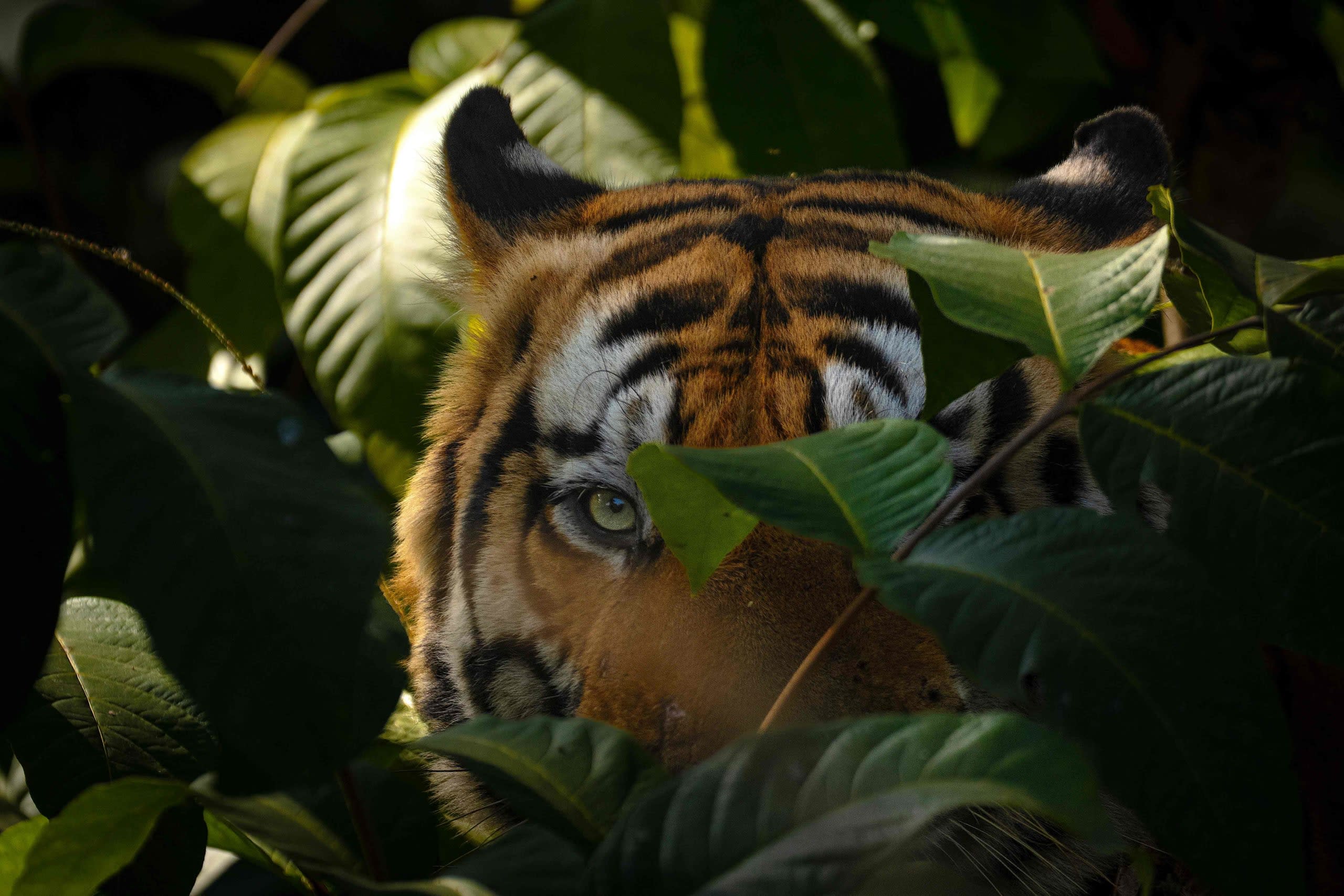
Cover photo: The Bengal tiger can weigh up to 350 kg and measure up to 3.3 m in length. This large cat’s stripes blur its outline, helping it blend into its habitat. Photo: Shivang Mehta
These normally gentle and sagacious giants drift ghost-like in small herds through grasslands and dry and moist forests in the West, Northeast, East, North, and South, led by a venerable old matriarch. Solo bulls can turn dangerous (to humans and other elephants) when in “musth” (when testosterone levels skyrocket), and herds which find their migratory routes blocked may enter villages and crop fields, storehouses, and kitchens. These “heritage” animals living to around 65 are the largest land animals in India and have no natural predators except humans. They are culturally renowned — in religion (Lord Ganesha) and have been tamed and trained to carry tourists on safari and haul logs.
One-horned rhinos
Tipping the scales at 2.2 tons (males), the armour-plated, baby-faced greater one-horned rhinoceros (Rhinoceros unicornis) heaves into second place. Most of the 4,075 surviving animals live in the Northeast, with 70 per cent of them in Kaziranga National Park, Assam. Hunting and poaching (for their horns, which are pure keratin and aphrodisiacally useless) had reduced their numbers to a precarious 12 survivors in Kaziranga National Park in 1908. Despite environmental degradation and annual flooding, strong protective measures, including providing rhinos with armed escorts, relocation programmes, and habitat protection, have allowed the rhino population to grow to over 4,000 individuals.

Despite its bulk, the rhino can rumble at up to 55 kmph in short bursts, is an excellent swimmer, has a keen sense of smell and hearing, but poor eyesight. It subsists entirely on grasses, and babies stay with their mothers for up to four years. It is, of course, protected by law. Its cultural significance goes back to the Indus Valley Civilisation.
World’s largest bovine
Standing on powerful, partially white legs, the huge, bulky gaur or Indian bison (Bos gaurus) is the largest wild bovine in the world. This dark brown to black mastodonic creature weighs up to 1.5 tonnes, and stands around 200 cm at the shoulder with horns reaching 165 cm, and likes evergreen, hilly forest tracts. It has been listed as Vulnerable on the IUCN Red List, and a large percentage of its population of 22,000 inhabits the Western Ghats and its outlying hills. Gaur live in small herds and, when left alone, are shy and timid and look deceptively calm, but if disturbed, they can turn aggressive.



Indian water buffalo
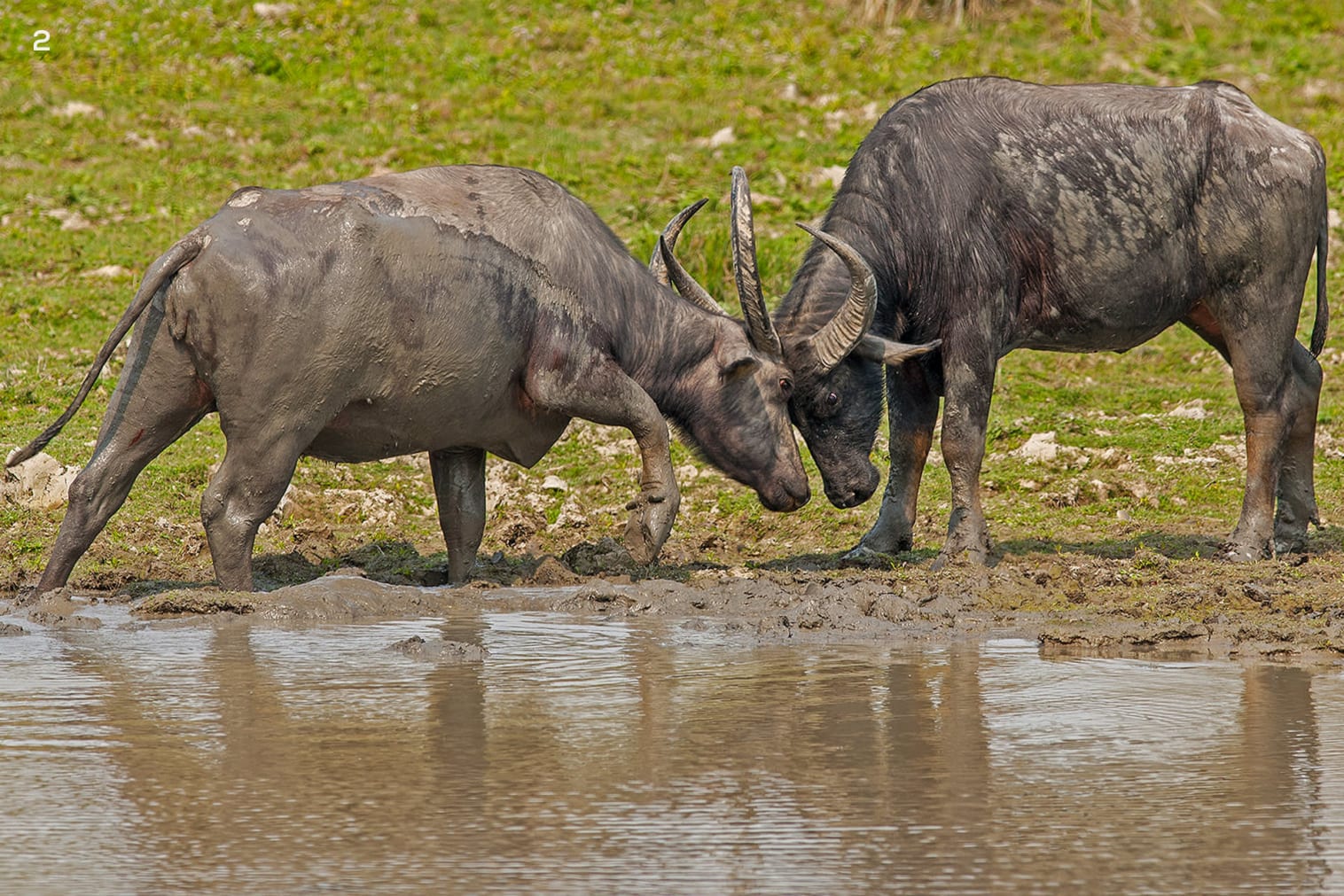
The belligerent, armed, and dangerous Indian water buffalo (Bubalus arnee) is also confined to the Northeast (especially Kaziranga National Park) with a small population in Indravati Tiger Reserve. It ranks fourth in size, with males weighing up to 1.2 tonnes. While their population was estimated at under 4,000 animals in 1986, rampant hybridisation with domestic water buffaloes is further weakening their gene pool. It is protected by law and preyed upon by tigers and (in Nepal) muggers as well.
The royal carnivore
The only carnivore making it to the top five list is the royal Bengal tiger (our national animal), weighing in at 260 kg (Panthera tigris tigris), whose tale is well-known. From a high of 40,000 animals in the early 1900s, its numbers plummeted to under 1,400 in 2002-2008, before rising to 3,642 in 2022. Hunted relentlessly by British colonialists, dignitaries, and royals, and Indian maharajas, and then poached wholesale for their skin and bones. It was only Project Tiger, launched in 1973, and the Wildlife Protection Act (1972) that saved them from extinction.

Tigers are solitary animals except for females with cubs. Cubs stay with their mother until they are 18 months or older. Photo: Shivang Mehta
Jim Corbett’s “Man Eaters of Kumaon” instilled fear of this “jungle gentleman”, as Corbett called the tiger, and Rudyard Kipling’s Sher Khan added notoriety to its reputation. However, conservationists such as Kailash Sankhala, Valmik Thapar, Fateh Singh Rathore (once Field Director of Ranthambore National Park), as well as Raghu Chundawat and Belinda Wright dedicated their lives to tiger conservation.
As human populations expand and tiger habitats reduce, human-tiger conflicts are inevitable and usually end badly for tigers. Tiger tourism has become the rage in most Tiger Reserves, and the sight of 25 Gypsy safari vehicles surrounding a single bewildered tiger is dispiriting. While some say that too much money and resources have been expended on Project Tiger (at the expense of other non-tiger habitats), the fact remains that protecting the tiger has greatly benefited the entire forest ecosystem.
About the Author