Listen to this article
•
15:34 min
Listen to this article
•
15:34 min
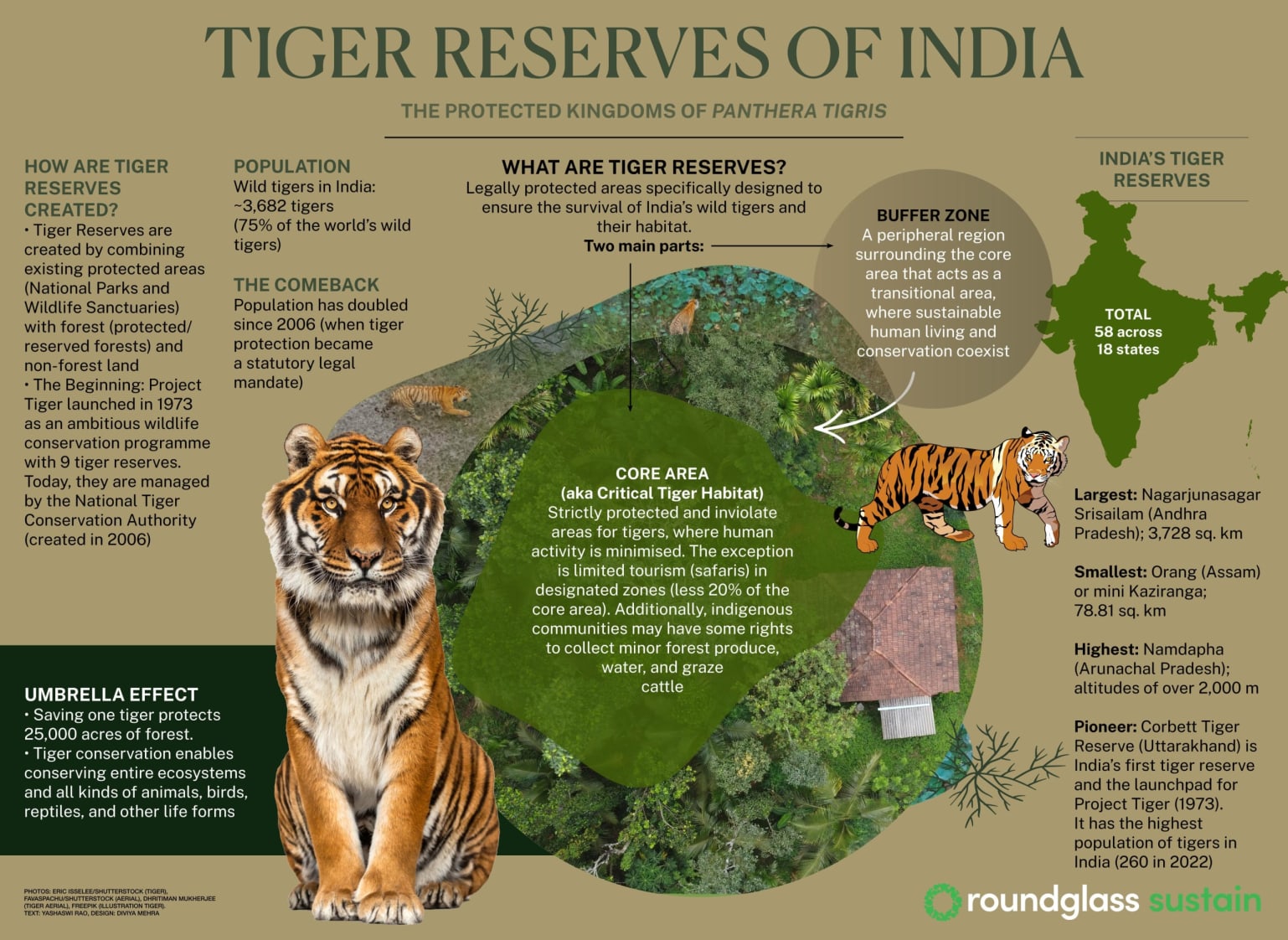
What are tiger reserves?
Tiger reserves in India are legally protected areas specifically designed to ensure the survival of India's wild tigers and their habitat. They consist of two parts: Core area and the Buffer zone. The core area, also known as Critical Tiger Habitat, is strictly protected, where human activity is minimised. Exceptions are sometimes made for safaris (in less than 20% of the core area) and indigenous communities may have some rights to collect minor forest produce, water and graze cattle. Buffer zones are transitional areas surrounding the core area, where sustainable human living and conservation coexist.
How many tiger reserves does India have?
India has 58 tiger reserves across 18 states. The largest tiger reserve in India is Nagarjunasagar Srisailam in Andhra Pradesh with an area of 3728 sq. km. The smallest tiger reserve is Orang in Assam, also known as Mini Kaziranga, with an area of 78.81 sq. km. Corbett Tiger Reserve is India's first tiger reserve and the launchpad for Project Tiger in 1973.
How many tigers does India have?
India has an approximate of 3,682 tigers which makes up for 75% of the world's wild tigers
What is the Umbrella effect of tiger conservation?
Tigers are considered umbrella species because tiger conservation enables conservation of numerous species of mammals, birds and reptiles which come under the same ecosystem umbrella. Additionally, saving one tiger leads to the protection of 25,000 acres of forest.
About the Authors